The connection between inner health and outer beauty is closer than ever.
But can ingredients taken internally that affect cognitive function and mood benefit the skin when used topically?
Not quite.
A slew of skin care brands are utilizing ingredients traditionally used in supplements to regulate mood in topical skin care. Think Griffonia simplicifolia, which contains a chemical called 5-hydroxytryptophan (5-HTP) and is said to support depression, anxiety and insomnia; gamma-aminobutyric acid (GABA), an inhibitory neurotransmitter that supports stress and sleep, and baicalin, which claims to boost memory.
Related Articles
It’s no wonder that skin care formulators are tapping such ingredients. According to YPulse’s research, 72 percent of Gen Z and Millennials have engaged in or are interested in beauty and self care activities to combat stress and anxiety, and 81 percent appreciate brands incorporating mental health in their marketing and messaging.
That said, ingredients that you take internally to regulate mood aren’t necessarily going to have the same effect on skin or get into the blood-brain barrier.
“There is no data on the use of any of these molecules topically,” said Dr. Amy Wechsler, who is one of the small handful of physicians in the country board-certified in dermatology and psychiatry. “There’s no way anything topical is getting to the brain. It’s not even getting into the bloodstream; that’s a whole other level. But the act of doing a skin care routine can often lower stress levels.”
Esther Olu, cosmetic chemist and licensed aesthetician, agrees. “There are some ingredients that have a sensorial and psychological effect on a consumer, such as essential oils or other ingredients isolated from plants,” she said. “The realm of mind and mood to skin is relatively new, so as of now, the effects that brands try to claim aren’t fully understood yet. Overall, it is an interesting trend, but I cannot say it is realistic. However, this provides the opportunity for more exploration.”
The brands tapping into these ingredients aren’t claiming to solve one’s mental health struggles or get to the brain with topical skin care, but they’re doing their part to encourage consumers to take care of themselves in more ways than just their self care routine.
Online retailer Cap Beauty recently revealed its debut namesake product, Serotoner, $58, a toner that utilizes cooling aloe, agave, prickly pear and, its hero, griffonia simplicifolia, which is said to calm and deeply hydrate the skin. 5-HTP, a popular ingredient used in supplements and said to alleviate depression by enhancing serotonin, is manufactured from the seeds of the African plant griffonia simplicifolia.

“[Griffonia simplicifolia] has anti-inflammatory properties which allow it to calm the skin and therefore has the ability to calm the mind,” said Kerrilynn Pamer, cofounder and chief executive officer of Cap Beauty. “I can’t say straight out this ingredient will make you happy; that would be false marketing and pushing the envelope. But it has properties that raise the spirits and [it] functions like a neurocosmetic.”
Pamer noted that Cap Beauty will weave griffonia simplicifolia throughout its product collection, with her next launch being a cream cleanser, launching in September. “The range is about how do we bring something that’s really special to people and allow them to have the best version of their skin, but also impacts them in a way beyond just the topical application of skin care products. I wanted it to make sense beyond just a physiological experience.”
Similarly, skin care brand A.P. Chem works with what it calls “Alt-Pharma” ingredients like GABA, an inhibitory neurotransmitter, palmitoyl isoleucine, which boosts energy and endurance, and baicalin, which is for stress release and relaxation. These are combined with more traditional skin care ingredients like hyaluronic acid, ceramides and peptides.
After being introduced to psychedelic medicine and utilizing ketamine for her autoimmune disease, A.P. Chem cofounder and CEO Sandra Statz was inspired to formulate her brand with clinically proven plant-based ingredients. “We started talking about psychedelic medicine and digging into the chemical reactions they have in your brain,” she said. “That really inspired how we formulate. We incorporated mental health regardless of the focus on psychedelics because we want to break down taboos to destigmatize mental and physical health conditions and illuminate options.”
While there are no psychedelics in A.P. Chem’s formulas, the brand is working with ingredients dubbed “neuropeptides” and product names are directly related to their inspiration, as with a moisturizer called MicroDose and an eye cream called Eyeahuasca. “For example, the neuropeptide GABA, as an oral supplement, is supposed to help with sleep,” said Dr. Sherwin Parikh, cofounder and chief science officer of A.P. Chem. “In a topical version, it has the ability to relax the skin and decrease muscle tension.” Statz added that GABA is known as nature’s Botox and claims it has very similar effects to when it’s injected.
A.P. Chem’s products range in price from $75 to $125, and are sold only on its website currently.
Parikh and Statz are interested in combining skin care with psychedelics in the future, but they noted that it will take time and careful research. Currently, there are psychedelic treatment centers experimenting with topical ketamine for mental health, not skin care, but the topical iteration makes it more accessible versus getting hooked up to an IV. “A lot of psychedelic medicine has anti-inflammatory properties,” said Statz, “so that piques our interest as it pertains to skin benefits. But when it comes to innovation and what’s next, we’re about deepening that mind-body connection and finding unique technologies that connect the two.”
That mind-body connection is exactly what excites psychotherapist Annie Armstrong Miyao about ingestible mood ingredients used topically. “I appreciate what brands are encouraging, which is attention to the body, mind and spirit as one,” she said. “There’s a lot of power in intention and hope. I don’t want to go so far as to say it’s the power of placebo; I’m not saying there isn’t actual scientific evidence that this could contribute to changing your neurochemistry in a positive way, but I like the intention.”
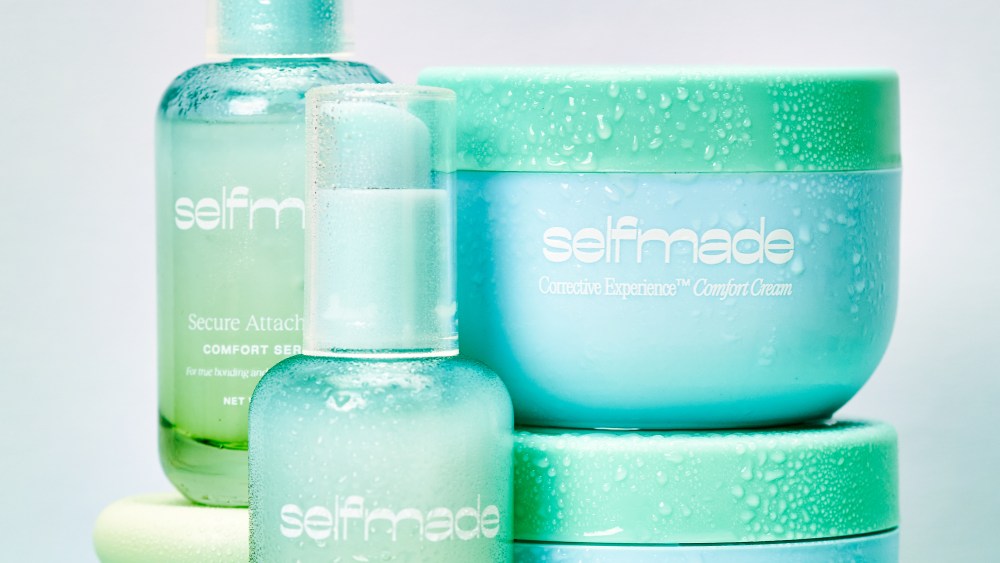
Meanwhile, Selfmade, which is priced from $28 to $36 and sold at Thirteen Lune as well as its own website, is a skin care brand developed with mental health experts working within communities of color. The brand is not promising to solve a consumer’s mental health struggles, but its aim is to create behavioral research-backed ways to implement small incremental habits. “It can be a really dangerous territory to say you’re a mental health company when you sit squarely in consumer goods, and specifically being in an industry with so much unrealistic standards from your lived experiences where so much of beauty actually depletes our feeling of positive mental health,” said Stephanie Lee, founder and CEO of Selfmade. “This is why we work with Gen Z and BIPOC communities in the mental health space to craft a brand that is trauma-informed. Our products embody psychological concepts and speak to where stress comes from.”
Speaking of stress, Lee gave the example of Selfmade’s Secure Attachment Comfort Serum, which is about attachment styles. “The formula bonds to your skin cells and hydrates, helping to strengthen your moisture barrier,” she said. “It also acts as a hybrid primer that helps to securely attach your makeup to your face and has an active ingredient called Cortinhib G, which promotes beta-endorphin production to help counter cortisol, the stress hormone.
“Instead of being around acne or anti-aging, our product families sit around vital building blocks of our humaneness, which are attachment, resilience and intimacy,” she continued. “And they all have their emotional benefits, but also their physical benefits. For example, self-disclosure within the intimacy realm is about chafing and discomfort. So all of our products speak to that.”
While none of these brands purely live in the realm of psychodermatology, the treatment of skin disorders using psychological and psychiatric techniques, each recognizes there is a correlation to the niche practice. “What psychodermatology means is that there is a connection between the mind and the skin,” said Wechsler. “And it works. It’s multidirectional. The brands trying to jump on the trend of psychodermatology are smart.”
Lee added, “Psychodermatology is the next evolution of clean beauty since we’re worried about what we put on our bodies and in our bodies.”
To that end, Armstrong Miyao believes there’s a balance that needs to be struck between broadening education around people’s ability to understand and categorize certain symptoms and what they’re experiencing when it comes to mental health. “Words can lose power and meaning when used outside of a clinical setting,” she said. “It’s important to be clear about the actual benefits of what these specific ingredients within a skin care brand could help with, but also be clear about their limitations.”