
To each his own.
The phrase never rang more true when looking at the various strategies professional firms are utilizing to get salon services and retail sales back on track.
While the dark curtain may be lifting — salon and spa owners surveyed by the Professional Beauty Association reported 3.7 percent and 0.4 percent increases in first-quarter service and retail sales, respectively — some professional companies are faring better than others. And it may be relative to how they’re approaching the market.
Indeed, value pricing for “affordable luxury” products helped John Paul Mitchell Systems realize double-digit sales gains over the past two years, despite the downturn, but continuing and growing consumer advertising may be at the heart of their success.
Related Articles
“We are the only professional brand to go on TV. But we make it about our culture, not our products. Hopefully, if a viewer likes what we stand for [the environment, charities] they’ll give one of our products a try,” said JPMS’ chief executive officer, John Paul DeJoria. The fourth quarter will see a $4 million print ad campaign from JPMS to tout a new treatment line, too.
Reuben Carranza, director of P&G Salon Professional North America, agreed that the ongoing fight for the beauty consumer’s attention calls for presence in magazines, as well as a push for stylist-focused programs.
“The truly savvy manufacturers and salon owners aren’t making a choice of whether they focus on stylist-driven programs or consumer-driven programs, but how to drive both vehicles. We believe you have to do both, with a specific focus on what you want to happen in the salon environment.”
P&G, for example, teaches salon owners how to talk to customers through hairdresser-only events aimed at creating excitement and insight into trends, Carranza said.
“We do local, future-vision, unplugged events that bring together 500 to 600 top colorists and stylists — some who are using our products, some who are influencers in the market who may not be using them. Here they can interact with P&G and see our best hairdresser artists like Nick Arrojo and Christopher and Sonya Dove. We stepped up investments in this so we have done 20 in the last 12 months. We are finding it speaks to a number of different elements, so stylists can go back to the salon the next day and demonstrate what they experienced,” Carranza said.
To target consumers, P&G’s Wella brand recently tapped actress Brooke Burke to educate color users on Wella’s current and new color offerings, a tact that looks to drive consumers to salons. While no consumer ads are planned, a Haircolor Discovery Tour, one that will visit eight U.S. cities throughout the summer, is under way.
In the past year, “a market correction” has developed, said Philippe Hostalery, president of Tigi, one where he is seeing beauty companies attract salons, stylists and beauty professionals with education programs to support and teach increased salon services.
“Our industry must help the salon professionals by offering the tools for career path progression,” he said.
In tandem with stylist efforts, “consumer, advertisement and public relations creates awareness for our products, boosts demand and creates traffic into the salons. Tigi consistently invests in such marketing activities, which show a direct benefit for the salon….Tigi is employing increased targeted media and public relations to drive brand and product messages.”
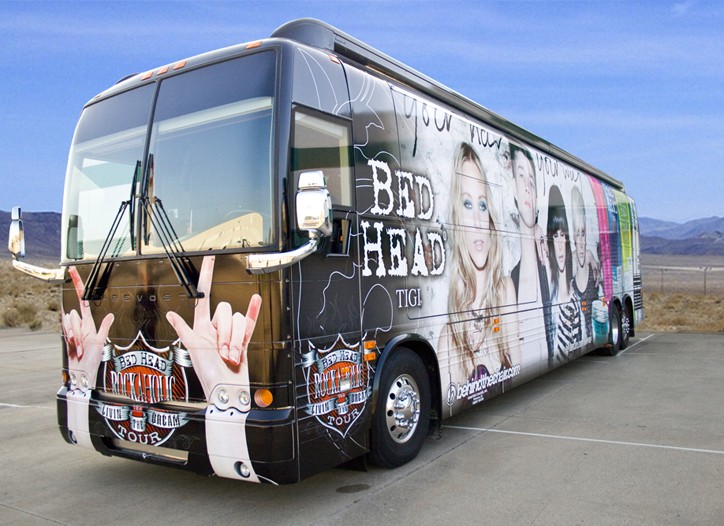
This week, Tigi announced its recommitment to sponsoring the Dallas Cowboys Cheerleaders. And, earlier this year, Tigi launched the Tigi Livin’ the Dream Traveling Salon Tour Bus. The bus makes visits to salons, beauty shows and beauty schools across the U.S. and Canada to give stylists the chance to give their clients the royal rock ’n’ roll treatment.
Rusk Professional Hair Care, another value-priced player that outperformed the industry last year, increased its consumer ad budget by 50 percent this year, said Brooke Carlson, vice president and general manager. Traditionally, the brand had placed ads in magazines such as People, but this year, Rusk is running 20 ad pages in Cosmopolitan.
“We have done some of the niche media publications, but this is a first from a reach standpoint. Cosmo is huge,” she said, explaining that the move looks to help salons generate business. “Salons need help,” said Carlson. Industry data show that sales of products sold by manufacturers to distributors fell 8 percent last year.
The brand also tapped celebrity journalist Nancy O’Dell, who will be featured in Rusk’s ads this month along with a statement that reinforces visiting the stylist, the local salon and Rusk’s Web site.
Matrix, on the other hand, nixed consumer advertising in the fourth quarter of 2009, putting all of its resources into programs that support the hairdresser, from pop-up education centers to reentering trade shows.
The new directive comes under Colin Wash, who joined Matrix in July 2009 as vice president and general manager. Walsh, who has been in the industry for 10 years, from product development to sales to distribution, said his main goal is to “get as close to the hairdresser as possible, as opposed to the consumer, in order for the brand to drive sales and build relationships.”
Creating contests to reinvigorate stylists’ morale also has been incorporated at Matrix via its Mannequin Mania competition. The contest invites stylists across the country to create a unique look on a mannequin head. The winner receives $25,000.
Walsh explained the stylist-based programs reinforce that Matrix “is a brand built by hairdressers for hairdressers. The excitement that was built within the hairdresser community was a commitment to the success of the brand. Now we need to reaffirm our commitment to them. This is more than selling products at retail. The most important aspect is inspiring and supporting and empowering stylists.”
Attending trade shows is also on Walsh’s agenda, an activity that had been ruled out for more than five years.
“Industry shows and events were about $300,000 of our budget [in previous years]. Now they are at $3 million,” Walsh said.
P&G’s Carranza, Rusk’s Carlson and Tigi’s Hostalery all said attending trade shows remained a vital part of staying in touch with the stylist.
“That’s where we really touch the stylist in a one-on-one way and present our new items in a more intimate and hands-on way, where they can touch the products, see how they are used,” said Carlson, adding that attending trade shows is the best way to control a brand’s message since so much communication between stylists and brands takes place through distributors. Rusk and parent company Conair attend about 100 trade shows globally a year.
In line with the commitment toward trade shows, the country’s top professional beauty expos reported gains in exhibitors this year versus 2009, including Cosmoprof North America, Premiere Orlando, America’s Beauty Show and ISSE Long Beach.
However, JPMS’ DeJoria said his firm has nearly ruled out trade shows, mainly because “there were a thousand people selling jewelry and everyone is talking too loud. We only stayed in the ones where there was an educational element. We do not plan to go back.”
Carranza agreed that, while trade shows are an important part of P&G Professional’s strategy in reaching stylists, unfortunately, for some, a flea market mentally has developed.
“It seems we are missing an opportunity to challenge the industry and what we should be focusing on for the future. I think we have had our head in the sand, not only about artistry, but how are we going to win our clients’ share of mind. They are being wooed by a lot of people.”
