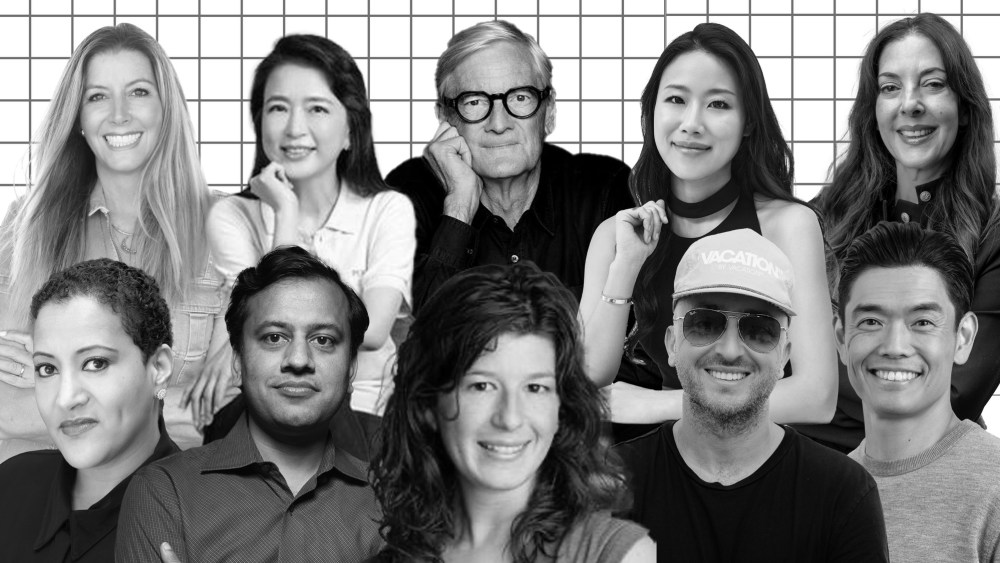
THE INNOVATORS
No risk, no reward is an adage that is particularly true during volatile times. To find out how beauty’s most creative companies foster a spirit of experimentation, we asked: At a time when differentiation and fresh thinking are critical, how do you foster a culture of innovation?
Sir James Dyson, founder, Dyson

At Dyson, we encourage what I call “wrong thinking.” Looking at things the wrong way means ignoring the so-called experts and naysayers who say, “That’ll never work.” It means asking the awkward question: “Why can’t we do it like that?” We enjoy seeking out new problems to solve and challenging conventional thinking at every step. It’s in our DNA, and as engineers, we thrive on it. It’s about embracing the unconventional, and asking the questions no one else dares. It can lead to failure, but for us that’s part of the process.
Related Articles
Dyson has a relentless obsession with understanding challenges people face and how to achieve excellence. Our mission is to develop products for every single hair type and every style, reducing hair damage for everyone. Everything we do is driven by our research and development teams.
The Dyson Institute of Engineering and Technology is a big part of our innovative culture too, where 160 undergraduate engineers live, work and study on our research and development campuses. Undergraduates combine study with practical, hands-on experience, earning a salary while tackling live Dyson projects. What excites me most about their contribution is their fresh perspective: They challenge established approaches and ask the brave — even naive — questions experienced engineers might overlook, or be too afraid to ask. The future of Dyson is to be bold, curious and relentlessly innovative.
Sara Blakely, founder, Spanx & Sneex
I like to ask my team, “if no one showed you how to do your job, how would do you it?” If you think about it, we are all on autopilot. We’re all doing our jobs in a way that someone taught us. We’ve all heard the line “well that’s just the way it’s done.” But what if there is a better way? Have the courage to challenge the status quo. Before I started Spanx, no one had ever questioned why all our undergarment options were uncomfortable and didn’t function well under clothes. We put a man on the moon! What do you mean we can’t have better undergarment options?
All of the best products and inventions exist because someone looked up from their routine and thought… “there is a better way. Let’s find it.” When trying to get Sneex made, I told our manufacturers, “I’m literally paying you to ‘fail.’” They were so afraid of making a mistake, anything done differently felt like a mistake to them. But you can’t have innovation without failure. Learn to celebrate them. We used to have “oops meetings” at Spanx. We would all stand up and name our failures and laugh about them. That’s the secret sauce. Get off autopilot, experiment, fail… have fun! Don’t take it all too seriously. What’s the worst that could happen? You become memorable.
Alice Chang, CEO and chairwoman of the board, Perfect Corp.
In an era where differentiation and fresh thinking are paramount, fostering a culture of innovation requires courage, clarity of vision and an unwavering commitment to pushing boundaries. Innovation thrives when teams feel empowered to challenge norms and explore new possibilities without fear of failure. It’s about creating an environment where bold ideas are encouraged and where problem-solving is driven by curiosity and purpose.
At Perfect Corp., we embrace a mindset of fearless innovation. This means not only developing cutting-edge technology but also reimagining how beauty consumers and brands interact in a rapidly evolving digital world. Effective communication is at the heart of our approach, ensuring that global teams remain aligned, inspired and equipped to bring transformative ideas to life.
Trust is also a key driver of innovation. By empowering individuals to take ownership of their work and contribute their unique perspectives, we cultivate a culture of collaboration that fuels creativity. When team members feel valued and supported, they are more likely to take the risks necessary for true breakthroughs.
Ultimately, innovation isn’t just about new technology — it’s about fostering a mindset that constantly seeks improvement, challenges conventions and delivers meaningful solutions.
Lach Hall, founding partner and executive chair of marketing, Vacation
There are two elements when it comes to fostering a culture of innovation at Vacation. First, there’s an element of “birds of a feather flock together.” That is, the very fact that we put creative, innovative products and marketing out into the world tends to attract creative, innovative people to want to work here. Secondly, once these people are working here, they find that we’ve set the space and structure for creativity and innovation to thrive.
There are three core things we do that facilitate that. Firstly, we encourage open creative conversations across the whole company. Our company Slack channels are wild… they’re abuzz with crazy design and copy inspiration that people find, bizarre things people see out in the world, crazy product ideas, and fun full-company feedback on product and marketing ideas we’re kicking about. This kind of open dialogue creates space for ideas to happen by accident. Some of our best products have come about this way.
Secondly, we build innovation into our company values. Two come to mind here: “Celebrate Creativity” and “Sweat the Small Stuff.” We encourage our team to infuse this approach into everything they’re working on. As a result, every touch point anyone has with us, be it product experience, website, unboxing, customer service or even B2B stakeholder meetings, becomes a moment to deliver on our “leisure enhancing” promise and “exceed expectations” (another one of our values).
Lastly, when formally briefing for ideas, we bring in a diverse group of people and agencies and deliberately ask them to explore a broad range of unorthodox directions, often borrowing from other categories. This allows for unexpected responses which we’ll then get together and jam on until we find ourselves laughing uncontrollably or too excited by a concept to continue working on anything else for the day. When that happens, we usually know we’re onto something.
Leslie Blodgett, beauty visionary, bestselling author and philanthropist
While the beauty industry is obsessed with overhyped, oversaturated categories in a cycle of old programming probably driven by investors needing to see fast growth, the future of innovation is underway by leaders who aren’t following the crowd but are positioning themselves in areas that others haven’t even imagined yet. A very long sentence to say that to create a mindset of fresh thinking teams need to rewire their operating systems and expand their universe by finding new collaborators and seeking novel intersection points with other industries, especially the ones driven by new technologies i.e., biotech, farming, cybernetics etc. To leave the broken system behind and think long term is scary and also liberating. As my friend, Astro Teller, captain of Moonshots at X, told me recently, if Choice A is giving your business a guaranteed value this year of a million dollars or Choice B, offering a billion dollars of value to your business this year but it’s not guaranteed, which would you choose? Everyone chooses B until they see that to support the innovation means making a mess and no one is willing to go there. It starts with extraordinary discipline with an infinite capacity to not know what can’t be done. I think Henry Ford came up with that last part.
Peri Edelstein, managing director and senior partner, and Pierre Dupreelle, managing director and partner, Boston Consulting Group
We spend a lot of time with our clients on how to nurture innovation and an entrepreneurial culture. First — you need to reward and celebrate risk taking, which means accepting a fair amount of failure. Second — you need a way to enable the best ideas from the bottom of the organization to get activated and rise to the top. This means enabling test and learn, and resource deployment at lower levels. Finally — you need to have a clear vision and aspiration that sets not only the frame but also inspires a passion for experimenting to win.
Piyush Jain, CEO, Maesa
At Maesa, we define ourselves as the next-gen beauty company. For us, innovation isn’t just a function, it’s a mindset. In a crowded landscape where differentiation is more important than ever, we believe the real unlock lies in building a culture where ideas move at the pace of pop culture, teams are mandated to challenge convention, and everyone is pushing our brands and the business forward.
We’ve intentionally broken down silos so innovation can come from anywhere, whether that’s a marketer spotting a shift in consumer behavior or a supply chain partner identifying a smarter way to scale. We prioritize curiosity over hierarchy and action over perfection, knowing that speed and adaptability are essential today.
We place a premium on foresight and leading from the front. Our teams are constantly scanning what’s next in culture, in technology and in how consumers live, shop, and express themselves. Our Blue Sky team has been instrumental in delivering best-in-class product innovation that has been driving category growth at our retail partners and capturing the hearts and minds of wellness and beauty consumers.
For me, leadership is about setting a clear vision, creating the right conditions for my teams to thrive and consistently removing barriers to execution. The beauty companies that will define the future aren’t just responding to what’s happening, they’re anticipating what’s next, creating the future and building towards it with purpose.
Tsedal Neeley, Ph.D., Harvard Business School, author: ‘The Digital Mindset: What It Takes to Thrive in the Age of Data, Algorithms and AI‘
AI is unlocking extraordinary gains. People who embrace AI daily are reporting, on average, a 40 percent boost in productivity, revenue uplifts and dramatically improved customer service. In beauty, this means real-time trend detection, hyper-personalized experiences and faster product development cycles. The opportunity is massive. But so is the fear.
The beauty industry has to go beyond brands or seasonal campaigns. Today, TikTok can sell out a product in hours. Consumers are creators. Trends are born in seconds. The new mandate? Move faster, get closer to your customer and design for a changing world. AI is the only way to innovate and scale at that speed.
Over the next 12 to 24 months, the greatest challenge facing organizations isn’t technological— it’s human. From the boardroom to the frontlines, anxiety is rising. Leaders worry they’ll fall behind. Employees fear obsolescence. Misunderstandings about AI’s role are stalling progress and, in some cases, actively derailing it.
To move forward, organizations must focus on three things: clarity, capability, and change. First, a shared understanding of what AI is — and isn’t. It’s not magic or menace; it’s a tool that augments intelligence and accelerates decision-making. Second, every team member must gain enough fluency to use AI meaningfully. This is the essence of the 30 percent rule: understanding just 30 percent of AI’s power can unlock 100 percent of its value. And third, companies must commit to real change — rebuilding workflows, structures, and cultures for an AI-native future.
This isn’t merely a tech trend. It’s a creative revolution. And it’s already here forcefully.
Robin Tsai, general partner, VMG
We think it’s important to celebrate diversity of thought and opinions. A consensus-driven model may feel more comfortable, but we strive to foster an environment where strong divergent views are embraced and unconventional ideas can thrive. To encourage this, we keep our teams small, autonomous and accountable.
Alicia Yoon, founder and CEO, Peach & Lily
At Peach & Lily, innovation is central to what we do. In a saturated industry, we’re one of the fastest-growing skin care brands. A large part of our success is a culture that promotes deep engagement and innovative thinking whether it comes to product formulas or exciting campaigns that break through the clutter.
We believe in a virtuous cycle of actionable innovation and constant improvement — outside-the-box, big-idea brainstorming structured into concrete execution, and importantly, distilled into incisive post-mortem learnings.
To support this, our teams deeply connect and collaborate — inspiring and learning from each other daily. We thrive on boldness and unconventional thinking drawing insights from other industries, our customers and even nature. New marketing concepts and A/B testing are encouraged. We have both structured and unstructured and individual and group idea sessions. And we hire people who love to connect the dots and push the boundaries on ideation, while structuring creativity into tangible action.
We take pride in our breakthrough products crafted to deliver potency and science-backed results. Our innovative formulas, some of which are patent pending, are only possible because we don’t follow a conventional playbook for product development. We conduct multidisciplinary research with our lab partners, we don’t put a timeline on innovation and we treat every formula as a hero product. There’s no such thing as tier-two products for us.
Innovation requires disciplined and bold independent thinking that delivers outcomes. To reinforce this, we celebrate every win — big or small — and share that across the organization.