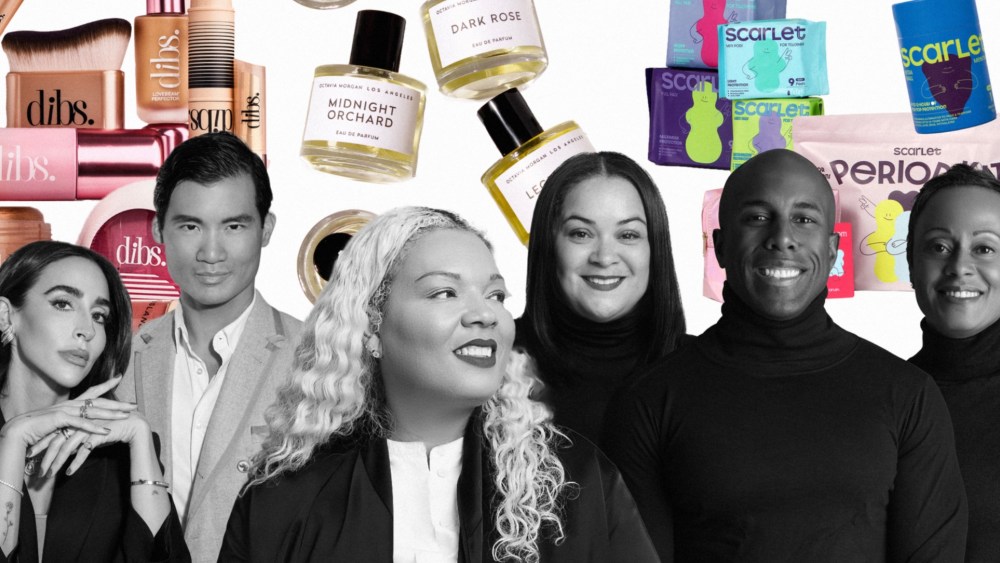
Seventeen years ago, in a classroom full of fifth grade girls, former teacher Dana Roberts noticed one thing missing: period kits.
Half of her students had started their menstrual cycle that year — her daughter included — but when the time came, they were grossly unprepared, mentally and materially, with not one appropriate “First-Period”-specific product available to them.
That “aha” moment led Roberts to create the “period purse,” a curated kit of menstrual essentials. “And that was the first iteration of Scarlet, my feminine care and wellness brand for teens and tweens,” the entrepreneur said.
Related Articles

Such is the affecting story that motivated chief merchandising officer, Jessica Philips, to help Roberts and her cofounder, Monica Williams, expedite the growth of Scarlet, formerly RedDrop, through Ulta’s Muse Accelerator program, an impact-driven initiative designed to amplify the visibility of nascent brands for future retail success. “What inspires me is people and founders, typically these earlier stage brands, coming from a ‘why,’” Philips said. “It usually comes from that unmet need they couldn’t find in the industry because more often than not, they’re not the only ones with that need.”
Launched in 2022, Muse Accelerator, which focuses on brands created by BIPOC founders in underserved communities, is one of two programs Ulta Beauty has added as part of its environmental, social and governance plan. The other is Sparked, a platform championing the next generation of beauty change-makers.
“The Muse Accelerator is a foundational part of our equity driven approach to building a more inclusive beauty industry,” Philips said. “It came from the gaps we saw and the inequities in terms of access to resources and mentorship post-peak COVID-19 and [the murder of] George Floyd when founders in the industry were putting a spotlight on the lack of access. This program was a powerful way for us to step up, not only to make an impact in the community, but to help drive a pipeline of brands for our business.”
Since its inception, Muse has fostered 24 founders, roughly eight per year, in its 10-week curriculum focusing on every aspect of brand management, from finance to social strategy. Already, Ulta’s seen a proliferation in applicants, resulting in a total of 500 received for the 2025 program.
Admission into Muse is dependent upon a slew of factors. “It’s a lot of what we look for in brands that launch at Ulta Beauty. The expectation of our consumer has changed so much if you think about our conscious beauty pillars, making sure that a lot of those are on the radar or met is important,” Philips noted. “It’s also about whether the brand has a clear point of difference. Is there a gap in the market around what they’re trying to solve for? What’s the founder like? How strong is the story? The quality of the product is also super important.”
Though brands are required to have realized revenue prior to Muse, founders receive a stipend of $50,000 when they’re admitted. They then are invited to a “demo day” at Ulta’s headquarters in Chicago, during which a board of investors will come in to provide initial feedback on their pitch. From there, the program transitions to eight weeks of online courses.
At the start, Muse was conducted entirely online. Ulta thus implemented an in-person mandate for the first and last weeks of the program once the pandemic settled. And while the community aspect of Muse certainly existed in its all-virtual era, the years since have enabled participating founders to connect with each other offline, which has been instrumental in cultivating their strong network of resources.
The program also includes a first-of-its-kind mentorship. “Early-stage founders are also matched with founders who are not totally well seasoned but have been where they were at one point or another, all of whom belong to Ulta’s existing portfolio of brands,” Philips said, adding that merchants are also placed in a cohort with advisers, too. Mentors and mentees are encouraged to meet at least once a week.
When it comes time for graduation, the celebration doesn’t exactly elicit the sterotypical stress-free mindset. If you ask Roberts, she’ll tell you the experience is the opposite. “Anxiety-inducing” was how she described it, to be exact.
Brands are given the opportunity to pitch Ulta executives for a chance to get their products in-stores. Of course, Muse is set up to ensure each brand is as prepared as they can be for this final “test.” “This is when you’re leaving everything on the floor. It’s a culmination of everything you learned,” said Octavia Morgan, founder of an eponymous clean fragrance line and graduate of the 2023 Muse program. “You tell them about your brand from the beginning and your star skus. Everyone was nervous, but even though you’re pitching to 15 executives, they’re all very supportive. It not an adverse environment at all.”
Success in this final pitch is “unique to the founders,” Philips said. “It’s a conversation around readiness and point of difference and what brands we think will really resonate with our guests and are ready for that.”
Morgan, Roberts and Williams ultimately impressed Ulta’s executives and venture capitalists, meaning they were invited into the next phase of development as new featured sellers under Ulta’s Sparked platform. Established in 2019, Sparked is Ulta’s way of reserving space in-stores and online to allow “further-along brands” to enter retail, maybe for the first time, at a lower cost of entry. “We pay for that space and those end-cap shelves so they can start to build their story,” Philips said.
Sparked brands don’t require as much “hand holding” as Muse participants do when they come in, but it’s still a platform geared toward emerging brands. “I view Sparked as this discovery platform of brands that we believe could be big in the future,” Philips explained. “We help them build their brand awareness, defer some of those high costs of doing business, so they get to profitability faster, and then help provide that amplification for our guests who just are craving to discover new brands.”
More than 50 companies have flourished under Sparked. Dibs, the TikTok-viral makeup brand founded by influencer Courtney Shields and Jeff Lee, joined in 2024, marking their inaugural venture into brick-and-mortar retail. Before Sparked, most of the brand’s consumer base derived from Shields’ online following. Now, more than half their brand discovery is coming from Ulta.
If you’re anything like Lee, you’re taking the initiative to be a hands-on Sparked brand owner. Every week he’s at new location, working with store associates, learning about the consumer and conceptualizing new models for the brand’s shelf and end cap space — all for the purpose of achieving long-term success. Already, Dibs has seen a jump in sales.
Yet, the most impressive consequence to come out of Muse and Sparked is not the retail achievement or the sales growth of a company; it’s the formation of founders willing and wanting to see the triumph of others like them in an the industry that’s rooted in competition. “ Sometimes being a founder can be a little bit lonely. You have questions and no one to help you with them,” Morgan said. “But here, at Ulta, I can pick up a telephone and call one of my Muse cohort members and they’ll give me the answers and advice I need.”
Rene Casares, Ulta’s chief legal officer, credited Muse and Sparked as rarities in not just the beauty industry, but retail as a whole. “Not all companies are really pushing forward and putting in the proportion of resources that Ulta is putting into these programs and the people whose roles are dedicated to sustainability, to ESG, to diversity, to good governance and to responsible operation.”
As Ulta prepares to enter into Mexico and the Middle East, both Casares and Philips are looking forward to seeing how Muse and Sparked prosper in those markets, giving a voice and a platform to founders across the globe.
Octavia Morgan
Established in 2022, Octavia Morgan is the clean fragrance brainchild of its eponymous founder, who designed the line for fragrance sensitive consumers like her. At the start, the business was operating direct-to-consumer, led by Morgan and her partner, Delaney McGill. Morgan joined Ulta’s Muse Accelerator program in 2023, where she was able to refine Octavia Morgan’s brand messaging, obtain the proper financial backing and learn the necessary manufacturing codes for retail readiness. Now, Octavia Morgan is the first Black- and woman-owned brand within the prestige fragrance category at Ulta, with four fragrances sold in 710 locations across the country. The product line has also expanded from its original four scents — Legendary, Dark Rose, Summer Fleur and Oud Noir — to include five additional offerings and a body care collection, consisting of four lotions, two body shimmers and an oil.
Scarlet
Formerly known as Red Drop, Scarlet is a feminine hygiene brand designed specifically for adolescent girls. Cofounder Dana Roberts initially thought of the idea for a pre-teen period kit while teaching a classroom full of fifth graders, including her daughter, who were just starting their menstrual cycles. There, she saw a massive gap in the industry, noticing the lack of products and educational tools available that were not only accessible, but approachable. Roberts tapped her sister-in-law, Monica Williams, to help run the business — which, at the start, was operating direct-to-consumer. In 2024, Scarlet was accepted into the Muse Accelerator program, where they later decided to change the brand name from Red Drop to Scarlet, per Ulta’s suggestion. Now, Scarlet is in 380 Ulta stores nationwide, offering period underwear, feminine wipes, pads and bathroom passes for at-school emergencies.
Ocoa
Sisters Cory Varona-Corniel and Nicol Varona Cancelmo first sowed the seeds of their curly hair care brand in 2021, two years before they rebranded as Ocoa, the name of their mother’s hometown in the Dominican Republic and the Taíno word for “the place between the mountains.” Every aspect of the brand, from its tricolor packaging to the product formulas, down to its bilingual messaging, is rooted in the culture of the Dominican Republic, designed to evoke the movement and beauty of the people there. Ocoa uses natural ingredients such as mango butter, hibiscus flour and marula — all popular in skin care — in their products to help homogenize the curl routine with a cream, hold spray and styling gel. On their third try, Varona-Corniel and Cancelmo were accepted into the Muse Accelerator program in 2024. There, they learned how to reconfigure their fulfillment and operations processes to be successful at a major retailer like Ulta. Now, the brand is set to launch in almost 500 under Sparked.
Snif
Founded by Bryan Edwards and Phil Riportella in 2020, Snif is the beauty industry’s clean scent disrupter offering fine yet affordable fragrances, mists, detergents and candles with baroque and whimsical aromas. Edwards and Riportella created Snif to democratize the fine fragrance industry, where reasonably priced, high-quality eau de parfums seemed nonexistent. Two years after Snif’s initial drop, Ulta reached out to the founders with the opportunity to join their Sparked program. Ulta started Snif out in 500 doors, with space on the top shelf of their Sparked end caps. In just seven months, the brand graduated, expanding into all Ulta locations in the U.S., with four body mists and eight fragrances on the shelves, as well as 41 products available online.
Dibs
A women- and minority-led brand, Dibs is the practical, clean beauty makeup line founded by lifestyle influencer Courtney Shields and chief executive officer Jeff Lee. From dual-ended contour and cream blush sticks to mascara and primer wands, Dibs targets consumers looking to solve common sense problems with easy-to-use products. Lee and Shields formulated their brand concept in 2020, a year before Dibs officially went live. In the beginning, the majority of their consumers were coming from Shields’ online following; however, the scale has tipped in the opposite direction since joining Ulta’s Sparked platform in 2024. Dibs currently sells 15 products online at ulta.com and 12 products in more than 590 Ulta locations. In 300 of those stores, Dibs has its own specialized endcap, plus a mini placement in all 1,400-plus stores. The decision to sell at Ulta was a no-brainer for the brand, considering 95 percent of its top 100 customers come from rural areas.