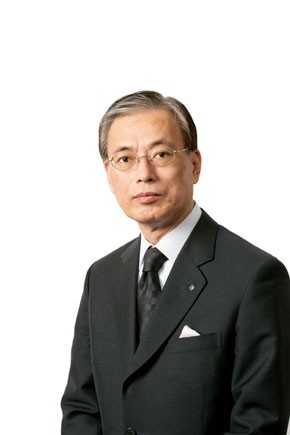

It isn’t noticeable in the orderly lobby of the company’s hushed Tokyo headquarters, a striking sanctuary of creamy leather, polished woods and the airy tranquility of traditional Japanese design. But beyond the fleet of uniformed receptionists, a transformation is occurring, led by president and chief executive officer Shinzo Maeda, a 37-year company veteran who took charge of the historic Japanese beauty company in 2005 and immediately ushered in an era of reform.
The movements thus far have been relatively quiet, at least to outsiders, and directed mainly at Shiseido’s domestic business, where the 135-year-old company – the longtime leader of Japan’s $13 billion beauty industry, where it commands a 17.5 percent market share – has faced increasing competition from both local and foreign brands in a very saturated market. But now, Maeda is turning his focus to advancing Shiseido’s international presence with the help of Carsten Fischer, a well-respected German with a strong beauty background as a former executive at Wella and Procter & Gamble. As of January, Fischer – who as corporate executive officer is the most senior foreign employee in Shiseido history – assumed responsibility for the company’s operations in the U.S., Europe and much of Asia. In Ooctober, he’ll begin overseeing Shiseido’s professional division and in January, he will take the lead for what is quickly becoming the company’s most important foreign market – China.
Related Articles
There are a lot of eyes watching these changes, which hasn’t always made things easy. Maeda has faced opposition and skepticism – both internal and external – for some of his domestic initiatives thus far, including abolishing sales quotas for in-store beauty consultants and discontinuing long-established brands while creating new “megabrands” that are better positioned to become lucrative category leaders. So far, he’s silenced critics with a record of results: The company, which has just completed year two of a three-year plan called “Growth and Advancement,” has seen annual sales rise to about $6 billion and share prices reach an unprecedented high since Maeda stepped in.
“Evolution is important to Shiseido and has become critical to growing our business,” says the reserved but friendly Maeda, sitting in a cream leather armchair in a sleek meeting room on the top floor of Shiseido’s Tokyo headquarters. When talking about the company’s reforms, his typical response is both measured and modest, reflecting the nature of Japan’s conservative business culture and deflecting self-praise for the company’s recent growth.
Others are quicker to give credit where it is increasingly due. Says Fischer, “If you look at the changes Mr. Maeda has made thus far, it gives you an indication of how committed he is to move [Shiseido] ahead. It’s not as if the company was on the brink of bankruptcy and needed someone to turn it around. The company is in a very healthy stage, and yet he’s managed to take it a step up with some very meaningful innovations. There’s a real determination to do the things that have to be done to take the company to the next level.”
To fully understand the seismic nature of the changes at Shiseido, it’s important to get a sense of the company’s storied history, starting with its founding in the posh Ginza district of Tokyo, where the company still maintains its headquarters as well as several historic properties. The most impressive of these is perhaps Shiseido Parlour, a swank 11-story landmark that houses an art gallery, confectionery and several high-end restaurants, including a two-story atrium tearoom at the top floor that overlooks the building’s equally luxurious neighbors such as Lanvin, Burberry and Gucci.
The Parlour is just across the street from Shiseido’s original location, where it opened in 1872 as Japan’s first Western-style pharmacy. (That building, still owned by the company, is now a luxury store selling fashion items and the full range of Shiseido products.) few minutes’ walk away is the charming House of Shiseido, where a small library of beauty and design books and a rotating exhibition of artworks from the company’s corporate museum in the Japanese city of Kakegawa attracts several hundred visitors per day. (The building, the former Shiseido headquarters until the company moved into its present location in 2003, still houses the office of Yoshiharu Fukuhara, the company’s honorary chairman and grandson of its founder.) Looking through a selection of the company’s vast archives – from the ruby vintage bottle of its first cosmetics product, Eudermine, created in 1898, to the current issue of its edgy, 83-year-old monthly fashion magazine Hanatsubaki – it’s easy to understand why is a veritable household name in Japan, a brand that has been passed down from mothers to daughters for generations.
When 23-year-old Maeda joined the company in 1970, he slowly worked his way up from an entry-level spot in a sales division to a member of the team launching cosmetics line Ipsa, the first company brand that would not carry the Shiseido name. The launch of Ipsa in 1986 was rocky – so much so that Maeda considered leaving the company in disgrace – but the motivated employee had already caught the attention of company higher-ups. He was promoted to corporate planning, while Ipsa eventually flourished to become a top-selling brand.
Maeda moved up through a wide range of departments, which gave him the exposure he needed to eventually become the leader of the company’s corporate planning department, responsible for strategizing new ways to take forward. His leadership abilities didn’t go unnoticed: Maeda, the youngest member of the company’s board, was appointed president and ceo in 2005 at the relatively young age of 58, raising some eyebrows in a company – and a country – that has always placed priority on hierarchy and seniority.
Maeda wasted no time in restructuring the company and updating its core offerings. (It wasn’t just the business that changed: The approachable Maeda earns kudos from employees for being the first president to regularly eat in the company cafeteria.) The reforms began with the domestic business, where the company drastically cut back the number of brands it distributed in Japan, reducing internal competition and creating new, full-range “megabrands” that would be better positioned to be leaders in major categories like hair care, cosmetics and men’s products. In the past two years, a fleet of more than 100 domestic brands has been whittled down to about 30.
“Before the reform started, we had so many domestic brands and our limited management resources were scattered among them,” Maeda says. “It wasn’t possible for individual brands to be fully developed and nurtured, and as a result, each brand didn’t receive strong recognition from the customers. We decided that if we could concentrate the brands, we could nurture them so they could each grow to be a top brand that could outperform other companies’ products.”
It was a potentially risky strategy, but the company immediately saw results – like in the hair care category, where had previously lagged in the number four spot in sales. The launch of hair care megabrand Tsubaki in March 2006 was a phenomenal success: The brand took in $150 million in sales during its first year – 80 percent higher than the original projection – and now Shiseido holds the number two spot in the category, according to company figures. Shiseido achieved similar success with other megabrands such as Maquillage, a prestige full-range makeup line that launched in August 2005 and replaced the popular foundation line Proudia and cosmetics line Pieds Nus.
“the past, when sales for Shiseido brands in each category were combined, they would be performing well,” Maeda says. “But each individual brand was not performing at the top level. This strategy allowed us to directly address that issue.”
Brands that had the strongest presence – like in skin care, the company’s historic driver – were retained but given more resources. The company’s ultraprestige skin care line, Clé de Peau Beauté, has bolstered its presence in department stores by introducing its own counters (previously, it shared space with Shiseido The Skincare) and renewing its makeup and basic skin care offerings earlier this year. The category was further strengthened by the launch of two skin care megabrands, the mass line Aqua Label and mid-range line Eelixir Superieur.
The key to the megabrands’ success was to ensure that longtime customers who had been loyal to the old brands would make the switch to the new ones. Shiseido embarked on a major marketing effort and spent considerably on its advertising and promotion campaigns, including hiring local and foreign celebrities to draw more attention to the new launches. Most prominently, Angelina Jolie was signed as the spokesperson for Integrate, a mass makeup line that launched in August. A prominent television and print campaign focused on the actresses’ famous bee-stung lips slicked in a glossy pink Integrate lipstick called Aqua Diamond Rouge.
So far, the massive marketing push and new product ranges have succeeded in not just converting old customers but attracting new ones by helping to revitalize the image of a beauty company that many younger customers had thought of as their mothers’ brand. The company hopes to maintain the momentum now that the launch phase is over and it focuses on development.
“I am satisfied with what we have achieved [in the domestic market],” says Maeda. “We are entering the phase where we can focus on nurturing these brands.”
Now comes the next step: bolstering Shiseido’s international presence, a key component to the company’s goal of becoming the leader of Asia’s booming beauty market and a major player in the prestige business in other areas like the U.S. and Europe. In the past 10 years, Shiseido – currently the fifth largest beauty company worldwide – has seen its global position grow significantly; where outside markets used to account for about 10 percent of the company’s business, they now contribute more than 30 percent of annual sales and are continuing to rise.
To add more fuel to the growth, the company recruited Fischer in late 2006 to oversee its international business. Fischer, who is fluent in Japanese, first joined Shiseido as a corporate advisor, which included a crash course in the company’s wide variety of products – a very illuminating education for someone with a hair care background as the former ceo of Wella Japan and the president of the Professional Care Division of Procter & Gamble. (As a result of his Shiseido schooling, the amiable Fischer admits to being compelled to update his moisturizing and cleansing routine. Plus, he adds, “my wife is very thrilled” with the product perks of his new job.)
Fischer had split his career between Europe and Japan since he came to Tokyo in 1991 to attend Japanese language school, where he met his wife, a fellow student from China. Hhe switches easily between fluent English and Japanese, noting that his language ability and local knowledge has allowed him to slip more easily into such a senior position in Japan’s formal business culture.
“Having worked in Japan [in the past], I think I’ve developed a sense of avoiding the biggest blunders,” Fischer says. “But would be mistaken if tried to conform to all the rules [of Japanese business culture]. I’m a German, which means by nature, quite direct in my communication. That’s not easy sometimes, but I believe it is also refreshing.”
Fischer now spends about half his time in Tokyo and the other half traveling between Shiseido’s international outposts, including leading markets like Ssoutheast Asia and the U.S. and the company’s research and development centers in Japan, the U.S., Europe, China and – as of October – Thailand. He is frank about Shiseido’s challenges in the international arena, but declines to define specific development strategies and merely hints at a wide range of possible upcoming changes.
One main focus for Fischer is the U.S. market, where the company sells a range of Shiseido-branded products as well as those from subsidiaries such as Nnars Cosmetics, Zirh and Beauté Prestige International, which holds the licenses for fragrances like Jean-Paul Gaultier, Issey Miyake and Narciso Rrodriguez. The company has been able to gain ground recently in skin care, moving into the number four spot in the category due to efforts by Heidi Manheimer, who was named ceo of Shiseido’s U.S. operations in early 2006. Manheimer, a former merchandising manager at Barney’s who joined in 2000, is the first Aamerican to hold a ceo title for the company’s U.S. arm (previously, the position had been filled by a rotation of executives from Japan). She is also the highest-ranking woman in the Shiseido empire.
After the recent gains, sees even more potential in the U.S. Though the market currently has an operating profitability of 5 percent, executives aim to double that within the next three-year cycle. Part of that growth will come from skin care, Shiseido’s longtime strength. The company just rolled out a major Shiseido The Skincare revamp in the U.S. in March, hoping to further invigorate its presence.
“It’s important to always stay fresh in a market that is very much driven by new approaches,” Fischer notes. “You also need to bring meaningful innovation with every relaunch, and believe we have done that now with Shiseido The Sskincare. not just the packaging that has changed; the technology behind the product has been updated as well. Our plan is to upgrade all of our products as new technology becomes available.”
Fischer counts antiaging and eye-related skin care products as the current core strengths of the category’s growth, and says he also expects a strong increase in areas like sun protection and brightening. “These are high-value categories and we are always looking [for new ways to grow them],” he says. “If you take antiaging, for example, there are areas of the body that are affected by aging that have not been fully brought to the attention of the consumer. We are looking at developing antiaging not just for face, but for the whole body. The growth in this category going forward could be tremendous.”
Fischer also believes that brightening products, which traditionally had only been targeted at Asians, have huge growth potential in outside markets as well. In March, the company launched its brightening line Shiseido White Lucency in Europe, where it says it has already receiveda strong response.
“Whitening started in Asia, and it’s still a very big thing,” Fischer says. “But the technology is valid for Caucasian and Hispanic skin as well and we’re starting to introduce it [to markets outside Asia]. It has slightly different positioning – we call it brightening instead of whitening – but we’re seeing very promising initial results. It may take a little bit of time, but we believe this will become a big category as well.”
Advanced home treatments are getting more focus. Aa major launch this year will be Shiseido Bio Performance Intensive Sskin Ccorrective Program, a two-week skin revitalization program that will be priced around $300 and will launch in the U.S. this fall.
“The female consumer is looking for better solutions and better results, and she’s willing to try more complicated solutions in order to achieve these results,” Fischer says. “We will be working on offering more products that have a similar effect to a dermatology visit. That way, we’re able to offer convenience but also provide more complicated products than just a standard cream.”
Prestige cosmetics will also be an area of global focus for the company, which plans to further advance the cosmetics line along with foundation to better utilize each brand’s strengths and identity. “If you talk about as a brand, makeup is not necessarily the first [thought],” Fischer admits. “We think we can strengthen this category with a dual approach – by using Shiseido, which is strong in skin care, to grow our foundation business, and using Nars to focus on color cosmetics. It will be a twofold strategy, using the different strengths of our different brands, to conquer the market.”
Along with the product changes comes a deeper examination of the company’s global presence. Oone area of improvement, both for the U.S. as well as the European market, could be bolstering the company’s presence in sales outlets that don’t have the benefit of dedicated sales staff. “We are not as strong in an environment where self-selection is the way of selling,” Fischer notes. “That’s because, by our aesthetic approaches, we don’t scream ‘Here we are!’ We are a company and a culture that is rather understated, not overstated. That’s not going to change, but I believe you can be understated and still make a point in saying, ‘I’m here.'”
It’s clear that consumers are going to start seeing a lot more of Shiseido. “don’t think we get all the share, in terms of public relations, that we are entitled to, and that could be one focus for us in the future,” Fischer remarks. “There are many opportunities for us to pursue.”
Such initiatives already make for a hefty workload, but in January, Fischer will take on even more responsibility when he assumes control of the company’s China operations, which have helped push sales for the Asia-Pacific region outside of Japan to more than $500 million per year. China has been a long-term and lucrative focus for the beauty industry, and has wasted no time in setting up a major presence there. The company currently has more than 10 brands in the market, led by top-selling prestige skin care line Aupres, its China-specific skin care line that launched in 1994. To keep up with the skyrocketing amount of wealth in China, Shiseido recently launched a second, even higher-end skin care line called Supreme Aupres, whose products retail for about $23 to $60.
Shiseido’s China business has been growing by about 30 percent each year for the past three years, mainly due to an initiative started in 2004 to increase the company’s reach into more rural areas. While Shiseido had previously focused on department store sales in China’s major cities, it began to see a demand for cosmetics in farther-flung areas of the country. Using a strategy modeled after the Japanese market, began distributing a range of beauty brands to locally owned specialty stores across the Cchinese countryside. The company dramatically grew its specialty store presence in China from 1,000 outlets in 2005 to 1,700 by the end of 2006 (by comparison, department store locations rose from 450 to 550 during the same time frame).
“[The specialty store strategy] is one factor behind our fast growth in the market, and it is a strength that cannot be easily copied by our competitors from Europe and the U.S.,” Maeda says. “This is a business model that we originally developed for Japan, and the reason for the success we’ve achieved here. Nnow, we’ve been able to apply this expertise to China as well.”
And just in time, it seems. Maeda is quick to point out that industry figures for are still very difficult to estimate, but that in the next few years, he expects China’s annual beauty sales will exceed that of the $13 billion Japanese market. “In the future, it will likely be the biggest cosmetics market in the world,” he says.
Beyond China, the company has its eye on other emerging beauty markets as well, including Vietnam, India and Russia, where the company set up a subsidiary in April. Those markets are a focus for Fischer as the company works to finalize its next three-year business plan, which will begin in April 2008.
That guarantees that big changes will continue at Shiseido, particularly as the company works to grow against its bigger competitors like L’Oréal, Procter & Gamble and Estée Lauder. Fischer points to several of the companies’ core strengths as its major assets in the battle for beauty market share, including its highly aesthetic approach, commitment to customer service and consultations and research and development expertise. But perhaps the company’s most compelling weapon is the untapped potential of their extensive roster of existing brands.
“One of our big strengths is our brand portfolio,” Fischer says. “Other companies have good brand portfolios as well, but Shiseido really possesses some unpolished gems. There’s the brand itself – which for insiders is very strong and aspirational, but it’s really not very well-known yet. And if you take Nars, or Issey Miyake and Jean-Paul Gaultier [fragrances], or brands like Decléor or Carita, there are a lot of unpolished gems in the crown jewel of that have not yet been put forth as forcefully as they could be. believe that’s a huge asset that we have and can develop.”
Will it get that far? After all, there is also plenty of speculation that the newly strengthened company may be prime for takeover by one of its major competitors. It’s an idea that Maeda neither endorses nor dismisses.
“Reform will continue; it is part of our fabric,” he says. “We made a plan, we acted on [it], and now we are achieving our goals.”