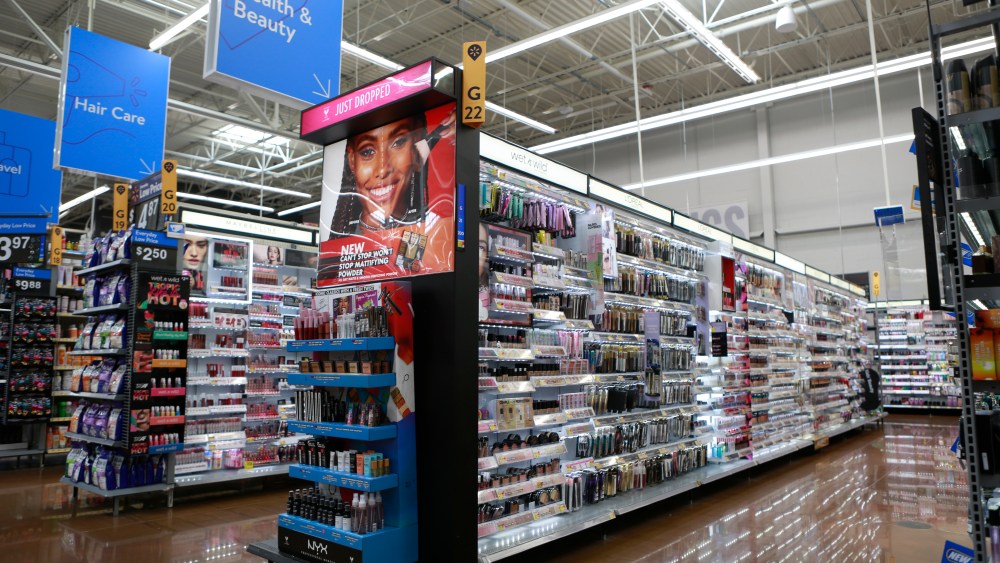
Mass beauty shoppers appear to be cutting back.
The U.S. may now be on track to avoid a recession this year, but all the uncertainty, combined with inflation and the back and forth on student loan debt forgiveness, has impacted mass beauty.
The sector is still growing on a dollar value basis, according to separate data from both Circana and Nielsen. The former reported that makeup and skin care both rose by 10 percent in the first half of 2023, compared with the same period a year earlier, while fragrance was up 9 percent and hair 6 percent. Nielsen, meanwhile, said mass beauty was up 8.5 percent in the most recent four-week period it tracked on a year-over-year basis.
Related Articles

But this does not tell the whole story as the figures also showed that unit sales, which measure the number of products actually sold, are trending flat to negative, suggesting that the dollar value growth is down to retailers and brands raising prices as they tackle inflation.
“As the unit performance is starting to slow to almost flat to negative, what’s happening is it’s really an average price story in the mass market as to why that particular side of the market is maintaining its performance levels today,” said Larissa Jensen, vice president and beauty industry adviser at Circana.
“[Consumers] might be buying less, they might be replenishing less often, they might be buying multipurpose products. And they could potentially be doing some shifts in terms of their brand choices,” she added.
On the Neilsen numbers, Anna Mayo, VP of NIQ Beauty Vertical, commented: “Many seem to be cutting back on or forgoing their beauty & personal care purchases to put their money towards everyday essentials like groceries, household care items, health & personal care items.”
Wendy Liebmann, a retail analyst and chief executive officer of WSL Strategic Retail, agreed that economic uncertainty has been driving a shift in shopping habits when it comes to mass beauty.
“There’s a lot of shifting shopping going on. Mainly because of inflation, people are being very cautious still, especially in the mass market,” she told Beauty Inc.
Another factor at play, according to Liebmann, has been some shoppers holding back as they awaited a decision on the cancellation of $430 billion of student loan debt. That happened in late June when the Supreme Court struck down President Joe Biden’s student loan forgiveness plan, although he is now pursuing an alternative and this week announced plans to cancel $39 billion of student loan debt.
“Everybody was waiting to see what happened with the student loan debt and once there’s uncertainty, people just pull back,” she continued. “We’re certainly seeing traffic down or shifting to other more affordable places or less tempting places. A bit of shifting from drug, for example, into mass. But not all mass, people not wanting to be tempted at Target are shifting to Walmart.”
The most recent results seem to bear Liebmann out. Walmart’s revenues for the quarter ended April 30 increased 7.6 percent to $152.3 billion, where analysts were looking for sales of $148.9 billion.
“The beauty of it is customers are even more price sensitive right now, they’re paying close attention,” Walmart CEO Doug McMillon told analysts during its most recent earnings call.
And trade down within mass isn’t just happening at retailers, but with brands too, with Jensen pointing to the “phenomenal” performance of E.l.f. Beauty of late, which has one of the lower price points on the mass side. It saw net sales jump 78 percent to $187.4 million in the three months ended March 31, surpassing analysts’ forecasts of $176 million.
At the time it released its results, Tarang Amin, E.l.f. Beauty’s chairman and CEO noted it was also “significant” that it became the number-one brand in the mass cosmetics category in Target, since the retailer had a head start on everyone else as it was E.l.f.’s first retail partner.
As for trade down from prestige to mass, Circana hasn’t seen this in the data, with unit performance in prestige up 15 percent so far this quarter.
“It has to do with the consumer, because on the mass side, the consumer skews to lower income. And then on the prestige side, the consumer skews to higher income,” Jensen said.
“When we look at the higher income consumer, those earning $100,000 plus on the prestige side, they are super engaged in the category,” she continued. “They’re spending about double what they did versus pre-pandemic. They really are subscribing to prestige beauty as their treat. There’s like the treat mindset going back to like the lipstick index as consumer sentiment goes down.”
In contrast, she noted that spending on mass beauty tends to be more functional.
“I need to update my mascara. I just need a quick let-me-go-pick-this-up really quick — sunscreen, whatever. But on the prestige side, it becomes a destination. It becomes an experience,” she said. “It’s a very different type of dynamic and we’re seeing the difference really playing out in terms of units. That’s why units to me are more important sory now during this inflationary period, because it really does speak to how consumers are spending what they’re purchasing.”
As for whether the downturn will persist? The market is hoping that with consumer price inflation easing to an annual rate of 3 percent in June, the lowest level since early 2021, mass shoppers will return to the beauty aisle, but they will need to see this reflected in their favorite products.