PARIS — Inflationary impacts and shifts in preferred retail channels are expected to continue impacting the beauty business in France this year, according to a study carried out by NielsenIQ.
Notably, it found that 45 percent of French consumers queried said they plan to spend less money on beauty products in 2023. And 41 percent shared they would purchase cheaper beauty products to reduce their category-related expenses.
In France on-year, the consumer price index rose 4.5 percent in June and 5.1 percent in May, according to INSEE, the country’s national statistics office. For many consecutive months prior to that, the monthly increase hovered at around 6 percent.
Related Articles

“The inflationary period we are going through has radically changed the behavior and purchasing habits of the French,” wrote NielsenIQ, adding beauty products are not exempt in such an economic climate.
Among the people queried, 52 percent said they had less and 26 percent said they had more disposable income available in 2023 versus 2022.
“In order to reduce expenses, consumers will look for cheaper products, also reduce their frequency of purchases and use existing products,” NielsenIQ said in the study.
Consumer sentiment has a direct impact on spending. Eighty-four percent of those polled estimated that beauty product prices had risen over the six months to March. Meanwhile, 24 percent thought the hikes were higher for beauty than categories like groceries.
“There is an opportunity here for manufacturers and distributors to rethink the way they communicate on promotions and also to innovate in order to highlight the price benefit for consumers,” said Nicolas Léger, an analytics director at NielsenIQ, in a statement.
By product category, 84 percent of respondents said they’ll never stop buying hair care, led by shampoo and conditioner. That was followed by 73 percent for skin care — especially moisturizers and cleansers.
Sixty-five percent explained they would always continue purchasing fragrance, with perfume and body spray leading the subcategories, and 55 percent cited that was the case for cosmetics, topped by those for the face, eyes and lips.
“The nail sector is the least important for our beauty product consumers, with far less than 44 percent of respondents stating they would never stop buying [related products],” said NielsenIQ. Their favorite items were colored products.
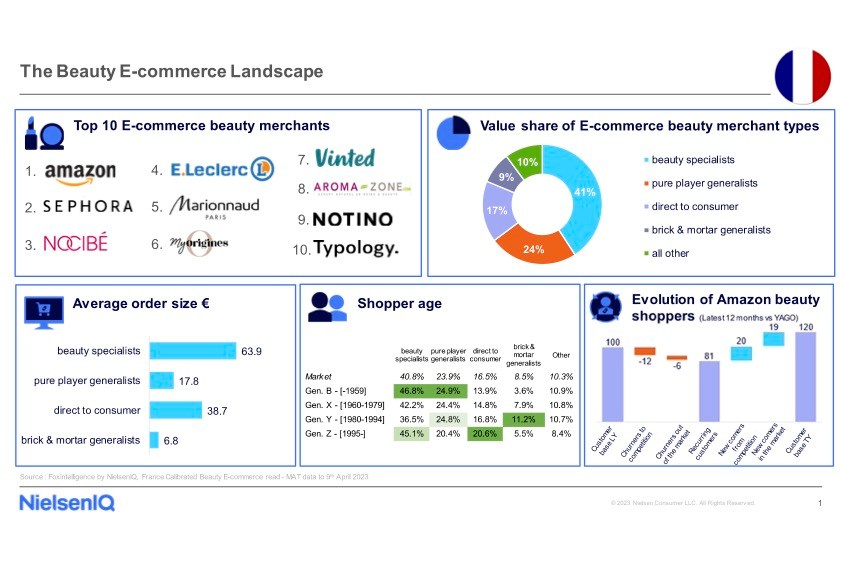
Retail-wise, people are increasingly turning to e-commerce to shop for beauty, according to NielsenIQ. In France, the top e-commerce beauty merchants are, in descending order, Amazon, Sephora, Nocibé, E.Leclerc, Marionnaud, MyOrigines, Vinted, Aroma-Zone, Notino and Typology.
By platform type, e-commerce beauty specialists have been generating the lion’s share of total sales, with 41 percent. That was followed by pure-player generalists, with 24 percent; direct-to-consumer, with 17 percent; brick-and-mortar generalists, with 9 percent, and “all other,” with 10 percent.
Regarding average order size, beauty specialists came in first, with 63.90 euros. It was 38.70 euros for d-to-c, 17.80 euros for pure player generalists and 6.80 euros for brick-and-mortar generalists.
“The beauty online sector is now a mainstay for consumers. The boundary between digital channels and physical stores is getting thinner and thinner,” said Claire Marty, vice president beauty vertical at NielsenIQ. “Manufacturers and distributors must understand these dynamics, and use online and offline levers to succeed.”