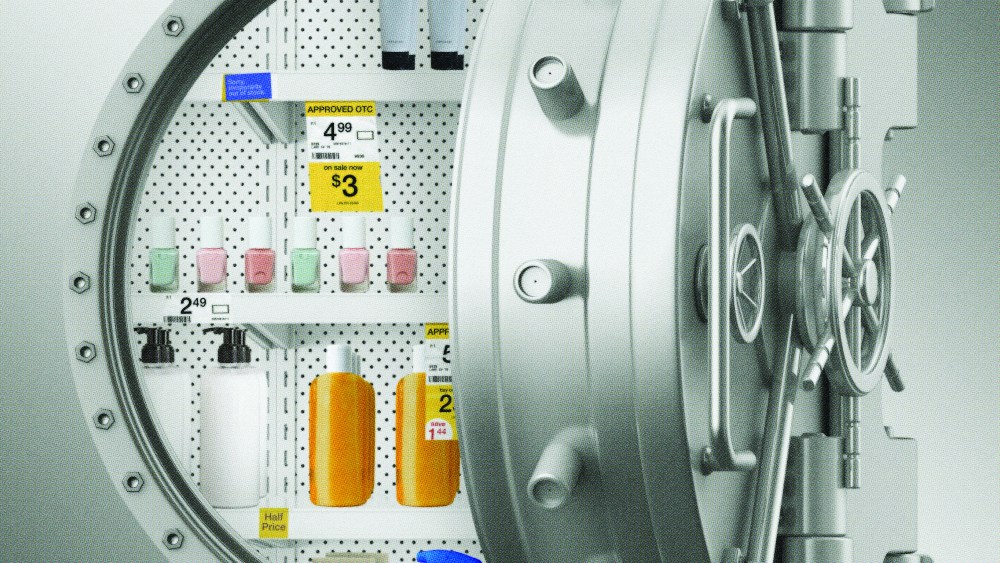
Personal care and beauty products under lock and key?
That is becoming increasingly common place in mass merchandisers and specialty beauty retailers across the country, with everyday items like body wash, shampoo and toothpaste safeguarded securely behind locked plexiglass windows in many stores and the likes of Ulta Beauty preparing to lock fragrance in cabinets in 70 percent of stores by the end of the year.
That’s because some retailers are reporting that inventory shrink — the difference between a balance-sheet inventory and actual stock that is often blamed on organized retail crime — is putting increased pressure on operating margins, with beauty being one of the most affected categories, in addition to electronics, video games, smart phone accessories, and power tools, according to UBS.
Related Articles

Most recently, Ulta cut its forecast for its operating margin from 14.7 to 15 percent to 14.5 to 14.8 percent, with chief executive officer Dave Kimbell telling analysts that “similar to what other retailers have shared, we continued to see pressure from inventory shrink this quarter and we have updated our full-year guidance to reflect the persistence of this trend.”
Target Corp., which is home to hundreds of Ulta’s shops-in-shop, has also highlighted the issue. In May, it said it expects inventory shrink will reduce this year’s profitability by more than $500 million compared with last year, while a number of other companies, including Walmart Inc., Walgreens and CVS, have highlighted the issue, too.
But as retailers grapple with how to deal with inventory shrinkage, it seems there’s more than one root cause.
Both Ulta and Target stressed that while shrink can be a result of a number of factors, they believe organized retail crime and theft are increasingly concerning challenges, with Ulta stating that it has seen “a rise in violence and aggression during these incidents.”
Then, in a recent note by UBS analysts based on their conversation with an anonymous former manager of asset protection and risk mitigation at a major retailer, the expert stressed that while a rise in organized retail crime, or ORC, has been a major driver of shrink, excessive focus on this “risks underestimating the magnitude of loss through the supply chain and in operations.”
According to the note, shrink was relatively stable pre-pandemic, but supply chain bottlenecks and redirected staffing over the last few years created a perfect storm for shrink to rise.
Although its figures have not been updated recently, the National Retail Federation’s 2022 National Retail Security Survey showed that while ORC was the biggest component of shrink in 2021, there were a number of reasons behind the trend.
When taken as a percentage of total retail sales in 2021, inventory shrinkage accounted for $94.5 billion in losses last year, up from $90.8 billion in 2020. External theft, including ORC, accounted for 37 percent; employee/internal theft 28.5 percent; process/control failures 25.7 percent; unknown loss 7.7 percent, and other sources 1.2 percent.
“The challenging piece is very few companies are giving you actual explicit figures,” said Olivia Tong, an analyst at Raymond James, noting the exception of Target which has provided more detailed numbers. “But it’s [shrink] becoming a bigger issue and it’s more violent.”
When it comes to organized retail crime, retailers have been tackling the issue in different ways. Kimbell, for one, has stated that “given the complexity, it will take collaboration across retail, manufacturing, law enforcement and legislative levels to solve these problems.” As part of its strategy, as well as the aforementioned locking up of fragrance, Ulta is also investing in security guards, and partnering with landlords to find solutions.
Target has stressed that it is investing to protect its team and guests, as well as installing fixtures to protect merchandise and adjusting its assortment in affected stores.
Walgreens, meanwhile, recently unveiled a newly designed store in downtown Chicago where apart from two aisles, all goods are accessed via a kiosk, although a spokeswoman stressed that this was more about testing technology.
“We are testing a new experience at this store with new concepts, technologies and practices to enhance the experiences of our customers and team members. It will continue to offer retail products and pharmacy services, just with a new look and feel that focuses on shopping digitally for convenience,” she said.
What’s more, during an earnings call in January, Walgreens’ global chief financial officer James Kehoe said the company may have previously overstated the situation.
“Maybe we cried too much last year when we were hitting numbers that were 3.5 percent of sales. We’re down in the lower twos, call it, the mid-2.5, 2.6 kind of range now,” he said. “And we’re stabilized. But we’ve spent a fair amount, and that could be one of the disconnects in SG&A. We’ve put in incremental security in the stores in the first quarter.”
He even stated that it may have done too much, but from the actions it has taken, it can see that law enforcement has been much more effective than employing security companies.
Whatever the reasons behind this trend, as retailers across the U.S. continue to face the issue to varying degrees, the UBS note suggested that AI should be part of the long-term solution.
“The expert believes that retailers must make substantial investments rather than spending minimally on solutions such as padlocks and off-duty officers that have already been in place for decades, and work with third-party providers that are at the forefront of leveraging AI and existing surveillance infrastructure to deploy innovative technologies that mitigate pain points and flag shrink risks,” the UBS note said. It added that RFID is an important technology that affords true item visibility that can address supply chain-related shrink.
Human intervention is vital, too, and increased staffing is needed as shrink monitoring technologies are only effective insofar as they flag risk, it said, but with reports of increasing violent incidents, this is a complicated issue for retailers.
Tong agreed it was a tough needle to thread in stores. “You are trying to minimize a disruption to the consumer experience while also protecting them and your product.”