
VICENZA, Italy — Despite improved sales and growth in emerging markets, some high-end Italian jewelry players said they will diffuse an uncertain outlook for precious metals and stones by raising prices in 2012.
Exhibitors at Vicenzaoro’s winter fair, which ended its six-day run here Jan. 19, totaled 1,395, equal to last year, as the nation’s economic turmoil continues to weed out small and medium-sized Italian businesses that make up the backbone of the euro zone’s third-largest economy.
After peaking in 2011, precious metal prices have stabilized and slightly declined. In September 2011, gold touched $1,900 an ounce, and by the end of last year, had settled above $1,600 an ounce, a report released by Vicenzaoro said. As of Friday, gold was trading at $1,732 an ounce.
Related Articles
“The key focus will be on headwinds from raw material inflation and currency,” Nomura Equity Research said in a recent note, commenting that mega-players like Compagnie Financière Richemont SA have significant pricing power, which will help them face market volatility.
You May Also Like
Stefano Solaro, chief executive officer of Leading Italian Jewels, the Italian holding company that is controlled by India’s Gitanjali Group and houses the Stefan Hafner, Nouvelle Bague, Valente Milano, Io Si, Porrati and Giannti brands, said that the company will raise prices about 5 percent this year. That follows a 20 percent price hike in 2011.
Sales for Leading Italian Jewels rose 15 percent in 2011 from 2010, driven by strong sales in new markets like Malaysia, the Philippines and Vietnam.
“The U.S. and European markets are slow. New markets are offsetting losses in the U.S. and Europe,” Solaro said.
At Fope, a family-run company that is known for its upscale, bejewelled gold and silver chains, gold still remains its top seller. The firm hiked prices 8 to 10 percent in 2012 from 2011, despite the fact that sales rose 45 percent in 2011 compared to the previous year.
“Final consumers know that gold prices have risen and they are conscious in a difficult market,” said Michele Chiappone, U.S. sales director. “They see gold as a good investment.”
Fratelli Staurino said it posted a 30 to 40 percent rise for the year, on the strength of holiday sales in the U.S., where the brand is sold at upscale retailers like Neiman Marcus.
“We hope not to raise prices,” Fratelli Staurino designer and co-owner Stefano Staurino said. “The real problem for us is diamonds. There are lots of factors affecting diamond prices, such as energy.”
He noted diamond prices rose 40 percent for the company last year.
Vicenza-based upscale jeweler Roberto Coin echoed Staurino, saying that at the moment he plans to hold prices steady in 2012.
“We hope the situation stabilizes even more,” Coin said, noting sales increased 30 percent in 2011 versus 2010. Revenue was driven by growth in Russia, the United Arab Emirates and the U.S., where the brand is carried in stores like Saks Fifth Avenue, Bloomingdale’s and Neiman’s.
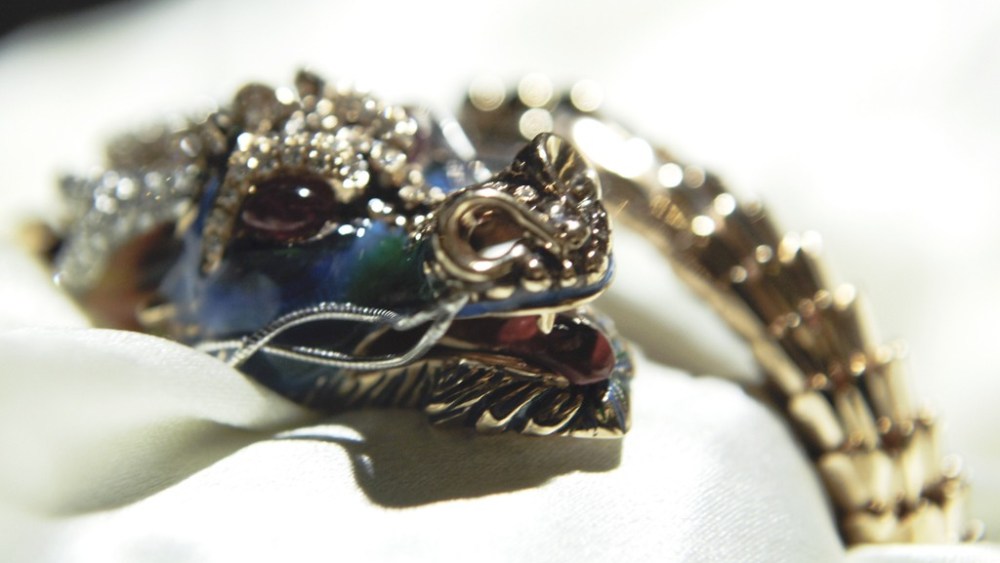
To usher in the Chinese Year of the Dragon, the company showcased its limited edition Dragon collection, which features rose and white gold bangles with colorless diamonds, rubies and intricately painted enamel. Already sold out in China, Coin will present the same collection to the American market in April. Coin’s winter collection featured a menagerie of styles ranging from turtles to black bears snacking on salmon. All designs are ensconced with precious stones like black, yellow and white diamonds, as well as rubies and sapphires.
Exotic, fantastical animals and nature scenes were also paramount at Fratelli Staurino, which rang in 2012 with an array of nature-inspired designs like dragonflies, swans and the ocean floor. Staurino also presented its Moresca collection of spiderweb cuffs and rings made with rose gold, white and black diamonds, rubies and rock crystals.
Stretch silver and gold were key at Fope, where elastic bangles of silver and palladium were embellished with diamonds.
A strong artisan heritage is what Coin believes is the key to his success. As smaller Italian companies close, he noted, larger brands are moving in and consequently cramping the handmade tradition that makes Italian jewelry so unique.
“Big brands want to dress women the same way,” Coin said. “We would like to dress every woman differently.”