
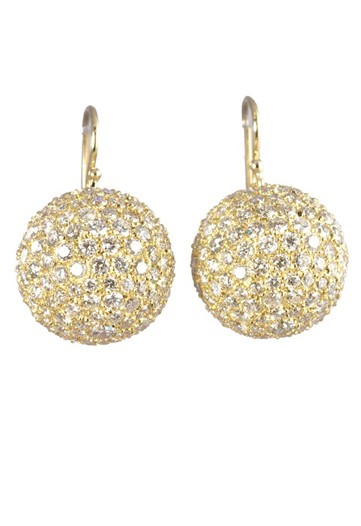
The jewelry industry is scrambling to adapt as the price of gold hits new peaks.
With economic uncertainty high and interest rates at historic lows, investors have sought refuge in the precious metal, which has risen almost 23 percent this year. Gold is selling for well north of $1,300 an ounce — a record $1,364.97 on Thursday — and closed at $1,345.30 on Friday. That compares with $1,271.68 on Sept. 30 and $997.04 the same time last year. Five years ago, the price was near $456.
“Until investors’ fears are allayed and interest rates pick up, gold prices look set to test these highs,” according to a commodities research report from Barclays Capital last month.
Related Articles
The surge in gold has forced jewelers to turn to lower-cost metals such as brass and copper, adjust with designs that require less of the precious metal and expand the use of cheaper mixed materials such as a combination of gold and sterling silver called “gilver.”
You May Also Like
Lowering the price of fine jewelry by incorporating silver is no longer full-proof as silver hit a high last week, of $23.52 and has increased 27 percent this year. Silver has more industrial applications than gold — for use in electronic devices like iPods and computers. As such, it’s seen as a “value buying opportunity” and is forecast to keep climbing, said Jim Wyckoff, a senior market analyst for Trader Planet.
“When the [gold] price goes up this much, it’s sort of a numbers game,” said Jennifer Meyer, whose jewelry line retails from $100 to $40,000 and is almost entirely 18-karat gold. “You have to factor in the possible cost going forward. You can’t go back and forth [with retailers]. You can’t say, ‘Today my piece is $200…oh, now, today it’s $225.’ As much as you don’t want to change your prices, you have to keep your business going…the biggest challenge is sustaining the business while making your retailers happy, and trying to find balance, and being confident enough that when you have to raise prices, you have to raise prices. Unfortunately, there’s no other option.”
Meyer is reluctant to cut back on gold weight or quality. “When people are spending a certain amount, they like it if a piece is heavy, if it feels substantial,” she said.
An NPD Group Inc. Consumer Tracking Service report for the year ending in August calculated a 10 percent decrease in all jewelry purchases, compared with the same year-ago period. The researchers said $18.6 billion worth of jewelry had been sold in the period, 75 percent in fine jewelry. In unit sales, lower-priced fashion jewelry declined 8 percent year over year, compared with fine jewelry’s 11 percent drop.
Retailers got more encouraging news in September same-store sales results, when Saks Fifth Avenue, Neiman Marcus, Macy’s and J.C. Penney reported robust fine jewelry volume and luxury stores gained amid forecasts that wealthier consumers want to buy holiday gifts that have lasting value.
Mary Brennan, owner of a namesake better contemporary fashion accessories showroom, said her challenge began almost three years ago, when gold reached $800 an ounce and “the bottom fell out of my industry.” Brennan found “the only way to stay in the game is to do brass.…With manufacturers taking such low margins, people had to reinvent their whole collections.”
Jewelry designer Diane Yang, a Brennan showroom client whose popular gold chandelier earrings once wholesaled for $100, now relies on small initial necklaces that wholesale for $5 to $32. The earrings, Brennan said, “were intricate…there was great workmanship, but it got to a point a few years ago, I couldn’t give them away…everybody has been humbled in the contemporary market.”
Yang said she tweaked her business strategy to deal with the recession.
“When the economy was going down, people weren’t able to spend $300 to $400 at retail, so I had to come up with something to replace all that high-end merchandise…I ended up plating brass, in an ‘easy, instant-gratification price range,’ under $50 [retail]. For me, that was a smart business move.”
Designer Melissa Joy Manning, whose line sells from $150 to $8,000 retail, said she is relying on more circle details within chains, reducing the amount of gold she uses. In addition, she is incorporating more mixed metals in her designs.
“It’s a learning curve, figuring out what people want to see in the mixed metals, and what they don’t,” she said.
Henry Dunay, who had been in business more than 50 years when he filed for Chapter 11 bankruptcy protection last year, said his firm was partly a victim of the spike in gold. Dunay reopened this month in Manhattan, under a new name, HDDI, and in a space one-eighth the size of his previous location. He now incorporates metals such as brass and copper in an effort to better control his prices — though his jewelry still retails for $3,000 and up.
“I made a lot of wonderful wide bracelets but…all of a sudden the heavy gold bracelet came out of style because of the price,” he said.
Yossi Harari prefers to see the high price of gold as a positive development, saying, “Consumers are much happier with their investment.” But that hasn’t stopped Harari, whose line was originally crafted in only 24-karat gold, from using the mixture of sterling silver and gold to provide lower-priced options.
“When you have a crisis that really moves you to find solutions, it really just adds value to the collection….the same bangle, made in 24-karat gold, made in gilver, is around 80 percent less expensive,” he said.
Joanne Teichman, co-founder of online fine jewelry retailer Ylang23, has continued to embrace gold and recently began selling Paul Morelli and Lucifer Vir Honestus, who primarily work with precious metal. “We…pursue the luxe customer in designer jewelry who has the sophistication and means to buy the most original new collections,” she said.
The rising price of gold has compelled jewelers to market themselves in different ways. Environmentally conscious fine jewelers Kimberly McDonald and Pippa Small, who both price designs from about $1,500 to $50,000 at retail, add buying incentive by using recycled and fair trade gold. The fair trade designation means that during mining the metals are not separated with arsenic or cyanide, and that the mercury involved in the process is disposed of properly, tacking on a 10 percent premium.
Small said her first fair trade-certified collection sold out. “There’s so much to be said about the perceived value in jewelry…and all these different ways of working with jewelry to change people’s perception of what jewelry is about.”
The rush to gold has been so strong that J.P. Morgan reopened an underground storage vault in New York that was last used almost 20 years ago, according to the Financial Times, and Deutsche Bank and Barclays Capital are considering opening new vaults in London.
There isn’t complete agreement on the longer-term future of gold prices. Some experts see it soon climbing to as much as $1,500. At the annual London Bullion Market Association conference last month, more than 200 commodities analysts forecast gold would hit $1,406 by next September.
Barclays Capital predicted the price will start to decline after next March to $1,225, and drop to $1,010 in 2012. Barclays analyst Suki Cooper said the prediction was partly based on anticipated increased confidence in the economy.
Cooper said she believes consumer demand will increase over the next year because “the interest is still there, and they become more comfortable at these higher prices.”