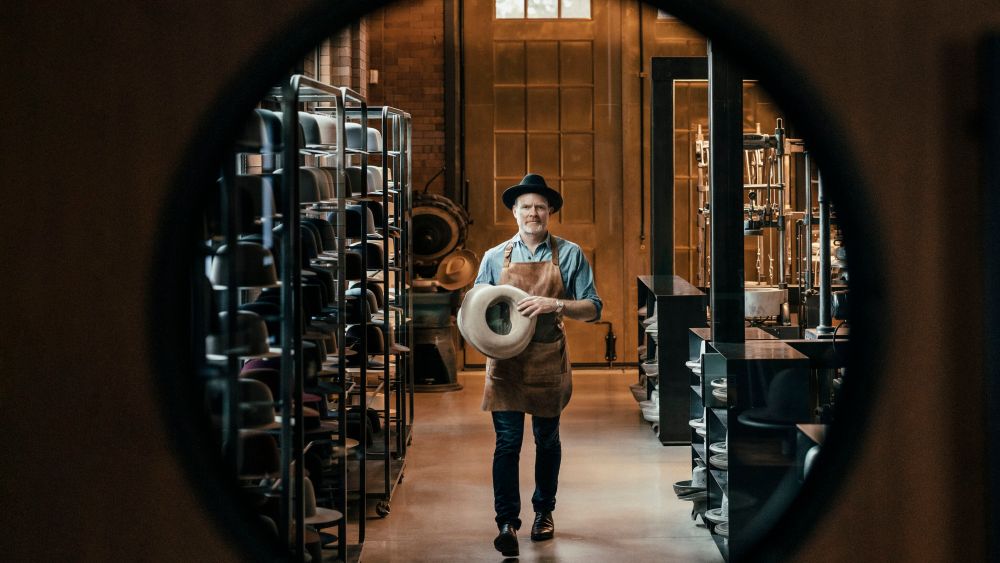
Graham Thompson is an old soul.
Whether it’s classic movies, vintage cars or cigars, the founder and owner of Optimo, a Chicago-based bespoke hatmaker, has always been a fan of what he calls “Old World stuff.”
It was this love that ultimately led him to his life’s work, reviving the lost art of fine hatmaking. Since he founded his business in 1996, Thompson has created chapeaus for musicians, artists, entrepreneurs and regular people who appreciate quality and craftsmanship.
Related Articles
A visit to his shop on Chicago’s South Side is like stepping back in time. His workshop is located in a 7,700-square-foot firehouse that he purchased for $1 in 2015 when it was being decommissioned by the city. He hired Skidmore Owings & Merrill to renovate it and it won a Design Excellence Award in 2018.
You May Also Like

The space is essentially a working museum of hat equipment that dates back to the turn of the century. Thompson scoured the globe for each machine and can recite the history of each piece as well as its distinct place within the hatmaking process.
Because Thompson uses techniques invented in the late 1800s, much of today’s modern machinery is unable to achieve the quality he insists upon. So he is constantly on the search for old factories that are closing or collectors willing to part with their stash to find just the right machine for each job.
Creating a bespoke hat requires dozens of steps, starting with the felt bodies that Thompson sources from Fespa in Portugal, a company he believes is the finest in the world. When the hats arrive in Chicago, they are stored in a climate-controlled cellar until they are ready to go through Optimo’s rigorous process.
The first step is blocking, where a hat body is clamped, stretched and steamed. Next is baking the bodies in a chamber of steam with circulating hot air, a process known as decatizing. This renders the size and shape more exact and permanent.
The hats are left on racks to settle before being brought into the finishing room, where the true art of the process begins. Most hats are finished smooth, requiring shaving and polishing of both the crown and brims. Different tools and machines can also achieve special, more exotic finishes.
The hats are then placed in a blocking machine before they undergo a trimming process where the sweatband, linings, ribbon and edge treatments are added.
After trimming, the brims are given their distinct shape through a process called flanging, where any flaws or inconsistencies are identified and rectified before the hat is completed and presented to the customer.
With this labor-intensive process, it’s no wonder that the prices of Optimo’s hats average around $1,500 and can go up into five figures.
Although the workshop has the ability to take on more capacity, Thompson only manufactures between 2,500 to 3,000 hats a year. “We would like to grow,” he says, but not at the risk of sacrificing quality. “We’re never going to be a big producer.”
Although he makes a variety of models, the most popular is the fedora, which represents some 80 percent of Optimo’s dress hat business. He’s also finding customers are being drawn more to straw hats, while western models also have their fans.
“I don’t like stuff that looks like a costume,” he says, adding that most other hats are akin to clip-on ties. “They’re pre-shaped and pre-formed and lack elegance. Part of the ritual of hat wearing is how you crease and shape it to reflect your personality.”
Thompson knows of what he speaks. His path to hatmaking began when he was 16 and started scouring Chicago’s men’s stores for a fine hat like the ones he’d see in old movies or on the album covers of jazz and blues musicians.
“I wanted to get a real hat,” he says, “but I couldn’t find one.”
His search led him to Johnny’s Hat Shop on the South Side, where he met Johnny Tyus, master hatter, and his life would never be the same.
Tyus primarily restored and renovated hats but also created custom hats for people as well as for films, including Robert DeNiro’s Al Capone hat in “The Untouchables.”
Thompson was hooked and started to work at Johnny’s Chicago workshop.
When he got out of college with a degree in international finance and Japanese, he returned to Chicago and found out that Tyus was planning to retire and close the shop. But Thompson talked Tyus into taking him on as an apprentice to teach him the skills and intricacies of the trade. He then cut a deal to buy the business, complete with the tools and client book, and pay it off over time.
“Johnny was a wonderful mentor and taught me the fundamentals,” he says. “When you buy a business like that, you need someone to teach you.”
Once he was confident in his abilities, Thompson struck out on his own. Today, in addition to the workshop on the South Side, Optimo operates a retail store in the Monadnock building in Chicago’s Loop where clients can stop in and see the latest collection or be fitted for a bespoke hat. For a custom hat, heads are carefully measured and kiln-dried timber is crafted into two separate molds that are then kept in the workshop for future orders.
Thompson’s story was chronicled earlier this year in a coffee table book titled “Optimo: The Art of the Hatmaker” by Danish publisher Forlaget Ehrhorn Hummerston. In the foreword, Justin Hummerston and Morten Ehrhorn write that Thompson’s hats “are so intuitively beautiful, you instantly feel naked not wearing them — even though you have never worn a hat in your life.”
They describe Thompson’s “relentless ambitions of resurrecting a lost quality of hats. Many manufacturers stare into the future, looking for potential technologies to improve their product today. Graham’s glance is aimed at the past.”
The book features a section on the Golden Age of hats, which was in the early part of the 20th century. It was 1914 when per capita hat sales peaked in the U.S., but when the automobile was introduced, people spent less time outdoors and more time driving around, reducing the need for hats to protect them from the elements. Thompson believes the greatest hats were created in the 1930s and ’40s when manufacturers competed on quality. But as sales declined, so did quality, with producers focusing more on price. It was this period when pre-shaped hats came into the market, which were cheaper and more disposable.
That’s something that will never happen at Optimo, even if Thompson is lured into expanding his business.
“We might grow two to three times larger, but we want to stay on principle,” he says. “We’ve spent 25 years in research and development and have built a wonderful clientele. We’re still under the radar, but we’re ready for more awareness of our brand.”