
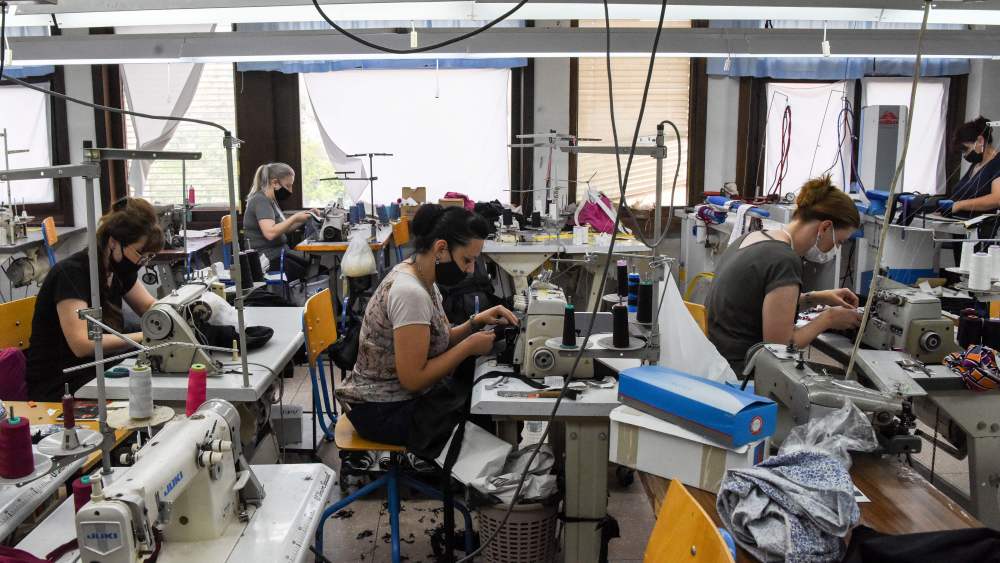
By their powers combined, a collective of programs supporting the women who support the supply chain is seeking to advance conditions and opportunities for those workers.
Taking a page out of the playbook sustainable fashion could stand to reference more often and merging efforts instead of operating each organization for itself, BSR’s HERproject, Gap Inc.’s P.A.C.E., CARE and Better Work came together in March to form a new initiative dubbed RISE: Reimagining Industry to Support Equality.
Related Articles
The aim is to scale their collective impact and push forward faster when it comes to equality for women. Particularly since, according to the International Labour Organization, nearly 60 percent of garment workers globally are women, and in some places, that number reaches as high as 80 percent.
You May Also Like
When Gap Inc.’s P.A.C.E. (personal advancement, career enhancement) program started 15 years ago, it was at the forefront of efforts to give women garment workers more than just jobs. Since then, the program has been able to reach 1 million women and girls, and the goal is to raise that number and expand that reach.
At its heart, P.A.C.E. is a life- and work-skills curriculum that covers things like problem solving, decision making, financial literacy, women’s health, water, sanitation and hygiene, according to Sally Gilligan, Gap Inc.’s chief supply chain strategy and transformation officer, who spoke at WWD’s recent Sustainability Forum, “Scaling Solutions.” Gender-based violence modules are part of the learnings now, too.
“Knowing that we have women throughout the supply chain around the world who have generally been subjected to gender-based violence, inequalities, all the different factors of workplace barriers and limitations on what they’ve been able to do — I think we’ve had countries where women haven’t been able to open their own checking accounts. We looked and said, based on women being the core of our business, we felt an obligation to do more, and particularly around some really basic life skills,” Mark Breitbard, president and chief executive officer of Gap Brand, said of the catalyst for starting P.A.C.E. “We set really ambitious targets about the number of people we want to get through. We have had tremendous partners but, essentially, we want to turn this into kind of open source and to open it up and build partnership to scale it. That’s where we see the next frontier.”
While the program is designed to help workers, Gilligan said factories have embraced the program for its benefits to the workplace as well. “The efficacy is actually held over within the factories, meaning lower absenteeism, less turnover, higher productivity,” she said.
When women in the program said they wanted to extend the curriculum to their daughters, Gap Inc. widened its reach to girls ages 13 to 17. And it has even partnered with countries for scale, including Cambodia and Indonesia, where P.A.C.E. is part of their public school systems. Other brands have also been able to tap in and benefit from local trainers who teach their workforce of interested women.
“One hundred percent of our strategic factories will invest in the P.A.C.E. program and reaching at least over 50 percent of the women that work in those factories,” Gilligan said. “And that’s really what encouraged us also to reach out and partner and to begin to scale it across the industry, which is what brought us to RISE.”
While RISE may be a start-up, it’s a start-up with 15 years of legacy, according to Christine Svarer, the new program’s executive director.
“It’s bigger than P.A.C.E., it’s a legacy that’s already built on the work of many brands, many buyers, many factories, many manufacturers and we’re ready to go further,” she said. While “further” would ideally include getting all brands, buyers, retailers, manufacturers and suppliers on board, Svarer said, the primary focus for RISE boils down to some key things.
“We are all aware that there are systemic barriers that require systemic solutions,” she said. “There are three simple reasons why as RISE we think we can create much greater impact than any one single program can do on its own: We want to remove duplication; we want to leverage each other’s strengths…we’ve got this nugget that there’s an opportunity to insert here and scale, and then thirdly we have an opportunity to speak with one voice and that consistency is important when we seek to influence — not just directly support workers but influence markets and policy more broadly.”
Where RISE will outpace P.A.C.E. is also how deep into the supply chain it hopes to go.
“The ability to go past our tier-one vendors or large-scale vendors that produce the clothes in our stores, when we can scale with RISE and reach deeper into the supply chain, we can go into yarn spinners, into mills and really expand the program,” Breitbard said. “So, I think that’s what we’re really excited about.”