
Each year, more than 60 percent of textiles produced globally are made from blended fibers, yet less than 1 percent of these materials are effectively recycled.
The issue stems from the source, of course.
Mixed-fiber textiles consist of, at minimum, two different polymers — think of cotton and polyester or nylon and Lycra. When these respective polymers are woven together during fabric formation, they inseparably intertwine in a way that doesn’t compute with current capabilities.
Related Articles
Take mechanical recycling, for example.
You May Also Like
Frontiers published an article from the German Technical University in Dresden that said mechanical recycling is not suitable for mixed-fiber textiles. The authors, faculty of the institute’s mechanical science and engineering department, reported that the more dominant method, aka mechanical recycling, uses a downcycling approach to recycle single fiber textile waste — meaning that it produces materials with limited utility, often restricted to applications like industrial fillers or insulation, per the publisher of peer-reviewed scientific articles; mechanical disintegration is unable to separate and recover individual polymers from the intertwined, heterogeneous microstructure of blended textiles.
As such, mechanical recycling isn’t possible for mixed-fiber waste, according to the journal. Plus, most other traditional technologies — think chemical, thermochemical and enzymatic methods — have historically struggled to effectively process mixed-fiber textiles due to technical and economic limitations.
The Lycra Company and lingerie brand Triumph have teamed with Bergamo, Italy-based RadiciGroup on a new recycling process specific to mixed-fiber textiles. The Italian synthetic fiber manufacturer’s latest effort can treat mixed textile waste and recover both nylon and Lycra fibers to use and spin “new” duds.
The collaboration addresses a long-standing challenge for the circular economy, as garments made from blended fibers — namely, those featuring the classic nylon-and-elastane mix — are notoriously more difficult to recycle. Plus, the process is reportedly equally economical as it is an environmentally sustainable, closed-loop system.
“This innovative project highlights the role that elastane can have in helping to advance circularity in the apparel industry,” said Nicholas Kurland, product development director of advanced concepts at The Lycra Company. “Working closely with Radici InNova and Triumph, [we] demonstrated that Lycra fiber can retain their renowned stretch and recovery performance — providing comfort, fit and ease of movement — even when reintegrated into the spinning cycle.”
The process itself was developed by Radici InNova, the Italian firm’s research and innovation arm centered around circularity, based on selective dissolution technology. And that internationally patented chemical recycling process uses nontoxic, non-flammable solvents, according to the group. This selective dissolution technology can separate and recover both Lycra elastane fiber and nylon (aka PA6 and PA66) from blended textile waste, regardless of the proportions of each material used in the final matrix.
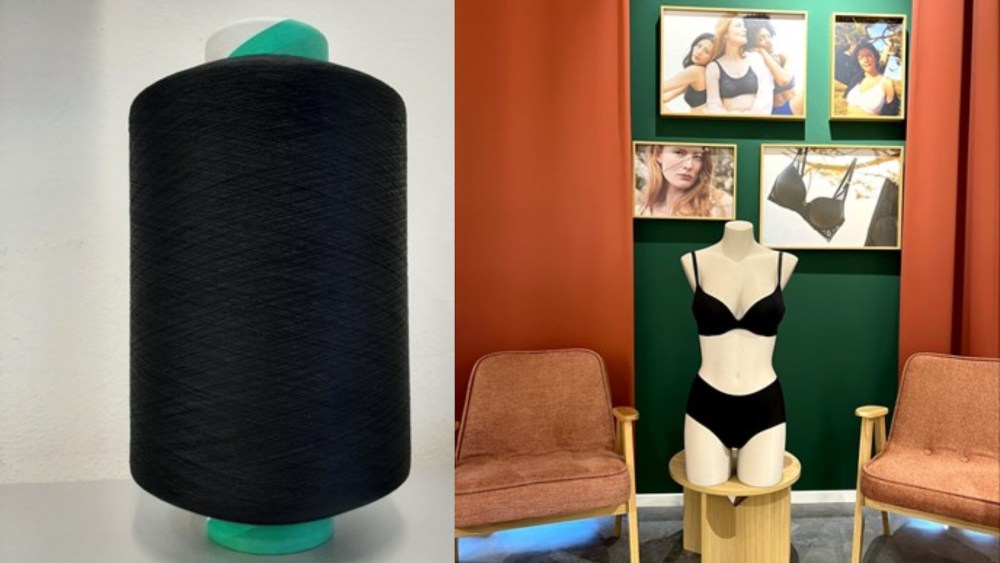
As with the prototype, which used these recycled yarns — in this case, specifically Lycra fiber and Radici Group’s Renycle — to create a 60-meter black fabric, Triumph turned it into a coordinated lingerie set.
The project behind the prototype, meanwhile, began four years ago. After the initial development phase, subsequent tests were completed, and the next step was to demonstrate the feasibility in practice, per the partners. So, Triumph shared some surplus: a fabric containing 16 percent Lycra fiber. From said material, Radici InNova recovered both its Lycra fiber and its nylon fiber. The former was re-spun by Lycra, while RadiciGroup processed the latter to produce its regenerated Renycle yarn.
“Thanks to this project, textile recycling enters a new dimension — demonstrating for the first time that it is possible to recover fibers from mixed fabrics and reuse them to produce new garments,” said Stefano Alini, chief executive officer of Radici InNova. “This is an unprecedented innovation that opens up revolutionary development opportunities for the textile industry.”
Looking ahead, Triumph wants to drop a capsule collection and support the circular economy by pursuing solutions for concepts like traceability and product identification. In doing so, garments would theoretically stay in circulation longer — therefore out of landfills and, instead, into a relevant recycling stream.
“Being part of this project strengthens our belief that circularity for garments made from mixed textile fibers is possible,” said Vera Galarza, global head of sustainability at Triumph. “We are proud to help turn this vision into reality.”