
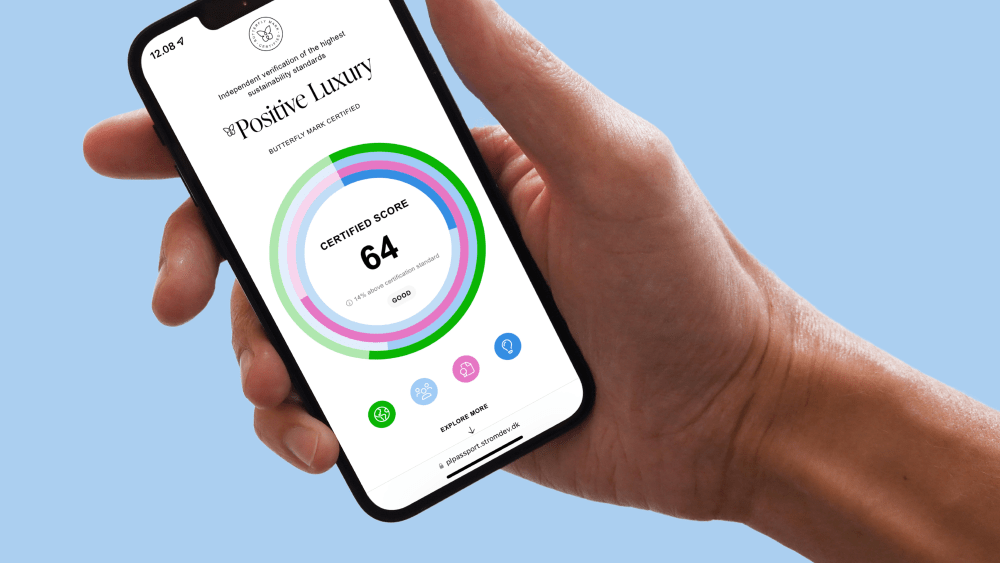
The newest version of Positive Luxury’s sustainability assessment Butterfly Mark takes flight this week, with additional details to put a company’s ESG status under the microscope.
The Butterfly Mark was launched a decade ago as a score and stamp of approval that a brand’s sustainability standards were vetted. A new platform is emerging that enables consumers to have more detail and transparency about what exactly those performance scores, certifications and targets mean.
With the new Connected Butterfly Mark, accessed via a webpage widget, QR code or an enabled tag in store, brands can do a deep-dive into their sustainability journey, explain the structural or supply chain changes they have made to reach these targets, or lay out new targets and key milestones and explain their roadmap to achieve them.
Related Articles
Tom Ford Beauty, Smythson, Anya Hindmarch and Etro are among the first brands to sign up for the new system.
You May Also Like
The new technology is not only a way for companies to track their own numbers, but Positive Luxury links their performance data with external metrics, benchmarks and tracks improvement over time to be able to provide context to consumers.
It also adds an education component for consumers, which can explain what a certification or technical term means and put in perspective why it matters. Positive Luxury calls the new system “holistic certification.”
Diana Verde Nieto, cofounder and chief executive officer, said the idea of awarding broad, static “scores” is outdated. “It doesn’t mean anything,” she said. “More and more the community really wants to understand specifics from an ESG perspective. A blended score doesn’t allow the wider stakeholder groups to identify if you are actually a business that has innovation and sustainability at the forefront.”
Certifications are “essentially a report card of what you’ve done in the past 12 or 24 months — sort of a backward-looking perspective,” added co-CEO Amy Nelson-Bennett. “There’s some value in that, but it doesn’t put the responsibility on you completely as a company to figure out how you’re going to use that going forward.”
Positive Luxury looks at a company’s overall impact in everything from the supply chain to the use of pesticides, procurement to labor practices from tier one to tier three suppliers. In the governance and innovation sector, they examine how companies are handling social issues attributed to climate change, as well as women’s equality and worker’s rights and how they are impacted.
Transparency and verifiable information are becoming business basics, Nelson-Bennett said.
“With increasing research, feedback and data, consumers are trying to align their behaviors to ethical company practices,” she said, and have raised their expectations for clear information. Those demands are coming from all sides, she added. “Companies are coming under increasing pressure from legislation, from their consumers and from their employees who only want to work for organizations whose values are aligned to their own.”
The duo noted that in their home base of the U.K. that means not only the Competition and Markets Authority examining companies’ greenwashing claims, but noted it is also the first country to adopt the Switzerland-based Financial Stability Board’s Task Force on Climate-related Financial Disclosures reporting standards which will come into play in 2023.
As consumers, investors and employees become more knowledgeable about ESG, they expect fact-based information, and the “intention gap” of conflicting values and purchases is closing. A company’s sustainability credentials impacts consumer perception of a brand more than 70 percent across age groups, according to Nelson-Bennett.
“The sort of soft, fluffy language around this hasn’t really helped consumers know what to believe and what not to believe,” said Nelson-Bennett. “But those days are numbered now.”