
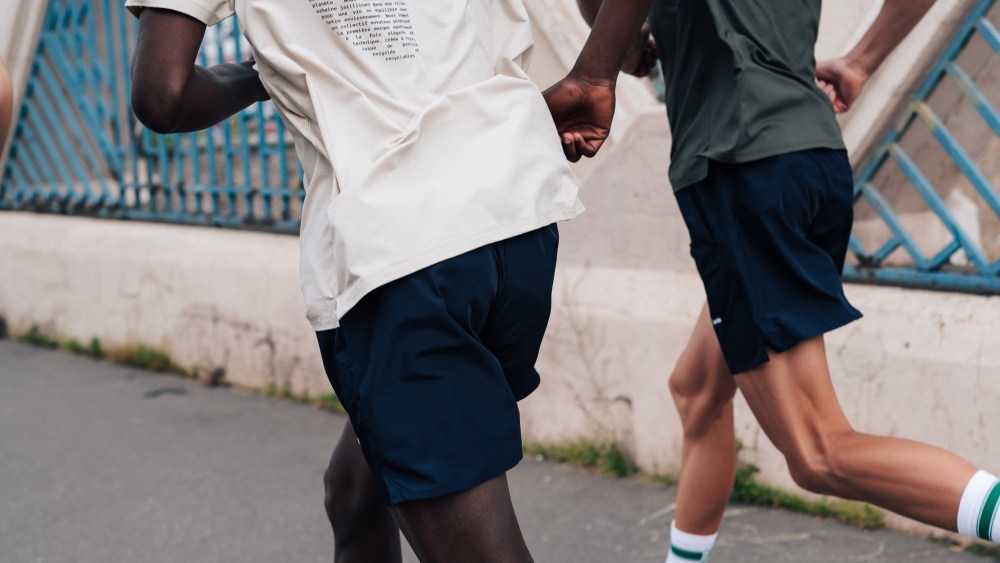
PARIS — French sustainable label Circle Sportswear has raised 2.5 million euros of funding, the company revealed this week.
The investment is earmarked to expand the team with experienced profiles in marketing and sales; accelerate its development of the wholesale business and expansion in new markets, such as the U.S., and continue materials research and development, especially on plant-based fibers.
After working for five years at L’Oréal in various positions from human resources to buying, and founding cloud-based talent platform Yoss, later sold to human resources firm Adecco, cofounder Romain Trébuil wanted to bring together his desire to work toward a circular economy and a personal passion for sports.
Related Articles
Launched via community fundraising platform Ululule in March 2020, Circle Sportswear hinges on Trébuil’s idea that “sportswear is everywhere but everyone is doing the same thing, manufacturing in Asia from petrol-based materials,” he said.
You May Also Like
“The lockdown was an accelerator for the values that we support. People started looking closely at where clothes they are wearing were made and by whom, in the same way they did for food,” said Trébuil, who launched the brand with Alex Auroux, formerly general manager of health club aggregator Classpass, and Solène Roure, a designer who has worked for the likes of Hogan, Alexander McQueen, Nike and Lululemon.
Products are developed with performance in mind and tested by some of the 30 high-level athletes who are in the brand’s orbit, such as French Paralympic tennis player Stéphane Houdet, who won gold in the doubles at the 2020 Toyko Olympics, and ultra-trail specialist Stéphanie Gicquel, who was the first French person to run a marathon around the North Pole. “There’s bit of pressure when you hand someone like that a prototype of your leggings and they take off for a 24-hour run to test them out,” remarked Trébuil.
Interest from consumers was strong: within 48 hours of launching the six-week preorder campaign, the initial 200 orders the brand wanted to garner were filled. By the end of it, they had 600 preorders. A first round of investment, in the first quarter of 2021, yielded a million euros from business angels.
Two years on, the company posted a 300,000-euro turnover in 2021 and is aiming for the 1-million euro mark in 2022. “We’re aiming for strong growth backed by our sustainability and circularity credentials because that’s how we’ll have the greatest impact,” said Trébuil, pointing out that 20 percent of its business was already done internationally.
Among the investors of this second funding round are London-based venture capital fund AA & Sons, founded by Romain Afflelou, a scion of the French eyewear retail empire Alain Afflelou; the Bpifrance state-owned investment bank, as well as individual investors.
“We wanted business angels that could support us on specific angles,” he said, naming Déborah Janicek, who was formerly president of shirting specialist Figaret and general manager of contemporary label Pablo; Chantal Barrat Duc Dodon, whose track record includes sustainable footwear label Melissa and circular-economy projects; Arthur de Soultrait, founder of menswear brand Vicomte A, and Sébastien Borget, a cofounder of The Sandbox. Others hail from the tech and sports sphere.
In the next few months, Circle Sportswear’s product line will be expanded from 30 to more than 90 stock keeping units, and the brand will make its first steps with retailers, launching at Le Bon Marché in late April before heading to La Samaritaine and Galeries Lafayette Haussmann, in a new sports-centric space, from July.
Further on the horizon, the development of the brand in new territories is slated for 2023. Ahead of a full launch in the U.S., the brand has already signed a partnership with SoulCycle. Putting the newly developed materials in consumers’ hands is the best way to convince them and drum up interest, Trébuil said.
But making and selling products isn’t the largest part of the challenge ahead. Material development is. As it stands, the company uses regenerated materials such as Econyl polyamide and Newlife polyester, or organic-certified lyocell, which is made from wood fibers.
At the end of their life cycle — although very few products have gotten there yet, he admits — items can be returned to the brand, which then takes the back to its factories to be disassembled back to threads that can be reused for new products, except for the recycled elasthane, which cannot be reused and is transformed into insulation material in buildings. Still, avoiding consuming resources at each step “all adds up,” he said.
But the French sports label wants to take it one step further, replacing any recycled petrol-based materials with bio-based alternatives. It doesn’t plan on making any discoveries the company makes proprietary, either. “If we have a positive impact on the environment, say with a fiber that doesn’t give off any microplastics, that’s great. But our goal is to create solutions for ourselves and other brands. If tomorrow, it’s Balenciaga, Decathlon or Nike, it’s great. They have a very large impact so if their products are environmentally better, we’ll be glad to have contributed because it means that we all win,” he said.