Vietnam’s apparel industry is growing greener with a new initiative designed to improve water quality and energy use in the Southeast Asian nation, which has been notching market-share gains of more than 10 percent year-on-year at the expense of China and whose clothing exports are forecast to hit $35 billion by year’s end and $50 billion by 2020, according to research and investment firm Dezra Shiran & Associates.
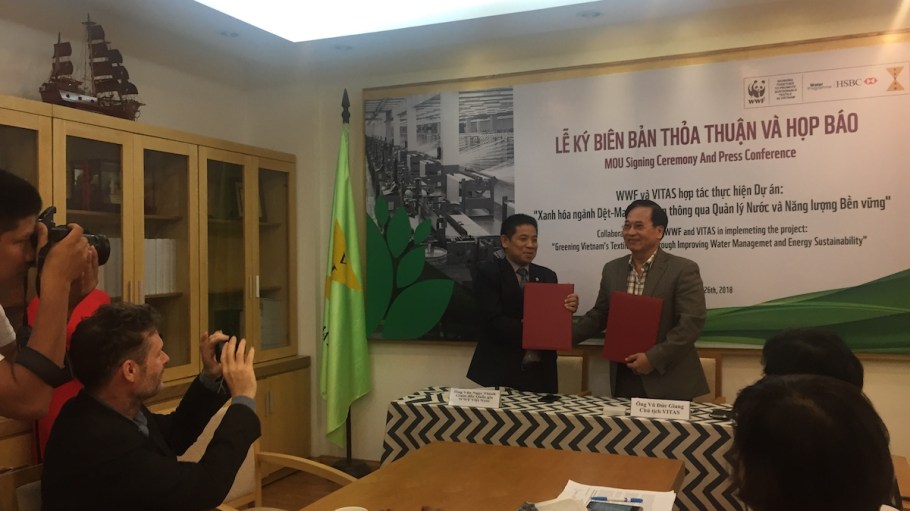
A collaboration between the Vietnam Textile and Apparel Association (VITAS) and the World Wildlife Fund (WWF), “Greening Vietnam’s Textile Sector Through Improving Water Management and Energy Sustainability” will engage a raft of stakeholders in the sector to promote better river-basin governance as part of a larger drive, sponsored by global banking giant HSBC, to boost sustainable textile manufacturing in China, Bangladesh, India and Vietnam.
Related Stories
As the cost of making goods in China climbs, a growing number of multinationals have been flocking to even more distant shores, including Vietnam, which is sometimes hailed by Western investors as “the next China.” Compared with $120 a month for a 40-hour workweek for even unskilled workers in China’s port-adjacent coastal provinces, factory workers in Vietnam earn as little as $50 a month for a 48-hour workweek (Saturdays included).
Still, Vietnam’s apparel and textile sector is among its most economically essential, contributing 15 percent of the country’s total exports and employing 3 million people across 6,000 factories, VITAS said.
Though the country isn’t known for its robust social and environmental governance, VITAS admitted garment production’s “significant impacts” on water resources, energy consumption and greenhouse-gas emissions could spell its industry’s potential doom. To wit, it must adapt to a hotter and thirstier planet—or perish.
“Vietnam ranks as the fifth-largest exporter of apparel goods in the world, but our industry is more famous for low-cost production with limited environmental standards,” Vu Duc Giang, chairman of VITAS, said in a statement. “With customers worldwide now more conscious about the environment, this is forcing a lot of global brands to change their operations to include higher environmental and social standards. If we do not change our practice now, Vietnam could lose its competitiveness. That is why this project is so important and timely.”
The project with WWF, which will run through 2020, will focus on the Mekong and Dong Nai deltas in areas around Ho Chi Minh City, where more than half of Vietnam’s apparel factories reside. Besides encouraging garment manufacturers to be “more active river stewards,” practice sustainable energy planning and rally around long-term sustainable investments and development in the sector, the project also will engage Vietnam’s foreign textile investors, such as the China National Textile and Apparel Council, to share “their own lessons” and support a pivot, Vu said.
“For WWF, greening the textile sector in Vietnam is also a means to achieve our wider goal of addressing river governance and energy sustainability, which are top global environmental concerns,” said Marc Goichot, program advisor at WWF-Greater Mekong. “In the long run we want to see factories, industrial parks and other actors come together to take more proactive collective actions to address risks and impacts beyond their factory fences and more responsibly manage shared resource uses across sectors.”
Goichot said similar endeavors in WWF’s past, including its recent efforts with H&M to clean up the Yangtze River in China and the Ganges-Brahmaputra in Bangladesh, will stand the organization in good stead.
“With more than 10 years of working with the textile industries of top exporting countries as Bangladesh, China, India and Pakistan, WWF believes that we can help Vietnam to create a big positive change for the sector,” Goichot added.