ESG Outlook is Sourcing Journal’s discussion series with industry executives to get their take on their company’s latest environmental, social and governance initiatives and their own personal efforts toward sustainability.
Aarav Chavda is the CEO and co-founder of INVERSA—creators of Invasive™ Leather, an innovative, biodiversity-restoring, high-performance leather material created by removing harmful non-native species. Since its inception, INVERSA has grown to actively manage three destructive non-native species that plague the planet—the Lionfish, the Dragonfin and the Python—thus helping restore damaged ecosystems. Here, Chavda discusses why sustainability is not the same as regeneration.
Related Stories

Name: Aarav Chavda
Title: CEO and Co-Founder
Company: INVERSA
What do you consider your company’s best ESG-related achievement over the last 5 years?
I’m proud of how we’ve enabled the consumer to participate in biodiversity restoration in the easiest way possible, just by purchasing something they like and identify with.
Additionally, I’d say our business model is another notable achievement in terms of making the environment, biodiversity and our ecosystems more resilient. Our model inherently scales the removal of invasive species, which cause $423 billion in damage each year and 60 percent of species’ extinctions. We partner with locals on the front lines of these invasions to structure supply chains and economies around the removals, which allows these communities to earn livelihoods while protecting their precious resources and home environments.
We’d like to differentiate between sustainability and regeneration. Sustainability is fine, but regeneration is a better way to tell a story because you are making something better, regenerating, not sustaining the same level of whatever the status quo is. Our ecosystems need rebuilding, not maintenance.
What is your company’s latest ESG-related initiative?
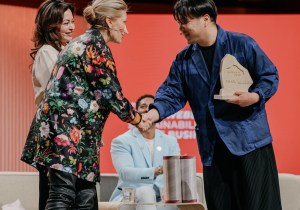
Traceability and transparency. That’s the future in terms of showing the consumer where, and how, your product is made and the impact it has on the planet. We debuted our digital product passport in Davos, called Reef to Runway, that tells the consumer everything about a product’s journey, from the coordinates of where the product came from to the associated biodiversity benefits and saved resources (water, emissions, and land use) simply from one’s fashion choices.
What is the biggest misconception consumers have about sustainability in fashion/accessories?
The biggest misconception is that that consumers must sacrifice quality for “doing the right thing.” That’s unreasonable, should never happen, and more importantly, will never happen. People cannot be expected to accept a lower quality product. That means we have to create models where the existence of the product is inherently good. To that point, we’re incredibly proud of the aspects that INVERSA’s materials encompass: beautiful, luxurious leathers that revive ecosystems being destroyed by invasive species.
We see this belief validated with our customers, and we see an overwhelmingly high retention rate and order volumes consistently increasing from month to month. Some of our brand partners’ initial capsule collections sell out as fast as in five days and five times in a row. The consumer absolutely cares about doing the right thing, they just will not, and should not, sacrifice quality.
What do you consider to be the apparel industry’s biggest missed opportunity related to securing meaningful change?
The industry views sustainability through a lens of obligation, duty, regulation and compliance. Fashion is art, and art is emotion. By viewing sustainability as a compliance issue, we leave beautiful and incredible products on the table, simply because sustainability or regeneration is not inherent in our creative process. Viewing sustainability as an artistic aspect to be embraced, not an obligatory requirement, could fundamentally transform and enhance fashion’s potential for securing and enacting meaningful change.
How much do you look into a brand’s social or environmental practices before shopping?
When a brand really cares about sustainability and the environment, they’re proud of it; they don’t make a claim without transparently showing their work to back the claim. I love diving into the details and understanding how a particular brand solved a hard problem. This is the difference between greenwashing and genuine sustainability. Did you show your work? Does it make an impact?
After working in this space, it’s hard not to obsessively evaluate and research the brands you are considering buying. It’s getting easier to know what is greenwashing versus what is truly positive product, and I think we gravitate towards companies that have a similar approach and commitment to telling that story honestly.