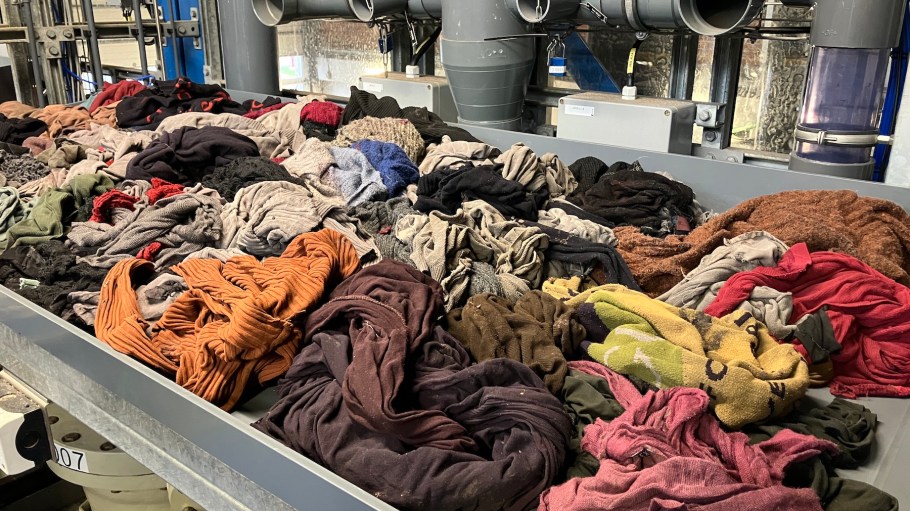
The reason textile waste is such a talismanic threat—one even recognized by the federal government last month—to both the environment and economy is, like most things, multifaceted.
The rise of fast fashion juxtaposed against the concomitant decrease in product lifetime and persistent plastic paralysis means that textile waste is growing at unprecedented speeds, and it will only get harder to manage. It’s high time, then, for some serious solutions.
It’s something Gert-Jan Gruter has been thinking about for a long time.
Related Stories
He’s been at Avantium since the new millennium, leading the chemistry company’s renewable and circular innovation initiatives as chief technology officer since 2003. Gruter also holds a part-time professorship at the University of Amsterdam (UvA), where he heads up the Industrial Sustainable Chemistry (ISC) group at the school’s Van’t Hoff Institute for Molecular Sciences (HIMS) research center.
Over 10 years in the making, Gruter and the research group have developed a patented, scalable method for recycling polycotton. Detailed in a paper published by Nature Communications, this method marks a moment for the space, Gruter said, as the first-ever process to recycle both polyester and cotton components with meaningful (see: monetary) outcomes.
“Out of the 100 million tons of annual polyester waste, more than half is polycotton; it’s really a huge problem. Gruter said. “Here in the Netherlands, we incinerate our waste—all of the polycotton is burned, which is really a waste,” Gruter said to Sourcing Journal. “It’s very difficult to have a viable business case. But this—this looks really attractive.”
The process starts at room temperature, with super-concentrated hydrochloric acid (HCL) to separate the poly from the cotton, enabling fiber-to-fiber recycling of both components. It’s important to note that previous methods relied on heat, risking damage to the fibers.
That process, essentially, splits polycotton fabric into half—one part polyester, one part cotton—and ignores the polyester to dissolve the cotton into glucose, with the aforementioned HCl acid. Also known as calcium chloride, this acid is pretty standard and used to make chlorine and fertilizer, even fireworks.

“I don’t know if you’ve ever seen the ‘Breaking Bad’ series, but at some point, they dissolve a body in acid—except they used the wrong type of tub, and the bathtub went through the floor,” Gruter said, referencing the iconic scene from the show’s second episode, known as “Breaking Bath” in some fandoms. “That is more or less what we do.”
This breakthrough has palpable potential for the industry, still struggling to combat the enduring deluge of garments destined for landfill or incineration.
To put this struggle into perspective, textile waste was up by over 800 percent from 1960-2018, the Environmental Protection Agency (EPA) reported in 2019. At the same time, over 110 million metric tons of fabric were produced that year: effectively making the apparel and textile industry the third most damaging market in the world, Gruter said.
That technology is the process deployed to split the poly from the cotton. That process uses highly concentrated HCl to dissolve the cotton—now converted into glucose—to detach it from polyester, enabling fiber-to-fiber recycling of both components.
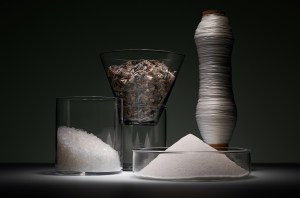
The recovered glucose serves as feedstock for various industrial applications—including Releaf, Avantium’s proprietary swap for plastic.
Circling back to the cotton: the patented tech uses super-strong HCl to break down the cotton cellulose and turn it into glucose. That now-recovered, not-for-coffee version of glucose becomes feedstock for various industrial applications, such as renewable plastic production.
This is where Releaf comes in. The fossil-fuel alternative to conventional plastics is made with Dawn technology, Avantium’s process to convert plant-based feedstocks into chemical building blocks.
While Dawn was initially developed with lignocellulosic biomass (like wood) materials in mind, Avantium trialed and adapted the Dawn Technology to successfully break down and recycle post-consumer polycotton waste textiles. The viability of using Dawn for polycotton recycling was confirmed at the Pangaia partner’s facility in Delfzijl, the Netherlands, during pilot plant testing.
Releaf is the Dutch renewable chemistry company’s plant-based and recyclable polymer, polyethylene furanoate (PEF), which can replace Polyethylene terephthalate (PET) fibers. Avantium’s PEF is derived from furan-dicarboxylic acid (FDCA), also known as next-gen polyester, made at the FDCA flagship facility, which became operational last October.
PEF claims to fit current polyester infrastructure for both production and recycling, therefore presenting a scalable future for renewable alternatives to fossil-fuel-derived PET. Not to mention, Avantium said, it has a significantly lower carbon footprint than traditional inputs and can be recycled into existing assets as well.
While PEF is a promising alternative to PET, the real kicker is the chemistry. The group’s analysis suggests that making glucose in this manner could end up being cheaper than the current methods involving wood chips. There’s a lot of interest in PEF from the fiber space, Gruter said, especially in light of the European Commission’s new regulation on recycled content in packaging.
“We are excited about this groundbreaking solution, which is not only providing feedstock for our own FDCA and PEF technology and aligns with our environmental objectives but also marks a crucial advancement towards achieving a circular economy,” Gruter said. “At Avantium, we are committed to perfecting this technology in collaboration with partners and broadening its application to address the global textile waste problem. Simultaneously, we aim to supply non-food glucose to support the large-scale transition toward a biobased economy.”