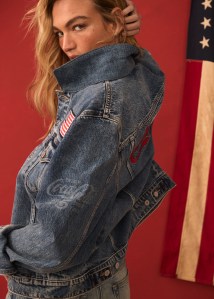
While the level of elasticity in jeans may ebb and flow with fashion trends, the comfort and freedom of movement offered by stretch denim have made it a timeless wardrobe essential. To enhance both performance and sustainability, fiber producers are advancing elastic yarn technologies specifically for denim.
One standout innovator is Carvico Group, an Italian textile conglomerate known for innovation and performance warp knit and circular knit fabrics. Carvico produces Xlance, a cross-linked polyolefin-based elastic yarn known for its durability, recyclability, and high performance.
Related Stories
Xlance has already impacted swimwear, sportswear and workwear, and is now making waves in the denim world by offering designers greater creative freedom. The company showcased its latest innovations last month at Denim Première Vision in Milan.
“It was our first time at Denim PV and in general our first time joining the denim community, and we were pleasantly surprised by the outcome,” said Melissa D’Innella, Xlance sales manager.
Xlance fiber is a sustainable alternative to traditional PU-based spandex. The fiber is produced through a clean process that eliminates harmful chemicals, ensuring a lower environmental impact. The fiber’s unique properties enable garments to retain their stretch and fit longer, reducing waste and promoting a circular economy.
Xlance is produced with 100 percent renewable energy and a solvent-free melt-spinning process. By using a lower heat setting during textile processing, it can reduce energy usage by 40 percent. The fiber also opens solutions for chemical recycling and reduces microfiber pollution during washing, the company reported.
Thanks to its unique combination of polyolefin backbone and chemical cross-links, it delivers comfort elasticity with superior thermal and chemical resistance. Xlance stands up to oxidizing agents like hypochlorite, laser, ozone and the intense wash cycles that denim is known for. The company reports that comparative tests consistently confirm its superiority over traditional elastomers, especially after aggressive industrial processing.
Xlance blends well with cotton, Tencel, polyester and wool, making it ideal for denim. Fabric producers typically use 2-5 percent Xlance in denim articles, depending on the required elasticity and design intent.
“Brands are looking for new technologies that allow them to achieve distressed looks, keeping a natural feel to the fabrics, without compromising the comfort of stretch. Alternative stretch technologies on the market give a synthetic touch to denim that designers are trying to avoid,” D’Innella said. “At the same time, denim mills see this kind of research as an opportunity, so there has been a lot of interest to understand more about Xlance.”
Xlance has been used by Pure Denim in Italy and Sapphire Mills in Pakistan, among many other mills around the world. At the time of the launch Yousuf Abdullah, CEO of Sapphire Mills, said the mill’s partnership with XLance Srl was a “step forward in enhancing our workwear fabrics with sustainable stretch technology.”
Xlance said the company is currently selecting key partners who are driven by innovation and cater to top denim brands to offer a unique technology and performance-based solutions.
“Our main goal is to build strong partnerships with key brands of the denim industry thanks to innovative developments with selected mills,” D’Innella said. “Brands are in need of new and innovative technologies that give them the opportunity to erase technical boundaries. We are aiming to provide this kind of solution. As long-term goal, we hope that a hundred years from now you will be able to find vintage stretch denim thanks to Xlance’s unbeatable durability.”