Circular design guidelines and the growing demand for technical fabrics have placed a greater emphasis on textiles in recent years. Fiber manufactures and textile mills have adopted consumer-focused marketing strategies and consumers are more knowledgeable about the ingredients used in their clothing. However, a gap between designer and textile designer remains.
At Denim Première Vision, textile designer Kelly Konings discussed how textiles and fashion move along parallel paths—closely connected, yet fundamentally different.
Related Stories
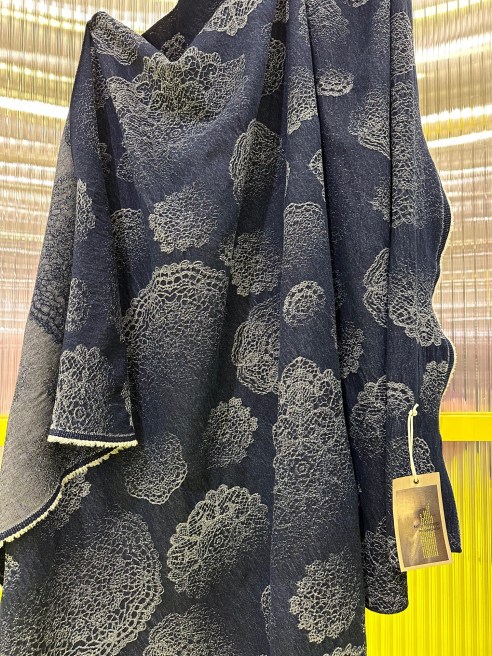
Konings’ studio partnered with Italian fabric manufacturer Gommatex to create a custom collection of jacquard fabrics and garments for the event. The studio used an innovative layering technique in which whole-garment and 3-D weaving were used to turn flat fabrics into structured and wearable pieces. The process streamlines production and minimizes off-cut waste.

“There is an interdependency between a textile and a garment, so one cannot exist without the other. However, in the current state of the textile and the fashion industry, these two are based on two separate systems, meaning that there is not a loss of interaction between the two, and they are also based at globally fragmented supply chains,” she said.
Textiles are the bedrock of the fashion industry, but very often there is also no direct communication between the textile designer and the garment designer.
This relationship is most commonly and not an equal one, she said, describing the “textile industry is often the “invisible backbone” of the fashion industry. “Most of us can name the fashion designer when we see a garment, but most of us do not know the textile designer who made the textile behind it,” Konings said.
When garments and textiles are designed on two separate timelines, Konings said there’s no connection point between the textile engineer and the fashion designer. Textiles are often designed in another place with no knowledge of the garments the textiles will be used for thereafter.
“The choice of the textile is not solely based on the look or the technical characteristics, but they are mostly chosen for the direct availability in production, the speed and the quantity and most important, it is prioritized by strategic pricing to lower the cost of the garments,” she said. “So very often the textiles that we see, they are textiles that are on stock.”
When textiles are not chosen for their characteristics, it can affect the quality and the lifespan of a garment and lead it ending up in a landfill prematurely. “The poor quality of a garment doesn’t necessarily mean that it’s poor quality of the textile. It also doesn’t always mean that it’s the poor quality of the stitching of a garment, but it can basically mean that it’s the wrong combination of these two separate components,” she said.
While it’s important for the denim industry to continue to develop new types of textiles, Konings urged it to also experiment with textile and fashion systems that could lead to innovation that benefit denim and the wider fashion industry. She advocates for textile and fashion designers to meet and talk. In doing this, Konings said new levels of creativity may be unlocked, creating new aesthetics and a reevaluation of sustainable design values.
“We should be able to have equal and integrated systems of textiles and fashion combined,” she said.