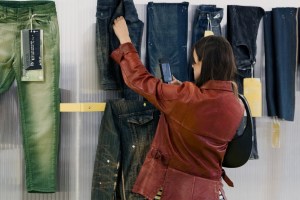
Neems Jeans delivers custom-made jeans to consumers’ doors at a price that matches or beats most premium brands. It’s an offer that’s hard to ignore for anyone who’s endured the exhausting, confidence-crushing experience of shopping for jeans that actually fit.
Most industry veterans would call the idea impossible—but it took two denim outsiders to prove them wrong.
In 2020, Daniela Rodriguez and Andre Ramirez—former business consultants who met at Northwestern University—co-founded the custom jeans brand after sharing their frustration for shopping for jeans. The idea sparked in late 2019, during a discouraging trip to the mall when every pair they tried on missed the mark. A quick, impromptu survey of fellow shoppers confirmed what they suspected—shopping for jeans was a universal struggle in need of a real solution.
Related Stories
“I don’t know a single person that finds the jean shopping experience, fun or successful in any way,” Daniela Rodriguez, co-founder of Neems Jeans, told SJ Denim.

The duo went into business with no background in fashion or denim, quickly schooling themselves in sourcing manufacturers, patternmakers and everything else that goes into making a pair of jeans. “We always say that we were very naive about what it takes to start a custom denim company, but I’m glad that we were naive, because I don’t think we would have taken that first step if we knew how complex it would be,” she said.
Neems relies on several different technological components for its customization model.
For body scanning technology, the company uses Choocr’s third-party mobile body scanning app. “The scanning technology is incredibly accurate,” Rodriguez said. “I personally tested maybe 10 body scanning technologies on the market, and that one was by far the best. We have a very, very close working relationship with them.”
Tukatech’s TUKAcad software is used for pattern making, and Rodriguez and Ramirez developed the algorithms Neems uses to apply body measurements to custom jeans through several fit tests.
“Obviously, we must consider the customer’s body shape and size. We also have to take into account fabric shrinkage. We have eight different fabrics and within those fabrics we have different washes. We test every single one. So, we must know every single roll’s shrinkage, and every single wash’s shrinkage. It’s complex,” she said.
The consumer-facing side of the customization process is less complicated. After placing an order online, Neems sends an email to the customer with instructions on how to access the Mobile Body Scanner on their smartphone. The Mobile Body Scanner takes two photos to gather body measurements, a step that takes just 30 seconds.
Neems Jeans receives the measurements data and begins production on the jeans, which takes 2-3 weeks for delivery. In comparison, Neems says most custom jeans take 5-6 weeks from start to finish.
Customers build their jeans by selecting their desired style, wash, length and rise on Neems’ website. They can also choose between stretch or non-stretch fabrics sourced from Cone Denim’s facility in Parras, Mexico. Wash options span light, medium, dark, rinse, black, charcoal and ecru.
Women can select straight, skinny, wide leg, relaxed and bootcut fits. Four rise options—ultra high (above the belly button), high (at the belly button), mid (1.5 inches below the belly button) and low (2.5 inches below the belly button)—are available. Lengths options are full length, ankle or cropped.
While Neems’ business is predominantly women’s, the service is available for men. Straight and slim fits are offered men. Rise options are low, mid and high. Lengths options are full length and ankle. Customers can also request a custom length and rise.
To ease consumers’ concerns about the technology’s accuracy, Neems offers free remakes within 14 days of receiving an order.
Custom jeans retail for $229. As of May, Neems moved its production from Los Angeles to Mexico City to keep costs down. “There are custom jeans in the market for $700, $800 but we didn’t want to increase to that, because it just we wanted to be a more accessible custom jean brand,” Rodriguez said.
Sourcing fabric and manufacturing jeans in Mexico has also mitigated challenges with importing fabrics. “We have a very close relationship our factory, and so working with them on costs and forecasting, we’re able to keep costs where we want them,” she said.
There’s no one-size-fits-all way to describe a Neems customer—highlighting the universal need for better-fitting jeans. Rodriguez sees a strong demand for jeans that properly fit tall people. Many brands that call themselves “tall friendly” only go up to a 33.5-inch inseam, she said.
“We also have a lot of plus size customers that can’t find their sizes in store or anywhere online. With Neems, they’re able to get jeans fit to their bodies without having to buy several pairs to try on and then return. That’s a big gap in the market,” Rodriguez said.
Neems has also become a go-to source for 100 percent cotton jeans, especially for curvier customers that want the rigid look and feel of cotton jeans but have them fitted to their waist and hips.
Currently bootcut is Neems most popular fit. The brand is seeing more orders for low rises, but high rises are consistently popular. Rodriguez noted how the company’s made-to-order operations allows it to try new fits and designs without having to make a large upfront investment. “I think that’s a really great part of our story, that we can really iterate on a style, release it, and if people want it, that we make it, if they don’t, then we don’t,” she said.
In addition to growing the Neems team, Rodriguez said expanding its range of custom bottoms is key to the company’s growth and LTV (customer lifetime value). The brand has already introduced $169 custom women’s shorts available in short and mid lengths. Denim skirts, chinos, trousers and corduroy are on the horizon.
Additionally, a robust calendar of popups is being planned for 2026. In October, Neems hosted its first solo two-day popup in Winnetka, Ill. just outside of Chicago. Rodriguez said the popup was a success, not just from a sales perspective but also from being able to connect with a community. There, Rodriguez and Ramirez met with customers over coffee and pastries, walked them through the customization process and assisted with their body scans. The full range of fabrics and washes were displayed for customers to touch as well as some unreleased samples.
“A long-term vision would be to be set up in a retailer permanently or even have our own storefront. So we’re just thinking about all those possibilities,” she said.