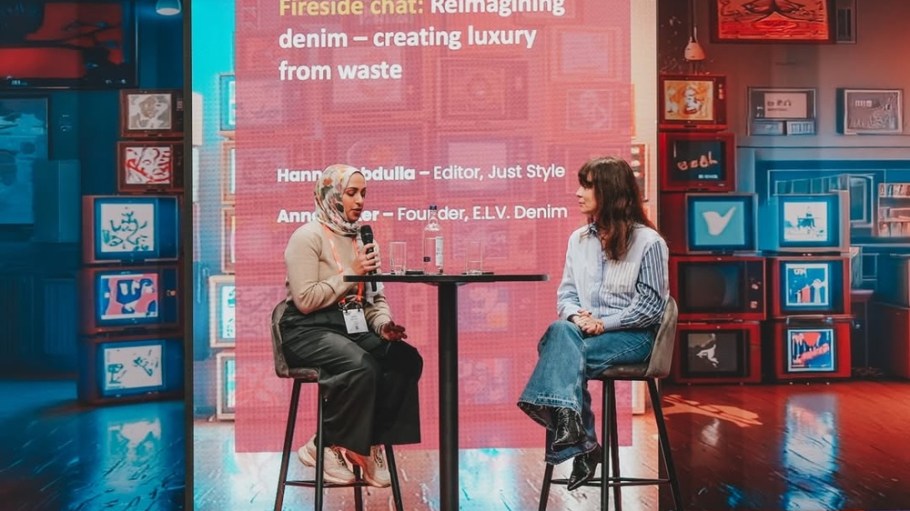
Anna Foster founded E.L.V. Denim in 2018 in a fit of pique.
“I’d been in the industry for 25 years,” she said at the Source Fashion trade show in London earlier this month. “And frankly, I was just a bit pissed off.”
Just about everything on store shelves reflected the “same mass, homogenized offering” that is no longer constructed to last, Foster said. She yearned for a time when individual style meant something and one’s glad rags weren’t a disposable commodity.
Related Stories
That, coupled with the fact that jeans weren’t designed for women’s bodies—another pet grouse—“cemented” the idea for a “concept around denim that was designed to respect and evolve for the woman’s shape,” Foster said.
Like its founder, E.L.V. Denim—the acronym stands for East London Vintage—is a Londoner through and through. It rummages through vintage warehouses across the United Kingdom for thousands of pairs of unwanted jeans that might otherwise be sent to the landfill because of rips, stains or sizing issues. They get a tumble wash at an East London launderette before arriving at the label’s East London studio for grading, sorting and debranding. The ateliers E.L.V. Denim employ to hand-cut and re-craft the jeans populate the same neighborhood, as do the leather factories whose remnants are revived into branded leather patches.
“Developing a local supply chain is so important, especially when you’re starting a business,” Foster said. I came from being a stylist. I had no idea about design. I knew I wanted to challenge what I saw, and so I had a kind of tunnel vision about what I wanted to do. Having that network very close to you means you can have meetings [where nothing gets lost in] translation.”
She said that it’s a mistake to believe that offshoring production is going to be cheaper because “if something goes wrong, you’re not there to manage it.”
“You’ve also got to travel backward and forward,” Foster added. “Your overheads are not built into your cost of sales, but they’re still really important costs. You can’t separate those two lines of your balance sheet. And I think it’s really important, as a British brand, to support British manufacturing.”
She pursed her lips: “I personally don’t understand why we offshore at all. It has meant the qualities have declined, fabrics have declined, designs have declined.”
E.L.V. Denim may be a profitable and quickly growing—if still comparatively small—business today, but it was far from an overnight success. Innovation, too, she said, takes time. But the problem is that everyone’s scrambling to cash in on sustainability, and they’re “reaching for the fast and simple option, which is textile recycling.”
“And that would be fine if this one shirt became one shirt, but it doesn’t,” she said. “This one shirt is the concentrate for 10,000 shirts. We have to address the issue that it’s not about making more material; it’s about reducing consumption and making clothes that are designed to last, so you can give a garment a better value. And so we’re not consuming 10 garments that we’re throwing away when we can consume just one.”
What the industry needs to learn, Foster said, is how to value the material that already exists without turning it into something new. Circular design is important, but so is support for companies to recapture textile waste after the “point of construction,” for which there is still a lack of clear regulation despite the emergence of extended producer responsibility schemes in Europe and California.
“Sustainability now is compliance,” she said. “It’s a whole load of tick boxes: organic fabric, recycled fabric. But actually, that recycled fiber? Maybe it’s a tiny percentage. What we actually need to think about is systemic change. It’s not about sustainability; it’s self-sustaining. And it’s not about circularity, because again, although those materials that you’re recycling are going back into the system, we’re adding so much more virgin fibers that circularity is growing like a Catherine wheel getting bigger and bigger.”
‘It’s a choice’
Foster doesn’t buy into the idea that scaling circularity has to be a slog. For her, the excuses about lack of access to quality textile waste are exactly that—excuses that are really about a company’s inability to turn a quick buck.
“It’s the choice: whether you want to or not,” she said. “And the more people that get involved, the more we can show that it’s a process. But again, whenever you’re challenging the status quo, people are going to say no because they don’t know the answer, or they’ve got a vested interest in saying no. Everyone’s too scared to be the one to put their head above the parapet and go, ‘We’ll do it.’”
And if demand for E.L.V. Denim suddenly spikes and London cannot manage it anymore? Expansion should be similarly thoughtful about the routes textile waste traverses, Foster said. Her vision is to call on the regions where the United Kingdom offloads its castoffs—say, West Africa or Eastern Europe—to re-manufacture it as well.
“Why can’t we upskill them and empower them to be the solution for the problem that’s been left on their shoulders?” she asked. “They’re not having to deal with the toxic implications of that waste. They’re actually turning it into something positive. So the idea is that we could be manufacturing locally and distributing in Asia, the Middle East, Europe and Africa.”
Foster considers E.L.V. Denim a waste-management company by another name, but it’s mid- to high-end fashion in the denim marketplace. Even though it’s “not hitting luxury in any way,” as she put it, the prices have a heft that reflects the amount of work that goes into the pieces—$607 for a two-tone-paneled pair of wide-legged jeans, for instance, or $2,024 for a swishy patchwork denim cape-coat combo.
“I think consumers have realized now that the price tag that we put on luxury goods is not necessarily worth it,” Foster said. “If a luxury brand is producing 10,000 garments with a huge 1,000-pound price tag, that’s a mass-produced item. But if you have a transparent model where customers can ask to see the process from start to finish, then they kind of fall in love at different stages of the process.”
It’s a way, she added, of “reframing what is quality, what is luxury” to mean something that’s “designed through its material, its style and its construction to last forever.”
Foster admitted she has constant battles with her daughter about buying clothing from the high street like all the other teens do. Still, she continues to stick to her guns, saying that it’s about “having strong values.”
“A dress 100 years ago was 20 pounds, and it’s now 20 pounds or less, 100 years later,” she said. “How did we get to a place where we have absolutely no respect for that garment and we want a dress for less than 5 pounds? And if you think about how it’s made and you assume that the company is taking profit from that dress, by the time you make it down to the material costing, probably about 10 pence, and the garment and the construction costing 10 pence, then you think, ‘Who is having to make that?’”
As for designing denim that fits women, Foster pointed to the way jeans are designed: with seams on either side, creating a “very flat” construction that doesn’t work for feminine waists and hips, leading brands to turn to stretch—meaning the addition of elastane—as the answer. As soon as elastane is added, she said, it “poisons the cotton.”
“I find that so insulting,” she added. “You don’t need stretch; you just need a good design.”
E.L.V. Denim takes the “good” halves of damaged jeans and stitches them together so that the seam runs along the middle and “creates this cylindrical shape rather than a flat shape.”
Pulling her thumb and forefinger apart to indicate the seam allowance the brand works into its new pieces, Foster described how a pair of jeans can “evolve with you” and “grow up to two or three sizes” with a few slight alterations. And if some mishap should fall upon a section of the garment, “we can replace that part for you with the parts that we don’t use.”
“We do the same thing with shirts,” she said. “Two shirts become two shirts with a seam down the back, but sometimes half the shirt is going to be damaged. So what are we going to do with that? It’s not just enough to say, ‘Well, I’ve made a good shirt. Congratulations, me.’ So we cut out sections. We use the plackets. We use all the parts that have characteristics and are part of the storytelling.”
For Foster, E.L.V. Denim’s trajectory over the past eight years has been about “trying to be better with the potential waste that you get.” The only items the label doesn’t yet have a solution for are the buttons and rivets that it strips from the original jeans. She’s hoping for a master’s student in a lab somewhere who might be working on “breaking down the boiling points of different metals.”
“The point of [E.L.V. Denim is] designing from waste and making it beautiful, but always trying to be that bit better,” she said. “We make one thing, and then we get left with a smaller bit, and we create something out of that, and we create something out of that, and create something out of that because each part of that is really valuable.”