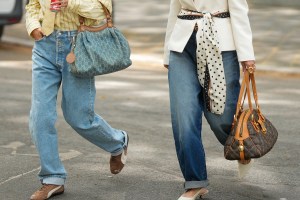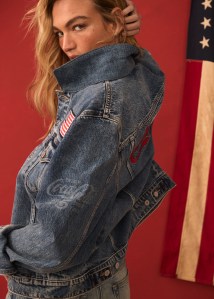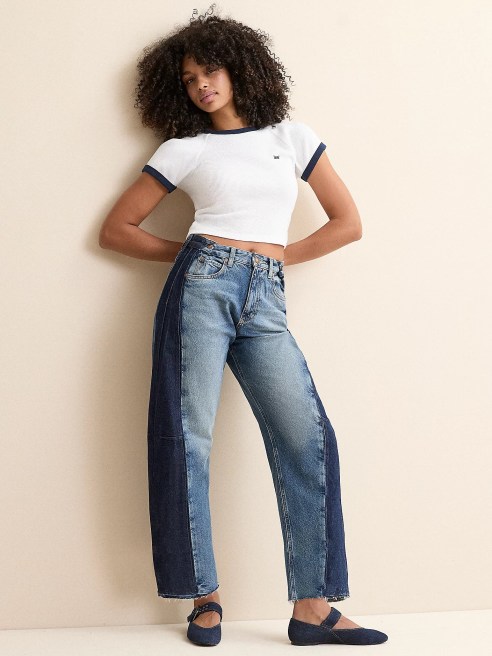
The current denim landscape—where there’s so much variety and no single dominating trend—means consumers have more options than ever. Personal preference now trumps passing fads, and denim dressing is being embraced in all its forms, from wide-leg to low-rise and everything in between. But with options comes questions. While denim has always had its own language—centered around fit, wash, and rise—the sheer range of choices today is leaving many shoppers unsure of where to begin.
Here, execs and designers from leading denim brands answer common questions.
Related Stories
Are low-rise jeans back?
Given the cyclical nature of fashion, the comeback of low-rise jeans was only a matter of time. And its not just hype or click bait—brands are seeing the trend reflect in their sales.
This season, AG’s sales are split almost evenly across low, mid, and high, but low-rise fits are outperforming expectations.
“We’re interpreting low rise in a way that feels modern, yet still true to our customer. It’s low enough to reflect the trend, but thoughtfully designed to remain wearable and approachable,” said Charis Chiu, AG Jeans public relations. “For us, it’s about striking the right balance—offering a flattering fit that feels timeless, effortless and classic, and not intimidating.”

AG’s best-selling jean this summer is the Adria in Helios. The low-rise, wide-leg silhouette has a forward-twisted side seam that adds a subtle, fashion-forward detail. Chiu noted that the jean is designed to sit low on the hips and finish with a soft puddle at the hem. She added how the style “captures that effortlessly relaxed look customers are gravitating toward” and aligns with where denim trends are heading.
Denim Forum is not interested in rehashing old ideas. Instead, Natalie Nelson, Denim Forum creative director, said the brand is approaching the low-rise trend “through the lens of intention and proportion.”
“For us, it’s less about returning to the past and more about rethinking balance; softer, slouchier shapes, refined fabrics, and a relaxed ease that feels deliberate. Our modern low-rise isn’t about rebellion; it’s about restraint. Understated, elegant, and styled with quiet attitude,” she said.
Joe’s began to see interest in lower rises a couple of ago when it introduced two new styles. The Lou Lou takes inspiration from the best-selling Mia fit, updated with a 9-inch rise and a modern wide-leg silhouette. The Ryan targets fashion-forward customers and features a low, slouchy fit with an 11.75-inch mid-rise. It’s available in denim and non-denim fabrications.
Silver Jeans’ take on low rise is more wearable than the early 2000s version. “We’ve raised the rise slightly for comfort but kept that low-slung look. The fits are relaxed, giving it a laid-back feel without compromising coverage or ease,” Marks said.
Blue Revival’s low rise is a modern take, not as extreme as the ’90s version, making it more wearable for mature customers. Lindsay Steinberg, Blue Revival’s VP of sales, said the brand added stretch to its low-rise styles for a “flattering fit that hugs in all the right places, unlike rigid denim, which can often sit lower and feel less secure.”
Combining lower rises with contemporary fits is key for VRG GRL. “We have designed some low to mid-rise styles that will be coming out later this year,” said Daniella Dionyssiou, VRG co-founder and co-CEO. “For us, the way we modernize the low rise is with more relaxed styles—therefore making it easier for the consumer to be able to wear, such as our mid-rise style as low rise if they size up.”
While high-rise styles remain relevant, low-rise is stepping into the spotlight, according to Christina Choi, creative director at Judy Blue. “We’re keeping a pulse on that trend while making sure our audience feels prioritized for who they authentically are,” she said. “The Judy Blue girl is easing into the low-rise so we’re meeting her halfway with a wider selection of mid-rises.”
This spring, Lee introduced a line targeted at younger female consumers. The collection’s bootcut, which has a slightly lower rise than the brand’s standard mid-rise, is resonating with 20-something consumers.
Styling plays a large role in modernizing low-rise jeans.
“In Lee’s premium collection, it’s really about attitude and wearing jeans lower on the hips, while the actual rise measurement may read like a regular length. Some consumers will size up to achieve that low-slung, easier fit,” said Sara Brenner, merchandising manager for Lee female, North America.
This works especially well with styles like Lee’s Rider Classic Straight, which can be worn true to size or upsized to be looser.
Low rise is successful for Hudson but Ricki Robinson, women’s senior designer for Hudson, noted how styles with dropped front rises are the real standouts. Hudson’s newest low-rise styles are designed to be worn loose and low-slung. The Kelli is a straight jean with a 9.25-inch rise. The Rylee is a wide-leg jean with a 10.5-inch rise.
“We always prioritize fit, so even though the front rise is lower, you will find these styles are slightly pitched in the back, so the back rise comes up higher and our customer feels more secure and confident. This isn’t the extreme low-rise that many remember taking the industry by storm in the early 2000s. Those were shockingly low, and the overall fit was tight. These have a more modern ease in the body,” Robinson said.
Why are my jeans so long?
Consumers appreciate the comfort and breezy style of wide-leg jeans, but many are still adjusting to their length. Unlike skinny jeans—which typically hit at the ankle, making them easy to pair with flats or tuck into boots—wide-leg styles often require more consideration when it comes to footwear and proportions.
One reason wide-leg and baggy jeans feel too long is because of how rise affects the inseam, said Janice Marks, Silver Jeans Co.’s senior VP of design. A low-rise jean sits lower on the hips, which means the inseam starts further down the body.
“Even if the technical inseam stays the same, say, 32 inches, it’ll fall lower than it would on a mid-rise style, often pooling at the ankle or dragging slightly. That effect is exaggerated when the fit is both low-slung and loose. The extra drape at the hip pulls the whole pant down, making it wear longer than intended. It can add the illusion of one to two extra inches in length, even though the actual measurement hasn’t changed,” she said. “At Silver, we build that into our design process. We adjust inseams based on rise and fit, and offer cropped, ankle, and full-length options to help customers get the look they want—whether that’s a clean crop or a floor-grazing puddle.”
“Wide-leg jeans can sometimes feel too long simply because of how they’re designed. The current trend leans toward a lower rise for that relaxed, low-slung fit, which means the jeans sit lower on the waist and naturally run longer,” Chiu said.
Most of AG’s wide-leg styles have an average inseam of 32 inches, and they’re often worn grazing the ground for the effortlessly cool-girl looks. “That said, they can just as easily be tailored to hit at a more approachable length. Whether you prefer them touching the ground or slightly cropped, it really comes down to personal style, and there’s no right or wrong way to wear them,” Chiu said.
The length is intentional, especially in looser fits, Nelson added. “We offer slightly longer inseams averaging around 32 inches to allow for personal tailoring,” she said. “That’s part of the beauty of denim: it invites customization. Whether grazing the floor or cropped to the ankle, the final length should serve the woman, not the trend.”
Carly Smith, denim design director for Favorite Daughter, said inseams are a hot topic in the design office, especially with co-founder Sara [Foster’s] model height. Foster wants to wear heels and dislikes when the brand’s jeans flood. Meanwhile, Smith said the rest of “us average gals can’t get away from the puddle.”
The brand’s solution is the Mikaela, a low-slung jean with a 33-inch inseam.
“In general, we’ve mostly scaled shorter to a 32-inch [inseam] on our looser styles, and this feels like the best middle ground,” Smith said. “I don’t categorize denim like a dress that needs to be the perfect fit on your special day so I don’t ever recommend tailoring especially when there are so many ways you can style a fit. Not to mention we are also a brand who love our shorties (petites) and offer her these wider/ looser fits with a shorter inseam.”
Hudson’s standard inseam for the Rylee low rise look straight is 32 inches. Robinson said the brand is planning a petite option, with an inseam of 29 inches. “The baggy, wide leg jean is meant to stack a little bit by your ankles,” Robinson said. “The pooling around the ankle is cool.”
Joe’s standard inseam is 32 inches which is intended to touch the ground. However, the brand also offers ankle, crop and petite inseams to service all heights and fit intents. “At Joe’s, we work hard to offer diversified lengths in a variety of fits, so we have the right length for all customers,” said Leore Arik, Joe’s Jeans general manager.
Judy Blue’s average inseam for loose-fitting jeans is 32-33 inches. “Baggy and wide-leg jeans are meant to be worn slightly scrunched up at the bottom to give that cool girl, trendy look,” Choi said.
In Lee’s premium business, Brenner said the brand is seeing longer inseams gain traction as consumers look for a puddling effect. “Younger consumers want a bit of pooling on top of their sneakers or platform footwear,” she said.
Lee offers several different styles of baggy and wide-leg jeans, including cropped versions with 26-inch inseam. The brand’s regular inseam is 32 inches. There are also 30-inch and 34-inch inseam options for its Legendary Trouser, a jean with a high waist and billowy legs. “It’s important to us that we offer multiple inseams in our best-selling styles,” Brenner said.
Steinberg says don’t be afraid of tailoring. Because height varies across all sizes, a single inseam length won’t work the same for everyone, which is why tailoring can be the best solution.
Blue Revival’s taller customers often gravitate toward the 32-inch inseam Wide Leg, which Steinberg said is quickly becoming the brand’s standard for this silhouette. For a no-tailoring option, she suggests the 26-inch Cropped Wide Leg. The style sold out this season and is perfect for petite heights.
“As someone who’s 5’8″, I love the 32-inch inseam. It drops just enough to cover my shoes without dragging, which we find is the ideal length for most people: long enough to skim the shoe but not hit the floor. The fit of our Wide Leg is a customer favorite, and many shorter shoppers are happy to tailor the length because they love how it fits everywhere else,” she said.
What’s the difference between flare and bootcut?
The resurgence of the Western trend has brought bootcut and flare jeans back into the spotlight, leaving many shoppers trying to distinguish between the two styles. The terms were used interchangeably to describe the jeans Kendrick Lamar wore during his Super Bowl halftime performance earlier this year.
Bootcut and flare jeans may start the same at the top, but how they end is what sets them apart.
“Bootcut jeans have a subtle kick-out that’s just wide enough to fit over boots, with a leg opening that usually ranges from about 16 to 18.5 inches. Flare jeans, on the other hand, are more dramatic. The leg widens much more below the knee, creating a bell-like shape, with openings that can reach 20 inches or more. It really comes down to how bold you want the silhouette to feel, bootcut is more understated, flare makes more of a statement,” Smith said.
Simply put, Chiu said a bootcut has a more subtle leg opening, whereas the flare has a wider, more exaggerated leg opening.
Smith added that the knee-to-hem opening ratio is what differentiates a bootcut from a flare. “A boot essentially is a fitted to narrow knee with an opening that either hugs or fits just over your boot and a flare is a similar knee with a more dramatic hem opening,” she said.
“No two bootcut or flare styles are alike, but in general, both bootcut and flares are slim through the hip and thigh with a wider leg opening than a straight jean, which falls straight from the knee to opening,” Brenner said.
Defining a flared silhouette depends on what decade the brand is referencing. Brenner said flares of the ’60s and ’70s were super wide with more extreme versions like bell bottoms. “Consumers will search for these in vintage shops, and Lee made flare jeans during that time. Our current versions are inspired by the past, but we’ve modernized their fits. The leg opens wider than a boot by a few inches and is more streamlined than what you’d find in a vintage pair,” she said.
“Both are leg shapes rooted in balance, but they diverge in intention,” Nelson said. “A bootcut maintains a straight line through the thigh and gently opens at the ankle—subtle and pragmatic. A flare is more sculptural—fitted through the thigh, then breaking with drama below the knee. The difference is often in the degree, and in the attitude it conveys.”