In October, Formula 1 announced LVMH Group will become a global partner of the sport in 2025. The 10-year deal will include several of LVMH’s iconic brands including Louis Vuitton, Moët Hennessy and TAG Heuer. At the time of the announcement, Stefano Domenicali, president and CEO of Formula 1, said “the strength and breadth of LVMH makes it the perfect partner” for the sport as it continues its “global growth, attracting new and more diverse audiences.”
F1’s partnership LVMH is just the tip of the iceberg when it comes to fashion’s fixation with racing, however. The sport, which will celebrate its 75th anniversary in 2025, and its teams have been gaining speed with men’s and women’s denim-centric fashion brands, particularly ones with millennial and Gen Z fanbases.
Related Stories
Social posts for F1 in general are up 15 percent to last year, said Kendall Becker, Trendalytics fashion and beauty director. Products in the market that mention F1 within their descriptions have increased 149 percent compared to last year, she added.
In February, Abercrombie dropped a second collection of licensed graphic apparel collection with the award-winning F1 team, McLaren. The partnership served as an “organic evolution” to Abercrombie’s first collection with the British team, which bowed in 2023. The collaboration went viral with Gen Z consumers on TikTok. Abercrombie marked the second drop by displaying McLaren’s F1 car inside its New York City flagship on Fifth Avenue.
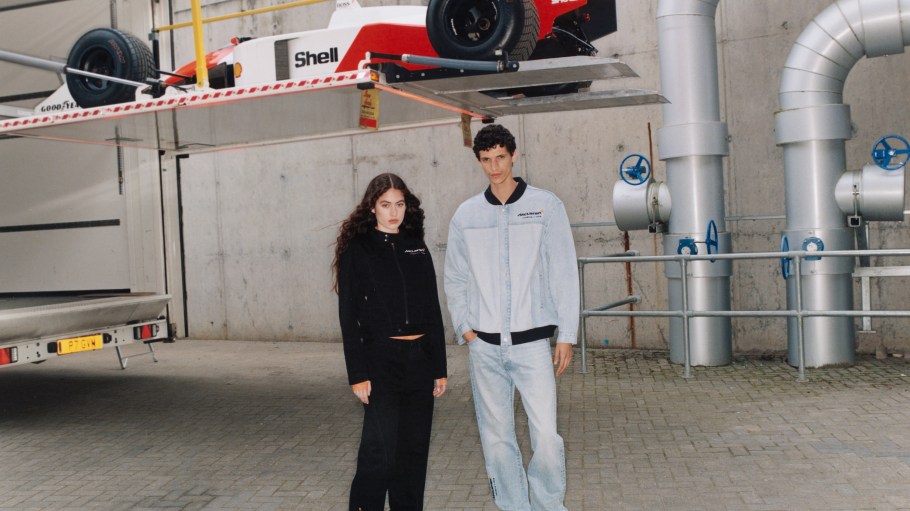
Levi’s followed up with its own collection with McLaren. The first drop launched in June spanned jeans, jackets, jumpsuits and tees inspired by the spirit of the F1 team’s past eras. In October, the denim giant released a second capsule focused on modern styles like the Baggy Dad loose fit and a Track Trucker, a jacket with contrasting panels and “McLaren Racing” embroidery on the front left chest.
Hugo announced its partnership with Visa Cash App RB Formula One Team (VCARB) in February, ahead of the start of the 2024 F1 season. As the team’s “Official Apparel Partner,” the Hugo logo is featured on the race suit, teamwear and the VCARB Team’s cars. The sartorial-themed livery was revealed at the Singapore Grand Prix in September and features a denim design including distressed markings and leather-looking patches.

Tommy Hilfiger also became an “Official Partner” of F1 Academy this year, designing Spanish driver Nerea Marti’s racing suit. The team also rode a Tommy Hilfiger-branded car. The partnership built on the PVH Corp.-owned heritage brand previous collaborations with racing legend Lewis Hamilton and its own legacy racing-inspired collections and for hosting fashion shows inspired by the track.
“Racing, car culture and Formula 1 in particular have surged in popularity in recent years with our consumer,” said Richard Cox, Pacsun’s chief merchandising officer.
The Gen Z-centric brand launched a F1 collection in August that drew inspiration from the Britain Grand Prix, Hungarian Grand Prix, and Belgium Grand Prix. The collection spanned graphic tees, parachute pants, a faux leather moto jacket to sweatshirts, sweatpants and shorts.
The retailer bowed an expanded collection in October when activated at F1 US Grand Prix in Austin, Texas (COTA) for a consecutive year. There, Pacsun dropped new styles and silhouettes inspired by motorsport culture for men, women and kids, including jeans, vests, trucker hats, along with T-shirts, hoodies, crewnecks and jackets. Additionally, fans were treated to a photo moment and tote bag at the activation.
Cox pointed out how the U.S. based races like Austin, Miami and Las Vegas along with cultural moments like the Netflix series “Drive to Survive” and brand partnerships such as Pacsun’s with F1 have helped make the sport “more accessible to the younger consumer, provide more connection to the teams and drivers on the circuit, and make them interested in being a part of the community.”
“I think there’s also a competitive and aspirational quality to the entire ecosystem of the sport that is really resonating,” he added.
There are synergies between denim culture and car culture as well. “Durability, utility and function are common threads that are important to both good quality denim and peak performance in racing,” Cox said. “So, I think the two are actually a good match when considering fashion collaborations. There’s opportunity for storytelling through product that doesn’t feel forced.”
The connection between racing and denim extends beyond F1. Wrangler, which has sponsored several Nascar teams and drivers including Dale Earnhardt, tapped into car culture and nostalgia when it released collection with Mattel’s Hot Wheels in August.
The collection spanned denim, jackets, coveralls and graphic tees in coordinating youth and adult styles, Patches of a bucking horse celebrate the brand’s Western roots and Hot Wheels horsepower. Tops combined Hot Wheels’ flame logo with racing flags, tires and other automobile motifs. The collab also featured a limited-edition Wrangler branded miniature diecast ’85 Ford Bronco, adding a sought after collectable component to the youth driven capsule.
“From rodeo to Nascar, Wrangler has long ties to adrenaline-filled sports and the idea of ‘horsepower.’ There is such rich iconography in the racing and rodeo worlds that are authentic to the Wrangler brand and bring a fresh, bold look to this collection,” said John Meagher, Wrangler’s VP of global marketing.
Meagher said the collection has been received incredibly well, with “some of the pinnacle pieces being the best sellers.” Case in point: the blue and yellow racing suit inspired coverall in the collection was Wrangler’s fastest seller in the U.S. and sold out in Europe. The collection’s reversible bomber jacket was worn by Grammy-winning country artist Lainey Wilson to the F1 US Grand Prix in Austin.
He added, “the iconography, the nostalgia, the adrenaline; and how brands are reinterpreting all of this in bold, graphic and streetwear inspired fashion,” is what’s capturing the attention of younger generations.
This article was published in Rivet’s winter issue. Click here to read about more 2024 trends.