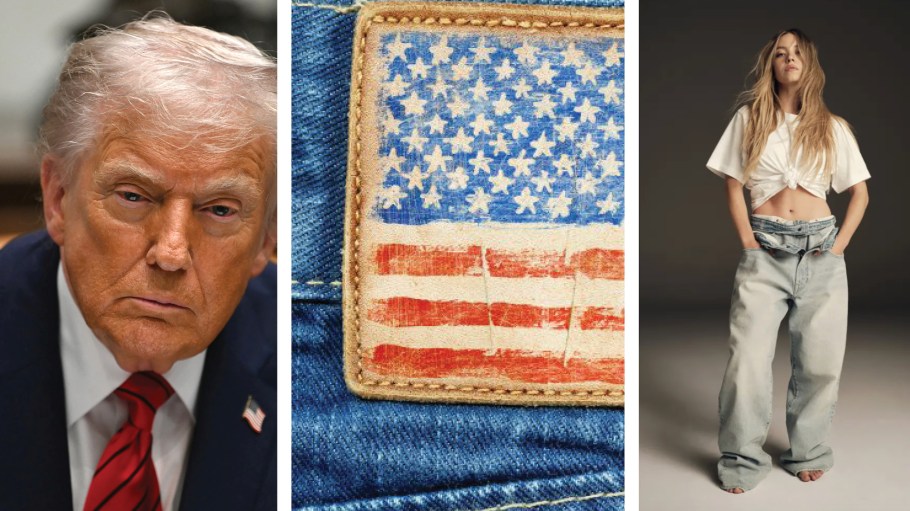
The biggest headlines shaping the denim industry in 2025 were driven by political forces and carried an overtly patriotic tone.
Here’s a look back at the events that pushed denim into the mainstream news cycle.
Tariff triage
President Trump unveiled his poster-size chart of reciprocal tariffs on April 2. By the time the global denim supply chain gathered in Kingpin Amsterdam two weeks later, moods and outlooks had plummeted to an all-time low.
Related Stories

Trump’s upheaval of global trade policies weighed on the minds of attendees and exhibitors who brought their Fall/Winter 2026-2027 collections to sell. One representative for Marmara Hemp compared the mood at the trade show to the quiet week between Christmas and New Years. Though there was a lot of excitement about products, no one felt confident to do business.
Companies saw existing U.S. clients pull back from their typical orders; others saw their U.S. business stall as clients waited to see how the tariff war would shake out.
The impact of the tariffs were evident in brands’ quarterly earnings. In one of the company’s final earnings calls before going private, Guess Inc. CEO Carlos Alberini said he expected the year over year impact of tariffs on Guess Inc.’s margins to be less than $10 million this year—an amount that Guess will achieve with “very minimal price increases.”
“The tariffs have also sparked renewed fears of inflation or recession, but we have not attempted to predict how they may affect the consumer’s appetite to spend their disposable income,” he said.
As the year continued, companies like Kontoor Brands, the owner of Wrangler and Lee, began to prepare tariff mitigation strategies. In the company’s Q1 2025 earnings call in May, Kontoor president, CEO and chairman Scott Baxter reiterated how the company was focused on controlling what it can—a strategy that has helped Kontoor maneuver other moments of disruption and uncertainty such as cotton spikes, inflation and ocean freight disruptions.
“This time will be no different. We have operated through multiple cycles and have the team and operating playbook to not only navigate the current environment but come through the other side even stronger,” he said.
By November, the Greensboro, N.C.-based company said it expected to substantially offset the impact from increases in tariffs over a 12-to-18-month period through a combination of targeted price increases, sourcing and production optimization within its global supply chain, inventory management, supplier partnerships and other initiatives.
Harmit J. Singh, Levi Strauss & Co.’s executive VP and chief financial and growth officer, described the tariff situation as “fluid” during the company’s Q1 2025 earnings call in April. By October, during the company’s Q3 earnings call, he said tariffs were starting to show their impact. “The good news is we have record gross margins. That means we offset the tariffs, and we had a beat while continuing the top-line momentum. Our latest guidance actually absorbs the incremental tariffs and raises the guidance both on the top line and the gross margin,” he said.
The industry’s mood grew more positive by the time the suppliers prepared to showcase their Spring/Summer 2027 collections. Denim mills and manufacturers’ approach to the season was strategic and agile. Across the board, suppliers responded with innovation—not just in product, but in partnership—offering responsive solutions to help brands navigate uncertainty while staying aligned with evolving consumer values.
While clients continued to plan with caution, Aleem Ahmad, US Denim Mills’ deputy general manager of business development, said the season felt more active.
Sapphire Finishing Mills described the season as one of “reorientation.”
“The mood feels steady and intentional,” said Jaffar Ali, Sapphire Finishing Mills digital marketing and communications manager. “Buyers are cautious, especially with U.S. tariffs still weighing on exporters like us in Pakistan. But that same caution means durability and versatility matter more than ever. When every purchase has to work harder, collections built to last end up speaking the loudest.”
Campaign showdown
Denim brands have long relied on celebrities to star in their campaigns and 2025 was a continuation of this tradition.
Wrangler continued to make music with Grammy Award-winning country music star Lainey Wilson, as well as other country artists like Tucker Wetmore and Cody Johnson.
Levi’s wrapped up its four-part “Reiimagine” campaign with Beyoncé. The campaign, which recreated iconic Levi’s advertising from the past, also spawned a T-shirt collaboration and a collection of Cowboy Carter-inspired denim gear. The heritage denim brand also teamed with five-time Grammy Award nominee country-pop artist Shaboozey for a Western-themed campaign that spotlighted the brand’s classic styles the 501 jean, Trucker jacket and Western shirt.
Gap’s “Better in Denim” campaign with rising global girl group Katseye had everyone on TikTok following Robbie Blue’s choreography to Kelis’s early-2000s hit “Milkshake.”
Los Angeles-based premium denim brand Frame partnered with ‘It’ girls Alix Earle and Amelia Gray for campaigns tied to new collaborations. Meanwhile, Lucky Brand teamed with Addison Rae to reintroduce itself to a younger consumer base with low-rise jeans.
While most of the campaigns generated online buzz among the celebs’ fanbase, American Eagle’s fall campaign with “Euphoria” actress Sydney Sweeney sparked a boycott and nationwide debate on eugenics and white supremacy.
In the campaign, the blonde hair and blue-eyed actress, who is registered as a Republican voter in Florida, spoke about genes being passed down from parents to offspring, followed by a voiceover stating, “Sydney Sweeney has great jeans.”
Almost immediately after the campaign went live, fans across social media tore apart the messaging, calling it a poorly executed stunt. MAGA supporters fired back, with many urging American Eagle to stand by its campaign.
President Trump also weighed in offering praise for the actress. In a Truth Social post, he wrote: “Sydney Sweeney, a registered Republican, has the HOTTEST ad out there. Go get ’em Sydney!”
Following the campaign’s release, foot traffic data from the AI-powered geospatial insights company Pass_by revealed a “significant reversal” from the brand’s months of steady year-over-year growth earlier this summer.
Despite the controversy, Jay Schottenstein, executive chairman of the board and chief executive officer of American Eagle Outfitters Inc., said the campaign helped fuel an uptick in customer awareness, engagement and comparable sales in Q2.
However, the brand took a more traditional approach for its winter campaign, selecting Martha Stewart as its star.
U.S. denim production
Although Vidalia Mills—the Louisiana mill that launched in 2018 with ambitions to revive U.S. denim manufacturing—never fully connected with hardcore denim enthusiasts, its closure and subsequent sheriff’s sale quickly captured the attention of the subculture and several niche brands.
The auction to reclaim some of the approximately $32.5 million in principal, interest, and late charges the mill owed to the Jefferson Financial Federal Credit Union and Greater Nevada Credit Union was announced in February. After several delays, the property was eventually deeded back to the unions in August.
While the mill’s closure shone a spotlight on the challenges of running a textile business in the U.S., most industry insiders pondered the fate of the historic Draper X3 looms that were housed at the Vidalia, La. facility.
After months of speculation, and executives speaking out about their wish to acquire the equipment, which once belonged to White Oak, Kaka Cotton, LLC stepped out claiming to be the owner of the rare weaving machinery. In October, the New York-based financial firm told SJ Denim that it was interested in “creative financial structures” in lieu of a straight sale of the looms.
A few weeks later, U.S. textile manufacturer Mount Vernon Mills announced a strategic partnership with KaKa Cotton to acquire and relocate the shuttle looms to its Mount flagship facility in Trion, Ga. The deal also included 45 Picanol President shuttle looms, which Mount Vernon said it planned to use to expand its selvedge denim weaving capacity.
In an interview with SJ Denim, Bill Rogers, Mount Vernon Mills president, shared the company’s plan to have a “phased rollout” of denim produced on the looms starting in 2026. The Draper X3 looms will be set up in a dedicated weaving area that dates to the 1800s, while other processes will integrate into Mount Vernon’s broader denim operations.
“It is our intention for the looms to never leave Trion,” Rogers said.
That’s good news to the several brands that spoke out about the challenges of sourcing U.S.-made denim to produce “Made in USA” jeans. Producing jeans domestically offers key advantages—such as speed-to-market, quality control, and the flexibility to adapt designs to shifting demand—but brand owners said these benefits come at a growing cost, driven by limited manufacturing capacity and tariffs introduced during the Trump administration.
“The single greatest challenge to producing denim apparel domestically is cost,” Dr. Erik Brodt (Ojibwe), co-founder of Ginew, told SJ Denim.
Not only has it become more difficult for the brand to obtain premium fabrics, but the cost of cut-and-sew has increased exponentially since it launched in 2017. And the market, while proud of ‘Made in USA’ items, is not willing to pay the necessary end prices for clothing made domestically, he said.