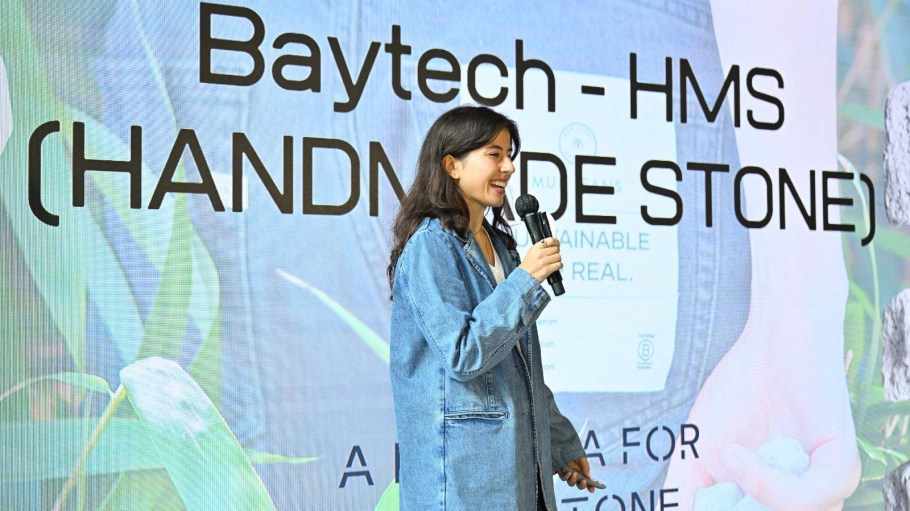
Baytech-HMS (Hand Made Stone) is settling into its first international office space in London.
In October, the Turkish supplier of ecological pumice stone alternatives, won first prize in the Techstyle for Social Good Global Innovation Challenge organized by The Mills Fabrica for its innovative and sustainable approach to denim washing. The grand prize includes mentorship from the sustainable materials science company Pangaia, complimentary office space in London, and incubation by The Mills Fabrica—support that’s providing valuable resources to propel Baytech-HMS’s growth.
Related Stories
The Techstyle for Social Good Global Innovation Challenge is an annual competition that recognizes innovative solutions to sustainability challenges in fashion and agriculture. HMS was selected from more than 150 applicants and was named one of 8 finalists from Brazil, Hong Kong, Thailand and the U.K. To be eligible, at least one member of the company’s core team must be a student or has graduated within the past three years. Beyza Baykan, founder and managing director of Baytech-HMS, graduated University of South California in 2022.
Baykan has relocated to London for the opportunity. “We didn’t have to move, but establishing a presence in London as part of Mills Fabrica program was a strategic decision,” she said. “London is a global hub for fashion, sustainability, and innovation, and being here allows us to connect with the right brands, manufacturers, and retailers who are pushing for more responsible production methods. The opportunity to work from Mills Fabrica’s office space and be part of its ecosystem is invaluable for HMS’s growth.”
HMS moved into Mills Fabrica in March and will be based there until mid-June. Establishing its first official office outside of Turkey marks an exciting step in the company’s global expansion. Though HMS has been exporting worldwide for years, having a base in London allows HMS to be more hands-on with European brands and decision-makers. Baykan said it also strengthens the company’s ability to collaborate on activations, retail partnerships, and direct engagement with the sustainability community.

“My primary goal is to leverage this opportunity to scale HMS into a globally recognized leader in sustainable denim washing solutions,” she said.
Baykan’s extensive to-do list includes efforts to secure strategic funding, expand HMS’s reach in retail and manufacturing, strengthen its business strategy, enhance industry collaborations and build community and awareness. “Ultimately, my goal is to leave Mills Fabrica with a stronger network, increased adoption of HMS, and a clear pathway for long-term growth in both industrial and retail markets,” she said.
The mentorship with London-based Panagia began in November and is already proving to be invaluable. “One of the biggest lessons we’ve learned so far is the importance of having a well-defined brand bible—a clear and structured identity that guides everything from our messaging to visual storytelling. This realization is helping us strengthen HMS’s presence and communicate our values more effectively,” Baykan said.
Baykan is immersing HMS into the London denim scene, which she described as a hotspot for emerging designers experimenting with customization, upcycling, and dry processes—which aligns perfectly with HMS’s capabilities.
“Being in the Camden-King’s Cross area, steps away from Central Saint Martins, has exposed us to some of the most creative iterations of personalized denim. The influence of fashion students is undeniable—many have distinct, eye-catching styles,” she said. “London street style is a mix of vintage-inspired workwear, oversized and deconstructed silhouettes, and bold customization. Denim is a key staple throughout the city, whether styled in a bold, statement-making way or kept refined and timeless.”
London’s network of denim aficionados is also rallying around the startup. Baykan said she invited to a workshop with designer Kei Kagami at the YKK Showroom, a dedicated space where the trims supplier regularly offers workshops and giveaways for designers and students, and a had dinner with a group of denim experts at Slowburn, the restaurant that Blackhorse Lane Atelier’s factory transforms into on weekends.
Winning the innovation challenge is proving to be an important steppingstone for HMS to take its impact to the next level and plan out its future.
“Our focus is on scaling up sustainably by expanding our manufacturing capacity, securing key partnerships with brands and retailers, and driving the adoption of HMS as the industry standard in both denim and non-denim washing. We also aim to deepen our global footprint. While we already sell to many countries, there are key regions where we’d like to establish a stronger presence. So, who knows? After our London adventure, we might find ourselves in yet another part of the world,” Baykan said.