No machine or human can yet control the rainfall or temperature of a cotton field, but Avalo is redefining what’s possible, using nature and artificial intelligence to take some of the guesswork out of cotton farming.
Through its Rapid Evolution Platform, the North Carolina-based plant biotechnology startup employs AI-powered genomic analysis to optimize certain traits in crops. Avalo can tailor seeds to region and climate, to grow in harsher conditions and to require less water, fertilizer and pesticide.
Related Stories
By developing crops that can thrive under stress and with fewer inputs, Avalo’s technology not only boosts productivity but also strengthens the resilience of agricultural systems facing climate volatility.
“Our globalized agricultural system has made it so that we have high demand on yield. The Green Revolution has made it so that we can force things to grow very quickly, but we’ve now ran into a situation where all those high intensity farming practices has led to bad sustainability downsides,” explained Nick Schwanz, Avalo’s chief marketing officer. “We have extremely high inputs; we have extremely high soil disturbance. We have very low resilience, because we’ve bred things specifically for yield. And so, the next big frontier in the agricultural world is all about resilience.”
Avalo’s technology is being applied to rice, rubber, sugar and cotton, which Schwanz said quickly rose to the top when its founders Mariano Alvarez and Brendan Collins examined which agricultural industries have not had the same investment or progress as crops like wheat, corn and soy.

“Cotton is one of the most important agricultural products on the planet, but it does not get the same love as some of the massive crops we grow in the United States,” Schwanz said. “It uses, traditionally, a lot more pesticide than any other row crop. It uses a lot of water, and a lot of regions use a lot of fertilizer.”
However, Avalo is on the path to develop low-input, high-quality cotton for these specific conditions.
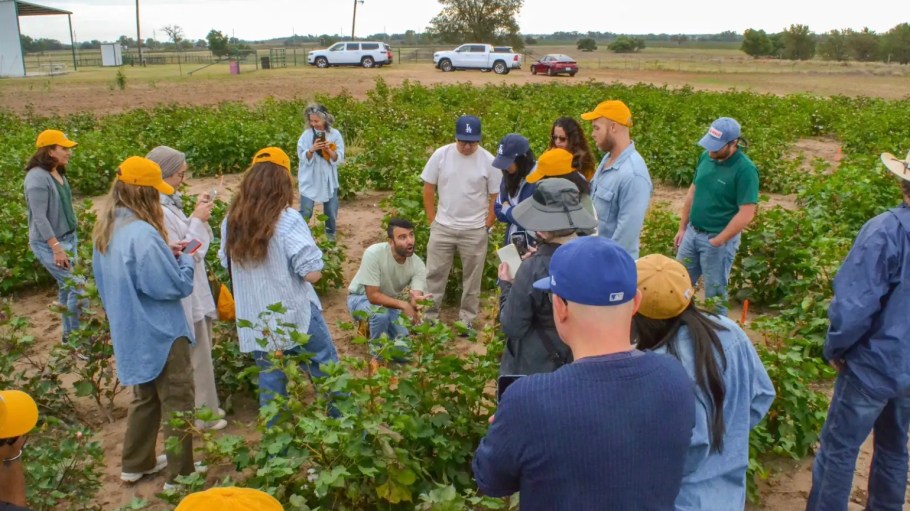
In Clarendon, Texas, on the northeast side of what is affectionately referred to as the “world’s largest cotton patch”—a region of Texas that that produces 30-50 percent of the U.S.’s cotton—stands one of Avalo’s three R&D plots in the state. Sourcing Journal toured the field last month.
Here, Avalo is creating data for a machine to learn from. “If we’re going to train a machine-learning algorithm to forecast how cotton is going to perform, we need to have high quality training data for it. And we live in the real world, and so this is what real data looks like,” Alvarez, who also serves as the chief science officer, said about the test field.
To prepare the plot, Alvarez said the company “raided” the USDA cotton seed bank in College Station, Texas to capture as much genetic diversity as it could, from wild varieties, cultivated varieties, modern varieties, to historical varieties.
“Having diversity in a crop development program is usually bad. You want to get away from it as quickly as possible. But in the context of machine learning, you need variation and diversity in order to learn something. You can’t learn anything about your crop if you don’t see more options,” he said.
In total, Avalo’s 5-acre field has 500 varieties of cotton. Each row is a different variety and each plant is tagged with identifiers. Alvarez emphasized that for machine learning to be effective, it needs to learn the evolutionary history of cotton in a very short period.
Drones are used to create digital maps and collect data that would otherwise be time consuming for humans. Weekly drone flights provide data on how much a plant has grown (measurable by the physical boundary of the plant from the top down) and much light it’s eating, which will help determine if a plant will put out more cotton bowls.
“By doing that every week, the drone adds to a growth trajectory for each of the plants,” he explained. “When there’s a rain event, for example, we can see if the plants are taking advantage of the rain. Are they eating more light because they’re less thirsty? Are they using the available nitrogen in the ground or are they like ignoring the nitrogen that’s available to them?”
The data Avalo collects is fed into a machine learning algorithm, along with all the environmental data that is coming from the field’s weather station so the model can predict the performance of the plants even when farmers put them out in the field in future years. “In this field, we have as much genetic data as 23andme would grab in about a year’s worth of business,” Alvarez said.
For this region specifically, Avalo aims to develop seeds that address its water and climate issues.
“Cotton can be a thirsty crop, and it takes a lot of water,” said Rebecca White, Avalo chief product officer, adding how the region is on top of the Ogallala Aquifer, which spans from south of Lubbock, Texas all the way into the Dakotas.
“The intensive agriculture that we’ve done over the past couple of centuries, especially the last 150 years, has detrimentally affected that aquifer and wells are drying up,” she said, pointing to a nearby well that stopped drawing enough water to have irrigated cotton.
If farmers in this region want to continue to cultivate cotton, they need cotton seed varieties that are not just drought resistant, meaning that they can tolerate it when there’s less rain than expected, but which are bred specifically to grow in low water environments.
White noted that a lot of the genetics that are available in the cotton industry are for irrigated cotton, or they are for wet area cotton.
Farmers also need varieties that are heat tolerant. Rising temperatures due to climate change is problematic for cotton, especially at night.
“One of the things that cotton needs to mature properly, is a good temperature differential between daytime and nighttime temperatures,” White said. “So, if it’s not cooling off at night, the cotton will drop its blooms. That’s a stress response. It would rather be a bush then put on fruit.”
That response, she added, is basically a defense mechanism that signals to the farmer to try again next year.
Cotton produced in this region comes with some limitations. Much of the cotton grown in Texas—especially under dryland, non-irrigated conditions—lacks the fiber quality required for textile manufacturing and is therefore often used for other purposes. White said this fiber characteristic is closely linked to factors like water availability and nitrogen levels.
Despite these drawbacks, dryland cotton offers notable sustainability advantages, including a smaller carbon footprint compared to other cotton varieties. Avalo chose Clarendon for its test field partly because local farmers rotate cotton with peanuts.
“One of the largest inputs in terms of carbon footprint for cotton is the nitrogen inputs,” White explained. “Peanuts, being a legume, naturally return nitrogen to the soil. So, you can grow peanuts for a year or two and then swap your cotton in, and you don’t have to use nitrogen fertilizer. The combination of being lower input in general and rotating with peanuts means that this cotton in particular has a low carbon footprint.”
Cotton will be the first product that Avalo takes to market. Schwanz said the goal is to use this same approach to regionally adapt cotton varieties to any growing region, so that it can have the attributes needed to both meet the ecological, agricultural and economic demands there.
“Taking data from real fields like this and being able to meld that with really advanced technology—that’s come a long way in the last few years, I think we’re going to really unlock some secrets that we’re not aware of,” said Dakota Keyser, Avalo’s production agronomist.
The technology is also creating new opportunities for farmers managing Avalo’s test fields, helping them boost income during challenging times. “The biggest challenge that cotton farmers are facing today is actually an economic answer,” said Roger Wade, a fifth-generation farmer and one of Avalo’s farming partners. “We’ve got a depressed price and increased input prices, which are things like diesel. As much as we want rechargeable electric tractors, logistically, it’s very hard. The chemicals that we’re using are very expensive, and fertility is very expensive.”
Avalo offers farmers a participation incentive of five cents per pound and contributes toward seed costs, supporting farmers both financially and operationally. In exchange, farmers follow Avalo’s guidelines like a limit on upper fertilizers (no more than 30 lbs. per acre) and collects data for a lifecycle assessment.
At its core, Avalo is focused on addressing challenges across the entire supply chain—creating solutions that benefit both ends and generate meaningful synergies throughout.
Schwanz pointed out how the work goes back to breeding resilience—not just breeding crops that can do more with less or maximizing yield—but true resilience for everyone. “You have to win the ecological and eco economical problem at the same time,” he said.