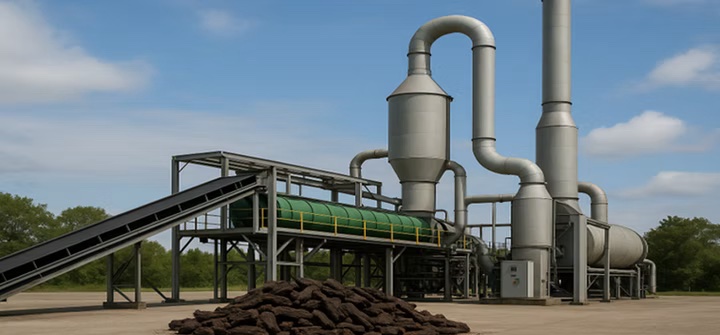
Arvind Limited is supporting India’s first industrial-scale cotton-stalk torrefaction project.
One of India’s leading textile-to-retail conglomerates, Arvind is partnering with Peak Sustainability Ventures, a Mumbai-based global climate investment firm, to build a large-scale cotton stalk torrefaction plant in Gujarat, with a capacity of 40,000-plus tonnes per year.
With this pant, the Gap supplier aims to to accelerate its decarbonization goals and promote torrefaction at scale in the region. The project will convert cotton stalk into torrefied biomass, a cleaner, drop-in substitute for coal in boilers at Arvind’s manufacturing operations, reducing fossil fuel usage.
Related Stories
The industrial-scale project, which is the first of its kind in India for cotton stalk, is intended to serve as an economically viable, scalable blueprint for industrial companies to transition away from coal towards biomass-based alternatives.
It also addresses the over 500 million tonnes of agriculture waste that Peak Sustainability Ventures says is produced in India every year. Corn stalk is the woody biomass that remains after cotton is extracted. Though it is often burned or left in the field, Arvind is currently using it for thermal energy at its manufacturing units.
However, fuel characteristics of the stalk are substantially improved through torrefaction. The thermal process enhances the energy density, stability and handling properties of biomass and increases the calorific value by up to 20 percent, resulting in biomass that closely mimics coal.
The torrefied biomass produced will be used to power Arvind’s industrial boilers, enabling the company to replace at least 20 percent of its coal-based thermal energy needs. In the future, both parties may explore producing biochar from cotton stalks to provide to farmers, which can in turn improve soil health and crop yield and promote regenerative agricultural practices.
“Through this collaboration, we hope to provide validation to the broader industry that waste-to-energy solutions can be economical, circular, and importantly, catalytic in accelerating India’s transition away from fossil fuels,” said Samir Shah, Peak Sustainability Ventures managing partner.
Arvind received a grant from Apparel Impact Institute’s (Aii) Climate Solutions Portfolio Grant program for the project, which helps accelerate Arvind’s transition to become a 100 percent coal-free company by 2030. Additionally, it means Arvind’s global customers can reduce their Scope 3 emissions through decarbonization of their supply chain.
“At Arvind, sustainability is not just a goal; it’s a journey with a sense of responsibility,” said Punit Lalbhai, Arvind Limited vice chairman. “We are innovating in all parts of our value chain to improve our sustainability and long-term business and meet our SBTI targets. This torrefaction project with Peak is one of the best examples of circular economy and waste-to-energy we have seen in the textiles space, exemplifying what a regenerative textile ecosystem can look like. I am proud to announce this collaboration as a bold step toward responsible manufacturing at scale.”
The large-scale cotton stalk torrefaction plant is just one projects that Arvind is investing in to ensure a more sustainable future for India’s garment sector.
In September, the company partnered with H&M Group and Deven Supercriticals Pvt. Ltd. to establish India’s first supercritical CO₂ dyeing machine at Arvind’s facility in Ahmedabad. Arvind is also supporting Future Forward Factories India, a double-pronged initiative with Fashion for Good to produce an open-source portfolio of best-in-class technologies and to a build a demonstration plant to validate the technologies’ environmental benefits.