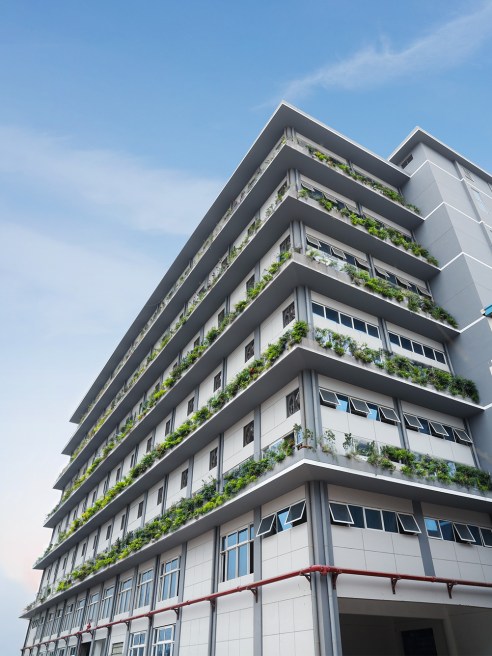
AGI Denim’s new Apparel Park is setting a powerful example of how large-scale production can be reimagined to lower environmental impact while supporting worker wellbeing, as sustainability continues to reshape global manufacturing. The state-of-the-art facility in Karachi, Pakistan, has already earned top sustainability credentials, including LEED Platinum certification from the U.S. Green Building Council, one of the highest honors in green building worldwide.
“LEED certifications evaluate buildings on a range of sustainability measures, including energy and water efficiency, carbon emissions and material use. Platinum status, which is the highest level achievable, reflects strong performance across all categories. Our Apparel Park’s LEED Platinum certification demonstrates leadership in sustainability as we drive greater accountability across the industry,” said Henry Wong, vice president of product development and marketing at AGI Denim.
Related Stories
Part of what distinguishes AGI Denim’s Apparel Park is its early-stage planning and integration of sustainable design practices. The facility is situated in an urban area, which encourages public transit, cycling and walkability, choices that help limit employee transportation-related emissions. Additionally, about 40 percent of the site is devoted to green space, which aids in rainwater management and supports local ecosystems.
Water conservation has also been a focus. In fact, the facility has reduced its freshwater use by an estimated 30 to 35 percent by incorporating a combination of low-flow fixtures, drip irrigation systems and gray water reuse strategies.
On the energy front, the vertical denim manufacturer reports that 30 percent of Apparel Park’s power comes from renewable sources, including biomass and photovoltaic energy, the process of converting sunlight directly into electricity using semiconductor materials.
Inside the facility, attention to worker health is visible in features like improved air quality, access to natural light and use of non-toxic building materials. These elements align with an industry-wide shift toward prioritizing both environmental and human well-being in manufacturing spaces. As part of its commitment to employee well-being, AGI Denim also introduced a childcare unit and dispensary facility at the Apparel Park.
AGI Denim has also looked beyond its own operations, developing solutions in collaboration with regional and global partners. For example, the Apparel Park aligns with frameworks like the United Nations Sustainable Development Goals (SDGs), the Science-Based Targets initiative (SBTi) and certifications like Global Organic Textile Standard (GOTS) and Oeko-Tex.
“While certifications like LEED Platinum signal progress, they also raise questions about scalability and accessibility across the industry. Apparel Park serves as a case study in how denim manufacturing can evolve, but whether this model can be adopted more broadly across different geographies and economic contexts remains to be seen,” said Wong. “Still, as brands and suppliers navigate mounting pressure to decarbonize, facilities like Apparel Park illustrate what’s currently possible and where challenges still lie.”
To learn more about AGI Denim and its Apparel Park, click here.