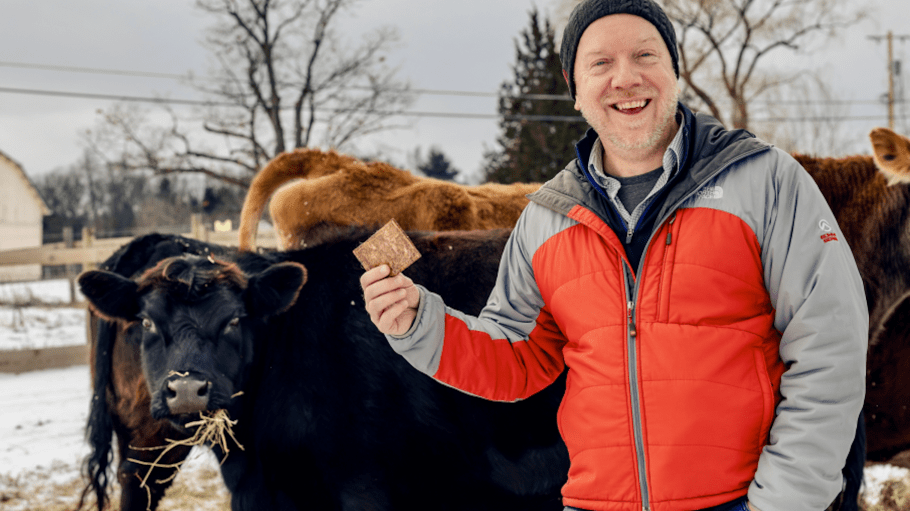
Move over, MSCHF. There’s a new cow in town.
Meet Angel: a living and breathing, sanctuary-grazing cow at the Sweet Farm animal sanctuary in upstate New York. She lived on a black angus ranch in Northern California, per the 50-plus acre farm, and was tagged for slaughter after two stillborn births—standard practice in controlled breeding programs, according to a paper out of the University of Missouri Extension.
Enter Cultivated Biomaterials: the mind behind the unprecedented, theoretically heirloom, harmlessly-cultivated leather jewelry collection, Angelry. The Raleigh, North Carolina-based company began a 60-day-long crowdfunding campaign for its lab-grown collection, as grown using Angel’s skin cells—hence the name.
Related Stories
“Angelry is more than just a fashion statement. This is a symbol of progress,” said biomedical engineer George Engelmayr, founder of Vasavance and, later, Cultivated Biomaterials. “Progress for animal welfare, progress for sustainability and progress for our planet.”
The company positions its campaign, in the sustainable luxury space, as creating “luxury cultivated leather without environmental or ethical compromises.”
Engelmayr spent the first part of his career engineering biomedical tissues, like heart valves and muscles, to save cardiac patients, as he prefaces in the campaign video. He’s taking those same skills—as “principles that help us grow tissues for heart surgery apply to growing leather,” per Engelmayr—and applying them through a cellular agricultural lens.
“Our process in making leather involves taking a very small sample of skin tissue from an animal and then using that to grow leather, without harming an animal,” Engelmayr said. “With the cultivated leather that we’re growing from Angel’s cells, we’re first introducing it in the context of jewelry.”

Put simply, that process began with a one-time sample from Angel, about the size of a pea, as collected during a checkup at Cornell University. Engelmayr used this to grow the cells to make the cultivated leather. He does so with his patent-pending plant-based process—made from durable materials like kapok tree fiber—and vegetable tanning. The cells multiply in bioreactors using animal-free nutrients, as developed with UK company Multus Biotechnology. The resulting leather sheets are tanned using natural vegetable processes.
“To allow cells to attach and grow, the Kapok scaffold is treated with entirely plant-based ingredients like sunflower lecithin and zein protein from corn,” the campaign reads. “The real magic happens when Angel’s cells are ‘seeded’ onto the scaffold material, where they grow and produce real collagen, the natural building block of leather.”
As it stands, Cultivated Biomaterials produces leather by hand, at laboratory scale—sufficient to make jewelry with—though tissue engineering. Relationships with the fashion industry and the luxury market at large will be explored post-campaign.
“We’re proving that cruelty-free luxury goods don’t require animal suffering,” said Engelmayr, who founded cultivated meat company Myodenovo about three years before Vasavance. “Angel’s cells create luxury cultivated leather while she continues living and being cared for at a beautiful animal sanctuary.”
The Angelry jewelry campaign kicked off today, with cultivated leather stud earrings, with 10-mm cultivated leather inlays, available in six fruit-forward color schemes as backer rewards. The inlay is protected within a metal bezel, per the campaign, beneath a protective glass dome cabochon. Some awards allow backers to select hypoallergenic stainless steel, while others offer sterling silver.
By crowdfunding, Cultivated Biomaterials is “creating a future where fashion doesn’t cost an animal its life,” per Engelmayr. The campaign puts the biotech company’s pitch in front of the American public benefit corporation’s userbase, which, as of last month, saw over 24.5 million people pledge monetary support toward any of the 650,000-plus projects on the platform, per self-published data. Around 35 percent were repeat backers.
Take Engelmayr’s choice to tap direct-consumers venture capitalist as evidence.
“This successful Kickstarter connects us with people who understand they’re backing one of the most meaningful Kickstarter campaigns—an opportunity to own something that’s never existed on planet Earth before,” Engelmayr said. He referenced the lab diamond market, likely its technology’s disruptive start in the early 2010s; Angelry, too, can create such commotion.
“The difference is our material can’t be commoditized,” Engelmayr said. “There’s only one Angel.”


