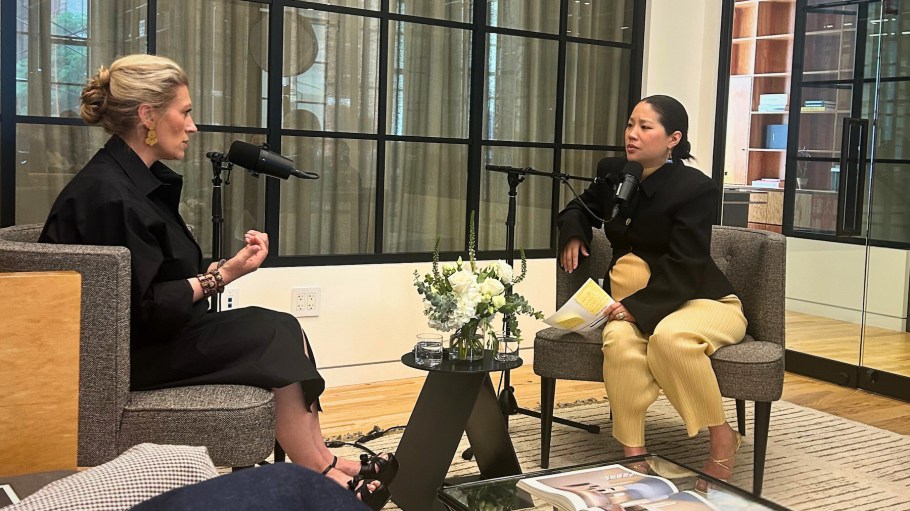
Real climate solutions demand more than talk—they require public and private sectors to move in lockstep, Kering’s sustainability chief Marie-Claire Daveu said at a recent breakfast at the luxury conglomerate’s Americas headquarters in Manhattan.
“I have the strong conviction that the issues are so big, we need really to work together,” she said. “I’m really convinced that we need regulation—sorry, I say that in the United States, but I’m French.”
In conversation with journalist Sophia Li, Daveu traced her environmental convictions back to her childhood on France’s Brittany coast and early years in public service—experiences she said still shape her approach to corporate sustainability.
Related Stories
“Nature was everywhere; it was really part of our daily life. My parents were doctors and really made me understand the fact that nature was important and key to protect,” Daveu said during the fireside. “That was really a key driver for the future, not only for my studies, but also in my [civil] career and also inside at Kering.”
Returning to regulation—and setting French jokes aside—Daveu said real progress requires both pressure and support from the public sector. Rules help, she added, but so does giving companies the clarity and time to make lasting change.
“We understand that a company can’t transform overnight,” Daveu said. “It’s about CapEx. It’s about OpEx. And, if you’re a listed company, it’s also about explaining everything to your investors. It takes time.”
What’s needed, she continued, is a policy that’s both firm and forward-looking.
“If you want to take care of the planet and take care of people, sometimes you have to transform your business models—and it’s not easy,” Daveu said. “It’s quite challenging; you [need] the right governance inside the company, ready to push the transformation.”
However, Li said, asking stateside consumers to maintain faith in corporate America is something of a tall order these days. What’s the solution? Is the industry having an identity crisis? Per Daveu, it’s at more of a crossroads. While it used to be enough to just talk about the environmental part of ESG, it isn’t anymore; customers, clients and employees alike are asking for more information on what’s happening within the other letters.
“It’s important to the consumer. It’s important to the employees because they are very proud to work at a company in a sector that is paying attention to the planet and to the people,” Daveu said. “Last but not least, when you are a listed company, investors pay attention to this kind of topic.”
To that end, Daveu referenced Kering’s ESG Roadshow.
“The [roadshow] don’t speak about sustainability or ESG, but they develop what we call a risk management approach. And beyond a risk management approach, they use the same criteria that we do in sustainability,” Daveu said. “It’s about the resilience of the supply chain and the fact that, if something goes wrong with your brand, you can destroy the brand equity very quickly.”
The presentation was established in 2018 to meet “growing interest for non-financial issues in the financial sector” around ESG transparency. Kering has since taken a two-pronged approach, incorporating feedback from targeted investors into future presentations and overall investor communications strategy. Furthermore, FCLT Global reported, Kering revised its pay structure to align with long-term goals, replacing a vague phantom stock plan with a transparent “free share plan” tied to financial and non-financial (ESG) performance metrics, according to the Boston-based not-for-profit.
“All of the best practices we implement at Kering, we open source—we think that, even if Kering is so big, we are not big enough to change the paradigm,” Daveu said. “We want to involve all of our ecosystem; so that means our suppliers, of course, but also our competitors.”