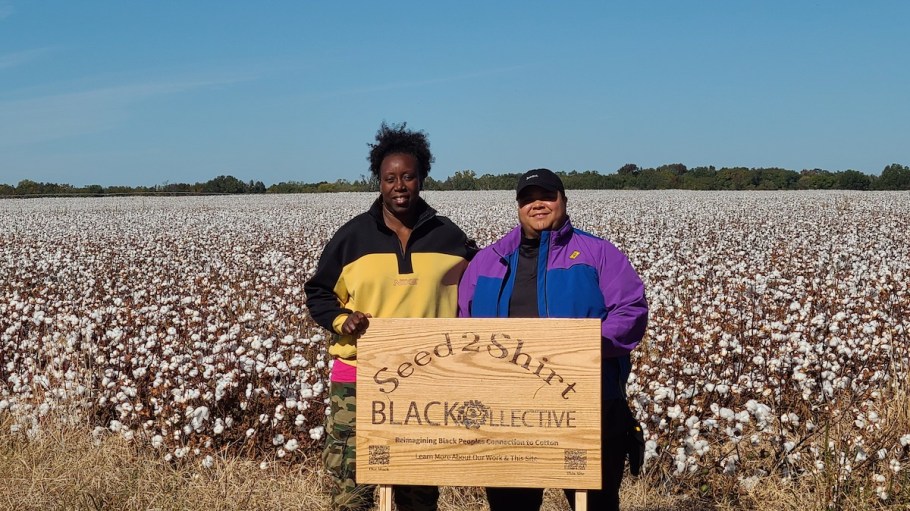
Tameka Peoples was putting on an event for a nonprofit in her California community some years ago, and needed items to fill a swag bag. The Air Force-veteran-turned-cyberspace contractor had an idea for a T-shirt, but because the community and the recipients of these freebies are predominantly Black, she wanted to source the garment from a Black-owned company, made with fabric from a Black-owned mill, with cotton grown by Black farmers.
She couldn’t find any such thing.
It got her thinking that maybe other people were also looking for Black-created goods or garments, and in 2017 the idea for Seed2Shirt was born.
Related Stories
The organization is a nonprofit that assists, educates and often offers various kinds of financial help to members of the Black Indigenous People of Color (BIPOC) farming community in the United States and in five nations in Africa. The pool of Black farmers in the U.S. is small, less than 1 percent of all farmers, with those growing cotton being even fewer.
Each of the five African nations represents a different scenario. In Burkina Faso, for example, Seed2Shirt works with the Union of Cotton Producers, which has 350,000 adherents, but only roughly 8,000 grow organic cotton. About 58 percent of those organic farmers are women.
In the five years since Seed2Shirt was officially founded, Peoples has worked to teach Black farmers necessary skills to improve their yield and lifestyles, in addition to networking skills so participants can share know-how and available resources. There are special programs for women, and others designed to bring young Africans into farming.
“Our mission is to empower those traditionally marginalized to create these climate beneficial products and services and use our profits for good,” she said. “We wanted to have something that supported the farmers who are really the most valuable part of any clothing line.”
The T-shirt component of the business has grown but is deliberately kept relatively small to keep the quality high and not add textiles to the landfill. To date, the company has produced about 4,500 customized shirts, customers for which include individuals and micro-brands, Peoples said. Available in small batches, they are all made from African-grown organic cotton, cut and sewn by African workers, and can be ordered from Seed2Shirt’s California-based website. The cotton is mostly grown in Burkina Faso and refined in Uganda and Kenya. The T-shirts are the public face of Seed2Shirt, one of the few Black, woman-owned, vertically integrated apparel manufacturing and print on-demand operations in the U.S.
The cotton sector operates differently on each continent, but both networks fall under the aegis of a Farmer Enrichment Program. In Africa, it helps farmers with seeds, education, mentoring and tools, often on a loan-to-own basis. Youth programs on the 4-H model are aimed at getting young people to work, and helping smallholders preserve the family farming heritage.
In Africa, the cotton is all organic, GOTS-certified, and goes into a collective crop, most of it destined for Europe or China. Seed2Shirt’s African farmers get extensive instruction in soil science techniques as a way of improving soil and eventually increasing the yield. They face extreme soil issues like nutrient depletion and drought, and with that a serious deficit of organic matter in the soil. Program participants are taught soil regeneration and crop rotation, key to amending the poor soil supply.
BIPOC Seed2Shirt farmers in the U.S. belong to the B.L.A.C.Kollective (Black land agroecology cotton-farmer collective), a membership group that assists with supply chain challenges and markets what they grow, none of which is organic. To encourage them to transition, Seed2Shirt provides a model for the adoption of climate-beneficial cotton farming practices. In the U.S. Seed2Shirt is affiliated with, among other groups, Fibershed, the California-based organization whose goal it is to restore the land and help the carbon imbalance. It also gives farmers curated market access for what they produce.
The U.S. branch of Seed2Shirt also gets the aid of grant money, like that from the U.S. Department of Agriculture’s Climate Smart Commodities, which recently came in with $2.8 billion. Peoples found that award particularly gratifying.
“It allows us to focus on Black cotton growers in the Southeast and help them with transitioning to beneficial, climate smart practices,” she said. “Well over 40 percent of our grant is going to be going towards resources to these growers so they can transition to more climate beneficial and climate smart methods.”
Grants have also come from Fibershed and from the Washington, D.C.-based National Gay and Lesbian Chamber of Commerce. Those were funded in part by the Coca-Cola Company and Johnson & Johnson.
Kyle Bridgeforth is a Black farmer from Alabama who participates in Seed2Shirt. His family works 10,000 acres, 3,000 of which they own outright and have been in the family since the 1870s. Now producing cotton, soybeans, corn and wheat, the property has, since Reconstruction, been passed from generation to generation through droughts, the Ku Klux Klan, systematic racism that took land from countless Black farmers, eminent domain for massive public works projects, the Great Migration, and now, former President Donald Trump’s trade policies with China. It was the biggest market for U.S. agricultural exports and has been sharply curtailed.
Bridgeforth, a graduate of Morehouse College, was in banking before he came back to the farm he grew up on where he now works with an assortment of cousins and uncles. He got a slice of the USDA grant, has gotten seeds and borrows equipment, all with the help of Seed2Shirt. He has also begun intercropping for the first time and is sold on the idea of climate-beneficial practices like carbon sequestration.
Much of his praise for Seed2Shirt is for the networking, which puts him in touch with other minority farmers to focus on the needs of this unique group.
“We try to find ways to get together,” he said. “You don’t just bump into them.”
Working with more Black farmers in the U.S. would be the goal of Seed2Shirt, however difficult it may be to attract them to a challenging way of life. According to Bridgeforth, farming might be highly capital intensive, but “we are trying to find ways to make it work.”