Marc Metrick, chief executive officer of Saks Global, wants nothing more than to move beyond all the financial intrigue and talk of past-due bills, mortgages and debts.
But a skeptical reading on the company’s new financing from Standard & Poor’s and some low-level grumbling from vendors show that he’s not there yet.
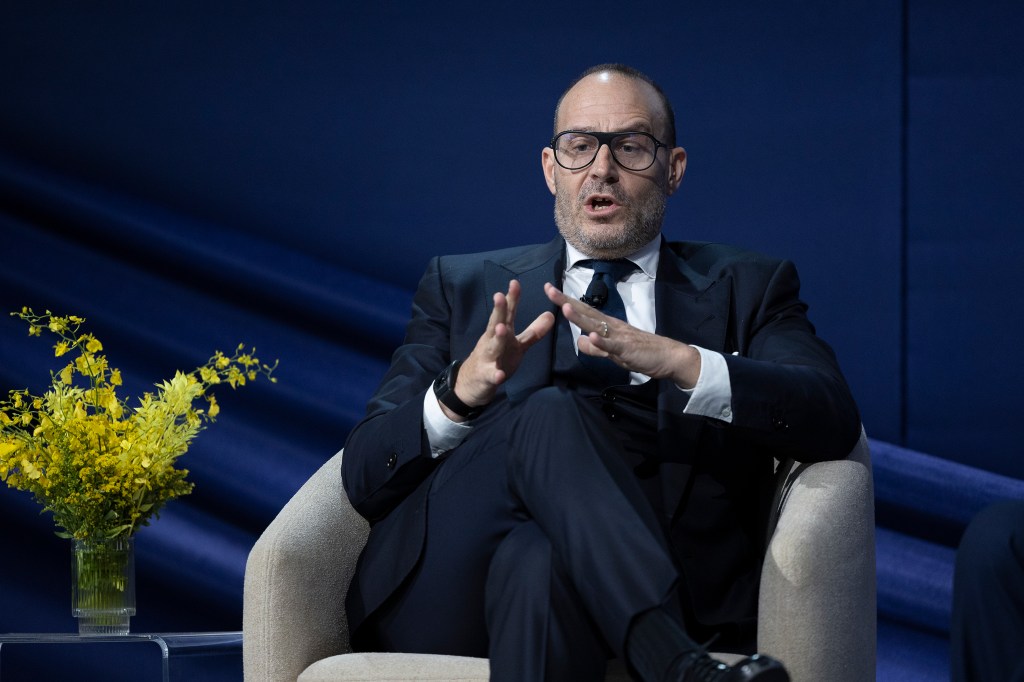
“We need to move on from that part of the conversation and move towards, ‘What are we doing for our brand partners?’” Metrick told journalists gathered for a pre-New York Fashion Week update at Bergdorf Goodman last week.
Related Stories
The CEO said brands would be paid, but insisted that wasn’t “exciting.”
“What’s going to excite them is, I’m going to add 50 percent of volume that we’re doing with you and Saks Global over the next five years,” he said.
Vendors want to have that same conversation.
But the retailer’s financial adventures have been the focus since Saks was combined with Neiman Marcus and Bergdorf Goodman in a $2.7 billion deal in December. This summer, the company brought more debt on board and refinanced most of the money it borrowed to close the deal.
Just after the meeting at Bergdorf’s, debt agency Standard & Poor’s rated the company’s restructured debt at “CCC” with a negative outlook. The rating had been in “Selected Default” after a below-par debt exchange.
Once again, the credit agency sent up a warning flare on Saks Global’s financing, reiterating past concerns and offering some estimates on the future that showed just how much work the company still has ahead of it.
“Our ‘CCC’ rating reflects default risk in the next 12 months without improvement,” S&P said.
Saks exchanged $2.2 billion in bonds issued in December for $762.5 million special purpose vehicle notes (which included $600 million in new money from lenders), $1.4 billion second-out notes, and $441 million third-out notes, all maturing in 2029.
“While the new capital structure provides a much-needed infusion of cash, we expect liquidity will be rapidly depleted by the investments required to stabilize the business amid a challenging macroeconomic environment,” S&P said.
The rating agency expects the company will see a $500 million deficit in reported free operating cash flow this year “partially driven by nonrecurring expenses related with the capital structure transaction, acquisition and higher interest expenses.”
Interest expense to cover all the debt load will be about $400 million over the next 12 months, S&P said — which comes on top of payments due to vendors, for past-due bills and new merchandise.
“As a result, we expect the company will continue to heavily rely on its [$1.8 billion asset-backed lending] facility,” S&P said. “We believe there’s risk of another default absent significant improvement. We continue to view liquidity as less than adequate despite the financial package…
“While potential cost savings from synergies are significant, we believe liquidity constraints can delay implementation,” S&P said. “In addition, we believe operating deleverage will continue to compress profitability if Saks cannot stabilize its business.”
A person close to Saks Global acknowledged that the retailer has to drive sales and keep its promises, but that it will save enough money from the integration to cover any of its needs.
“From a sustainability standpoint, if you look at a company that does $8 billion [in sales] and you look at what does the EBITDA margin need to be to do all these things, and then you think about $600 million of synergies [cost savings from the merger], I don’t know, it’s not where the concern should be,” the source said.
So far, the integration is a work in progress.
Saks Global moved from four different purchase order and supply chain systems to one over Labor Day weekend in a streamlining effort.
“They created duplicative purchase orders in some instances,” said a financial source watching Saks Global’s finances. “They created purchase orders that were not allowed with how the vendors expected their purchase orders to look.”
The result was $110 million to $180 million in canceled orders for holiday, the financial source claimed.
“They’re saying they can get that back,” the source said. “They’re going to reorder, but nobody’s sure if that’s true. We’re not sure if they’re going to get to holiday as smoothly as they could before.”
A Saks Global spokesperson said: “In early August, Saks Global initiated a merchandising systems integration, which was completed earlier this month. While the integration proceeded smoothly for the legacy Saks business, August inventory receipts for the Neiman Marcus business were negatively impacted. This was due solely to a systems integration issue related to data transfer and not related to brand partners delaying shipments. The company is now working closely with brand partners to bring in receipts. We remain focused on executing our multiyear transformation strategy, including working with our brand partners to drive growth, continuing to capture synergies and delivering for our customers across all of our retail brands.”
Brands are willing, but cautious.
“They paid me and so I was happy, but I only have a certain amount of money that I can ship them, that I’m willing to risk,” said an executive at one established brand selling goods to Saks Global.
If vendors are holding inventory for Saks Global in reserve, they can at least borrow against it, the vendor said. But if they ship their goods and are waiting to be paid, that inventory can’t be used as collateral.
“Their systems are a mess at the moment,” the vendor said. “The goods I shipped them, they can’t even receive. I have more goods that I won’t ship unless they pay me down.”
In at least this case, Saks executives seem to have earned back some goodwill. But the vibe is one of wait and see.
“One of two things is going to happen,” the vendor said. “They’re going to dig their way out of it. They own Neiman’s, Bergdorf [Goodman] and Saks. Nobody else is going to get that business. Or they’re never going to figure it out and they’re going to destroy three companies and have to sell them. Something is going to have to give. I want them to figure it out. It’s in everybody’s best interest.”
Bondholders have likewise settled in with their new deal after the refinancing, but are watching.
The rejiggered first-lien bonds have traded at 90 cents on the dollar, which is much better than before the refinancing, but one bond trader who’s closely following the company said the price “isn’t really a huge sign of success.”
“They have the liquidity to get through the end of the year,” said the bond trader. “If they don’t make their numbers in the fourth quarter, it’s going to be really difficult for them in 2026. They have to inflect to positive growth in the fourth quarter.”
But given that many luxury brands have moved to a concession or consignment model, meaning Saks never actually owns the inventory, a good holiday has to be even better to really move the needle.
“If you walk into a Saks store, you’re going to see a pretty nice assortment of industry and brands,” said one industry source. “A lot of the really high-end stuff is not actually owned by Saks, it’s all in there on consignment. Because that’s the case, their actual margin opportunity is depressed. That stuff, they want in the store because it’s the big traffic driver.”
That makes the goods Saks Global buys from brands directly all the more important.
“Vendors that Saks views as critical to them, they’re doing what they need to do in terms of getting them their money and paying them,” the industry source said.
Between orders new and old, interest payments and operating expenses, Saks Global has a lot of demands on the money that is coming into the business.
“They frankly just have an unsustainable debt load,” the source claimed.