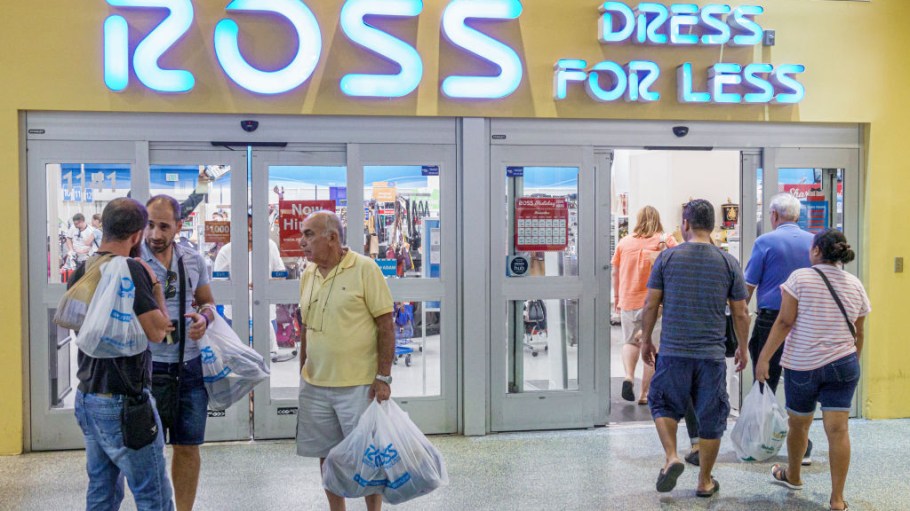
The low-to-moderate income customer who shops at Ross Stores Inc. continues to face inflationary pressures.
While Ross managed to beat first-quarter earnings and sales from year-ago levels, CEO Barbara Rentler said results that were in line with guidance was “primarily due to lower expenses relative to our plan.”
Net income for the three months ended May 4 rose 31 percent to $488 million, or $1.46 a diluted share, from $371.2 million, or $1.09, a year ago. Net sales increased 8 percent to $4.86 billion from $4.49 billion, with comparable store sales up 3 percent for the quarter.
Related Stories
In a conference call to investors, she said “we had hoped to do better,” noting that accessories and children’s were the strongest categories in the quarter at its Ross Dress For Less banner, while California and the Pacific Northwest were the top-performing regions. Rentler said that the retailer’s DD’s Discounts banner saw sales trends ahead of Ross “as shopper responded favorably to its improved value offering.” For newer markets, Rentler said the company is updating its assortment mix to better address the different tastes and preferences of its DD’s customer base. She also said that the apparel business historically improves heading in the second, third and fourth quarters.
Rentler said availability of merchandise is not a problem. “As usual, there are some businesses that have more availability than others. That’s just the natural kind of ebb and flow of the entire scenario,” she said, adding that if the merchants are getting better deals, that’s getting passed along to the customer.
Rentler said the company opened 11 new Ross stores and 7 DD’s in the quarter. The company ended the quarter with a total store count of 2,127 doors.
“We continue to plan for approximately 90 new stores this year, comprised of about 75 Ross and 15 DD’s. As usual, these numbers do not reflect our plans to close or relocate about 10 to 15 older stores,” Rentler said.
Adam M. Orvos, executive vice president and CFO, said lower distribution and freight costs in the quarter were partially offset by the firm’s planned merchandise margin decline. That helped the quarter’s operating margin rise 205 basis pints to 12.2 percent, up from 10.1 percent a year ago.
He also said ongoing macroeconomic and geopolitical uncertainty, including prolonged inflation, continues to squeeze its low to moderate income customers’ purchasing power. In addition, Orvos said the average basket was up slightly in the quarter, and that the company posted higher average unit retail due to a higher mix of brands that was partially offset by lower units per transaction.
For the second quarter ending Aug. 3, the company expects comps to be up 2 to 3 percent, with earnings per share (EPS) in the range of $1.43 to $1.49. He said sales are expected to increase 5 percent to 7 percent. Orvos also said the retailer expects to open 24 locations in the quarter, which includes 21 Ross Stores and 3 DD’s locations.
For the year ending Feb. 1, 2025, Orvos said comps remained unchanged from prior estimates of up 2 percent to 3 percent, with EPS between $5.79 to $5.98.