Along a nondescript street in the small town of Belmont, North Carolina, a community college is quietly helping revolutionize the textile industry.
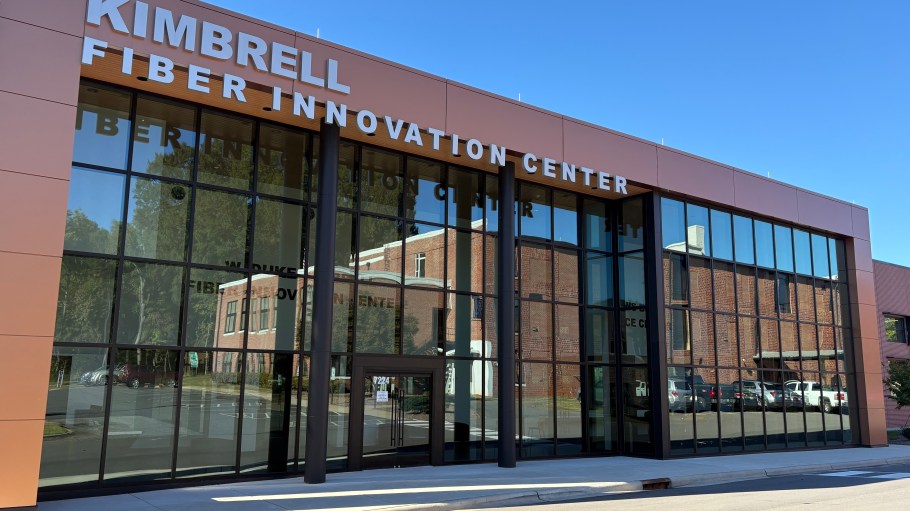
The Kimbrell Fiber Innovation Center at Gaston College cut the ribbon on its new facility in July, and since then, the institution has worked to get the building up and running to service its wide swath of clients ranging from apparel giants to the United States military. These clients come to the Fiber Innovation Center to experiment, test and develop cutting-edge textile technologies, fibers and other solutions that improve the sustainability and performance of fabrics.
Related Stories
“Say someone wants to develop the newest running gear—we can help them come up with the concept,” said Jasmine Cox-Wade, executive director of the Textile Technology Center at Gaston College. “If they have a concept in mind, we can reverse-engineer it and say, ‘these are the components you need,’ and then help them develop the fibers, yarn or fabrics.”
The high-tech processes that the Fiber Innovation Center utilizes to develop those prototypes are a far cry from the institution’s humble beginnings.
Gaston College’s Textile Center was established in 1941 as a trade school for the state’s bustling mill industry, which saw accelerated demand during World War II. For the first few decades of its existence, the center trained skilled laborers for jobs in the scads of textile mills across North Carolina, producing everything from hosiery to towels to upholstery.
“We gave out trade degrees for knitting, fixers, and other trades needed at the time,” Cox-Wade said. “We actually still have people on staff who were students of the trade school.”
As commodity textile production left the U.S. and many of North Carolina’s mills closed during the 1980s and ‘90s, the Textile Center had to evolve. While education remained a priority, the center—which took on the new name of the North Carolina Center for Applied Textile Technology—began to expand its mission to become a resource for the global textile industry.
“We focused on a few areas such as third-party testing and then product development,” Cox-Wade said. “Today we have seven labs and processing areas.”
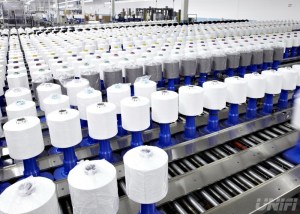
Those areas include facilities for dyeing, finishing, yarn development, woven fabric development, quality testing and other processes housed in the 39,000-square-foot Fiber Innovation Center. The facility utilizes state-of-the-art machinery donated by companies such as Uster, which not only benefit the center, but also the donating entities that can use it as a hybrid showroom.
“These testing units are very expensive, and in order to keep up with what the industry needs, a lot of vendors will partner with us to put their equipment here at no cost,” Cox-Wade said. “We’re able to utilize the equipment for our clients, and it encourages those companies to buy their own machinery after using it here.”
Industry partnerships like this fuel the work at the Fiber Innovation Center. Along with its clients, Gaston College works closely with other textile-focused entities in North Carolina, such as the textile manufacturing and sustainability nonprofit Industrial Commons, which is based in Morganton, as well as North Carolina State University’s Wilson College of Textiles.
The Fiber Innovation Center also recently partnered with Unitec, a university in Honduras that now trains students to work in the textile industry via a program developed with Gaston College.
“Many of the companies we work with are headquartered in the U.S., but they also have locations in Central America, so there was a need,” Cox-Wade said. “There were no formal textile programs there, so we created an online training in Spanish for workers in Central America.”
Gaston College also trains American workers at its Fiber Innovation Center. In 2022, the institution restarted a two-year degree program, and it also offers certificates and credential programs for textile professionals.
“We train about 300 textile employees annually on anything from industrial safety and how to manage a plant to machine operation and textile vocabulary,” Cox-Wade said.
And those students will get a first-hand look at the future of textiles at the Fiber Innovation Center. In addition to helping companies large and small develop and test cutting-edge fibers and materials, the facility also works to promote and scale circularity processes such as textile recycling.
“We want to help translate those ideas into the market and commercialization,” Cox-Wade said. “We do a lot of training and workforce development for local industry that’s focused on circularity.”
Gaston College works with the North Carolina Textile Innovation Engine, a nonprofit that works to promote the U.S. as a center for textile innovation and sustainability, grounded in regenerative materials and circularity. Cox-Wade serves on the organization’s board, and she said they help the Fiber Innovation Center play a larger role in creating next-gen materials.
“We look at how you turn textile waste into something useable, and not just applications such as carpet backing,” she said. “We want to be a bit more sophisticated, working with brands on how customers an take back used items and we can turn them into regenerated fiber. That’s a really big deal for us, and it has brought in a new wave of clients.”
In a state that once dominated the textile industry, the future of that business in North Carolina looks brighter than it has in decades. Entities such as the Fiber Innovation Center and the state’s wider ecosystem of textile organizations have refocused from pure production to an innovative approach designed to meet the needs of the industry’s future. And Cox-Wade said the Fiber Innovation Center plays an important role in that evolution, providing a hub of technology and expertise that allows future-focused companies to develop the next generation of textiles.
“When you think of the textile industry, it’s more than just socks, t-shirts and bedsheets,” she said. “That’s what the U.S. was know for years ago, and it has evolved. We see that with the companies coming to North Carolina, and we try to partner with those organizations so they have a resource and incentive to stay here to do their research and development.”