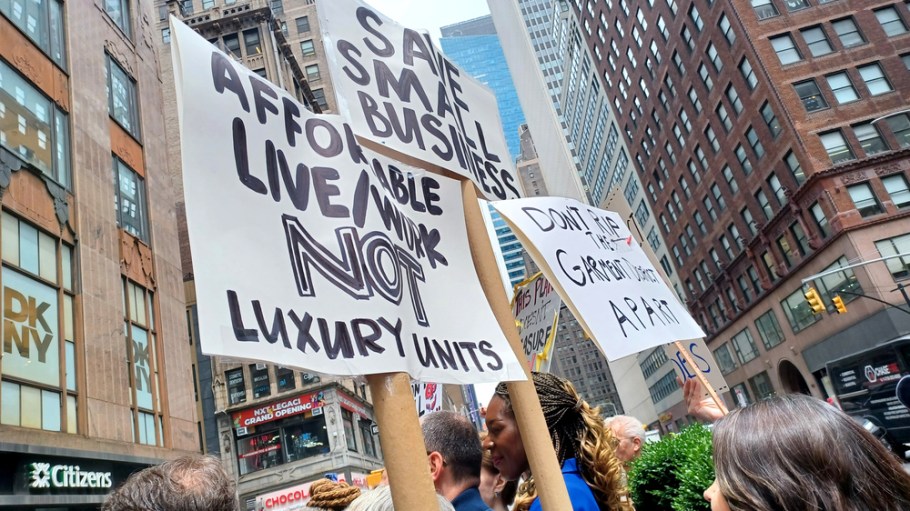
The puns were manifold, but the sentiment behind them was serious. “We are sew not letting this slide,” one sign said. “Don’t skirt around the zones,” read another. “Don’t rip the Garment District apart,” beseeched a third. “We’re not just a notion,” pleaded a fourth. “People want bespoke, not this joke,” touted a fifth, an arrow pointing to a drawing of a high-rise building.
On a steamy Wednesday afternoon in New York City, a picket line gathered on 37th St. and Seventh Ave., just outside the offices of the G-III Apparel Group, to demand changes to Mayor Eric Adam’s rezoning plan for Midtown South, a sprawling neighborhood that includes the 24 blocks that make up Manhattan’s historic Garment District. Many wore measuring tapes around their neck, a sign of their vocation—and allegiance to one of the last bastions of “made in the U.S.A.”
Related Stories
The idea behind the Midtown South Mixed-Use Plan, which the City Planning Commission voted in favor a short while before, is a simple one: Ease New York City’s housing crunch by making way for nearly 9,700 new homes across 42 blocks where new residential construction is currently not allowed and, in so doing, reinvigorate a piece of highly valuable real estate that has struggled to bounce back from the Covid-19 pandemic. While the plan must still be approved by the City Council, which will meet over the issue in August, it’s widely expected to pass because the councilmen who represent the area have spoken out in support of what is being described as a “24/7 mixed-use neighborhood” that will marry residential, commercial and manufacturing interests.
“This plan is an important opportunity to build a more livable, inclusive Manhattan,” Councilman Erik Bottcher said in a statement. “As we move forward, I am committed to ensuring that we strike the right balance between residential, commercial and light industrial uses, fostering a healthy, dynamic mix that supports both the people who live here and the jobs that keep our neighborhoods thriving. Together, we can build a future that meets today’s needs while honoring what makes Midtown South so vital to our city.”
But the “one-size-fits-all” proposal does not take into consideration the “different urban fabrics” of the four disparate quadrants betwen 23rd and 40th Sts. and Fifth and Eighth Aves. in the rezoning area, said Frampton Tolbert, executive director of the Historic Districts Council, an organization that advocates for New York City’s cultural neighborhoods.
“We want housing and jobs, but this plan will have long-term effects and will lead to the increased demolition of existing historic buildings, the loss of thousands of Garment District jobs and businesses, the construction of enormous buildings and the loss of millions of dollars of air rights for existing landmarks,” he said.
“In their rush to give a huge giveaway to property developers,” the City Planning Commission and the Adams administration have “turned their back” on the Garment District, small businesses, not-for-profits, residents and anyone who cares about the architectural heritage of the city, said Joe Rose, former director of the Department of City Planning. He said that while everyone wants more housing and investment in the area, the people in charge are not taking the time to “get it right.”
“We’re not anti-development; we’re not NIMBY,” he said, using an acronym for Not in My Backyard. “There’s no need to choose between housing, jobs and historic preservation. We can have it all, but it takes smart and intelligent planning. So what makes this plan so bad?”

It’s bad, Rose said, because it uses zoning to “pay off” developers to evict commercial tenants from buildings that once housed crucial industries but will now be marked for demolition. It’s bad because it deprives landmark buildings of the value of their surplus air rights. And it’s bad, he added, because any new structures will “overwhelm, suffocate and stand in the way” of emergent areas such as NoMad, referring to the neighborhood north of Madison Square Park, that “need to be the 24/7 mixed-use areas that we all want.”
A coalition comprising the Council of Fashion Designers of America, the New York Fashion Workforce Development Coalition, the Historic Districts Council, the New York Landmarks Conservancy and United Scenic Artists is calling for several major changes to the plan. They include lowering the proposed residential floor area ratio, which limits the total amount of floor space that can be built on a lot, to respect the built environment, encourage adaptive reuse and to ensure that the removal of existing businesses and manufacturing is not being incentivized. And they seek targeted tax relief and other incentives that will keep existing manufacturing and light industrial jobs in the Garment District.
New York City, one of the four global fashion capitals, alongside London, Paris and Milan, is the heart of the $400 billion American apparel and footwear industry, said Steven Kolb, CEO of the Council of Fashion Designers of America, a trade group that speaks on behalf of 450 American fashion and accessory designers. Fashion continues to be an economic driver for the city, employing more than 180,000 people and generating over $11 billion in annual wages. The Garment District, he added, is “where much of that work has historically happened and where it must continue to happen.” Since 2013, the CFDA Fashion Manufacturing Initiative has poured more than $6.1 million into New York’s manufacturing network, supporting more than 2,000 workers. The city must now do its part, Kolb said.
“This is where brands like Oscar de la Renta and Thom Browne got their start, and where emerging designers like Bach Mai and Kallmeyer are building their future,” he said. “And it’s not just about runways. It’s about manufacturing, design, logistics, retail and cultural identity. We’re grateful to the city and the mayor for supporting the industry over the years, but to stay competitive, we need more than gratitude. We need investment, policy alignment and long-promised commitments fulfilled.”
Kolb referred to a 2018 rezoning, during which both the city and landlords pledged to protect the Garment District with dedicated funding, preserved manufacturing space and targeted tax relief. Many of those promises, he said, remain unmet, and “we can’t let that happen again. To keep fashion thriving here, we need real support for space, for factories, for the people who make the industry possible.”
Reached for comment on Wednesday, Joe Marvilli, deputy press secretary at New York City’s Department of City Planning, called the Midtown South Mixed-Use Plan a “thoughtful” proposal to “bring much-needed housing to one of the city’s most centrally located areas, creating a more dynamic 24/7 neighborhood—all while matching Midtown South’s built environment, and supporting its historic districts and landmarked buildings.”
The City Planning Commission has made changes to the original planning, exempting, for instance, new buildings within 15 feet of a landmark from its ground-floor street wall requirements. The change is meant to “strike a balance” between flexibility for infill near historic buildings while still promoting strong street-level urban design rules.
“We value community input, which has included over a year of robust public meetings as well as positive recommendations from Community Board 5 and Borough President Mark Levine, and we look forward to continuing our collaborative work to craft the best plan possible for Midtown South,” Marvilli added.
But the plan, if passed in its current form, will displace at least 779 businesses, many of them immigrant-run, women-owned and union-supported, and more than 5,300 jobs, said Katie Sue Nicklos, owner and CEO of Wing & Weft Gloves, who wore a baseball cap pinned with a patch reading “Midtown is for Glovers.”
“The Garment District isn’t just a ZIP code—it’s infrastructure,” she said. “Thick loft floors built a century ago hold the heavy machines that make our work possible. Zoning laws don’t allow me to operate my three-ton clicker press in any other building in Manhattan—believe me, I checked. Without these spaces, I can’t make gloves the way I’ve been taught. It’s that simple.”
While many businesses have left the neighborhood for cheaper rents elsewhere, Nicklos said that she and others don’t want to.
“We want to be here,” she said. “We choose the Garment District in Midtown because it’s the only place where our work thrives at this scale, at this speed and with this history. So why is the city choosing not to care? Why are we—the city’s most elite makers of couture and costumes—being forced to beg for our survival in our homes? Why is it easier to pass plans that prioritize demolishing our buildings than to create policies that keep us here? Why are the spaces where we still make things by hand treated like a burden, while empty offices collect dust?”
Diminishing the Garment District will have knock-on effects on New York City’s role in television, film and theater, said Deirdra Elizabeth Govan, a costume designer and vice President of United Scenic Artists’ Local 829 union, which represents more than 5,000 artists and designers. She described the neighborhood as her “classroom, laboratory and sanctuary” when she was a student, first at Parsons School of Design, then the Pratt Institute, as she walked “wide-eyed and full of ambition” swatching fabrics from B&J, Elegance and Mood, purchasing her tools from Steinlauf & Stoller and getting trims from M&J. It was here, she said, where she transitioned to the “great halls of Broadway,” working on productions such as “Miss Saigon” and “The Phantom of the Opera.”
“It is one of the only places in the country where a designer can source, pleat, dye, stitch and deliver a garment within 24 to 48 hours,” she said. “It’s not just efficient, it’s exceptional.”
The stakes involved are also high, Govan said: The city’s film and television industry generates some $63 billion per year and employs more than 100,000 New Yorkers. Broadway contributes $14.7 billion annually to New York City’s economy and undergirds 97,000 local jobs.
“This district is the location that makes all of that possible,” she said. “If we lose it, productions will go elsewhere, and when they do, they’ll take jobs, local spending and city revenue with them. We support the need for affordable housing and expanded opportunity, but we cannot accept a vision of progress that lifts one community by displacing another, would wipe out good-paying union jobs and push thousands of skilled workers out of the New York City workforce they helped build.”
That the crowd might be thinner or less diverse is a product of tensions born of the Trump administration’s anti-immigrant policies, which resulted recently in an Immigration and Customs Enforcement raid of several Los Angeles businesses, including in the city’s Fashion District, said Tessa Maffucci, assistant chair of fashion at the Pratt Institute, who was with her six-month-old son, Finn. (It was his second protest.) The multi-family, multi-generational immigrants who make up a large part of the neighborhood, but toil mostly invisibly behind the scenes, are being represented by those who possess the privilege to show up in person, she said.
“We lose all of this at our peril,” Maffucci said. “It’s our creative community that drives this city. These are working-class jobs that are the backbone of our city’s creative industries. This is our cultural identity.”
For Mai, whom Kolb namedropped earlier, the Garment District is the “last place in the world” where such an ecosystem of skills exists, “right in the middle of the city.”
“As a young designer, as an emerging brand, I don’t have the resources to have my own atelier. I can’t build out a team of all of these different skill sets that are available here. But the Garment District, by allowing everyone to share their expertise. It’s like having our own New York-based atelier.
There’s a distinct advantage, he said, of being able to walk down the street to Tom’s Sons and ask them to develop a special pleat for him or to go upstairs to New York Embroidery Studio for a chat about stitching.
“And there’s always a last-minute something—some celebrity needs something in a week or the client has an emergency, and the fact that we can go down the street and find fabrics, get things printed, get things embroidered, work with these artisans and have the clothes made, too,” he said. “We’re making the clothes here. I don’t think people realize that it’s not just one-offs. There’s knowledge and history and know-how that need to be saved and cherished. It can’t just be about financial profit. There’s a cultural profit at stake here.”
It was only two years ago that Custom Collaborative, a nonprofit that trains low-income and immigrant women for careers in sustainable and ethical fashion, opened a 10,000-square-foot facility for that purpose in the Garment District. This could now be under threat.
“For generations, garment jobs have been a pathway to economic independence, especially for women and immigrants,” said Ngozi Okaro, the organization’s founder, adding that both groups are currently “under attack.” “This was true when our grandmothers sewed in factories, and it’s still true today. The Garment District in New York City is not just a place on the map—it’s an engine of opportunity. If this community ecosystem is gutted, we don’t just lose square footage; we lose jobs, we lose hope and we lose a pipeline that has empowered women for generations.”
The city needs to be expanding these opportunities, not eliminating them, she said, before ending on another pun, equally heartfelt: “Rip seams, not communities.”