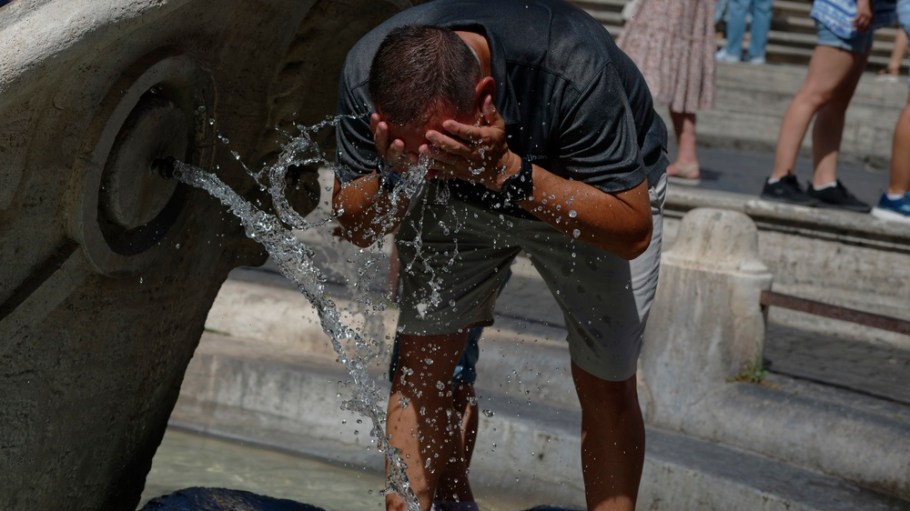
Factory workers and outdoor laborers across Italy are threatening to strike as the country continues to bake under a scorching anticyclone-driven heatwave.
“Staff should be given paid leave when the temperature exceeds 35 degrees Celsius,” Salvatore Cutaia, secretary general of the Milan unit of the FenealUil workers’ union, told the Guardian, which translates to 95 degrees Fahrenheit. “They also shouldn’t have to work during the hottest hours, while shaded areas should be created where they can take breaks and water [as] provided—these small precautions can save lives.”
Related Stories
Italy’s central and southern regions logged 7 percent more deaths than usual in July according to health ministry data, with the increased mortality rate especially palpable in southern cities such as Bari, Catania and Reggio Calabria.
Reuters reported two weeks ago that Prime Minister Giorgia Meloni’s cabinet greenlit a furlough program to keep construction and agricultural employees at home when temperatures become too intense, to the dissatisfaction of the CGIL, Italy’s main union, which argues that any such scheme should include other categories of employees, including people working for delivery firms.
Under current Italian law, agriculture companies can apply for temporary layoffs for no more than 52 weeks over two years, or 90 days per year. Extending the decree is expected to cost the state 10 million euros ($11 million), according to a draft, though the government said that some of the cost could be covered by funds from the ordinary furlough program, which hasn’t yet run out.
This comes after at least five Italian workers died last month from what is believed to be heat stress amid the anticyclone known as Caronte, which sent the mercury shooting past 47 degrees Celsius (116.6 degrees Fahrenheit) in regions such as Sicily. They include Ciro Adinolfi, 75, who died while operating a crane on the construction site of an Amazon warehouse in the town of Jesi in Marche.
Amazon told the Business & Human Rights Resource Centre on Monday that it was deeply saddened to hear of Adinolfi’s passing. The Everything Store said its supply chain standards require its suppliers, including third-party contractors, to provide workers with a safe and healthy work environment that avoids harm to workers’ physical and mental health, including providing them with adequate ventilation, PPE, rest options, sun protection and hydration when necessary.
At its workplaces, Amazon said it uses forecasting tools to predict increased levels of heat in order to adapt its processes accordingly.
“All our buildings are equipped with temperature controls, and we have implemented a range of measures in our facilities during periods of extreme heat,” it said. “These include providing cool-down areas with everyone encouraged to take a break anytime they need, cool water in work areas, and safety tips for all workers distributed through online and onsite communications channels about heat-related illness and hydration guidance.”
Italy’s workers aren’t the only ones willing to hit the streets over hot weather protections. After a summer of record-breaking temperatures in the United States, UPS’s 340,000 Teamsters union members made heat safety a central issue while negotiating for a new five-year contract. In June, UPS tentatively agreed to equip all new vehicles in its 95,000-vehicle fleet with air conditioning beginning in 2024. Should the agreement be ratified, current vehicles will get two fans per van, plus air induction vents to cool off the back.
Last week, Amazon warehouse employees in California “marched on managers” after enduring weeks of extreme heat and subpar safety protections at the San Bernardino KSBD Air Hub, according to the Inland Empire Amazon Workers United, which filed a complaint with the Division of Occupational Safety and Health demanding regular heat and preventative cool-down breaks, among other things. While the retail Goliath told Fox 11 that such protective measures were already in place, employees said that there was little consistency in implementing them.
“Amazon has been promising us shade structures outside for months, but we still don’t have them. When Cal/OSHA was here, managers staffed up crews to give us more heat breaks and kept the water coolers practically overflowing,” said employee and IEAWU member Rex Evans, adding that this lasted 24 hours before returning to “business as usual.”
The increasing number of extreme weather events is a hallmark of climate collapse caused by burning fossil fuels and other human activities, scientists say. July 6, with its global average temperature of 17.1 degrees Celsius (62.6 degrees Fahrenheit), was Earth’s hottest recorded day, according to the United Nations’ World Meteorological Organization.