For the material innovators reshaping the industry’s understanding of sustainability, brand interest is often abundant. Commitment, less so. Welcome to innovation tourism: where the best intentions meet the cold economics of the market, rife with minimum order quantities and biotech that takes more than a seasonal cycle to scale.
Behind the scenes, a few emerging biotech firms are trying to make the brand partnership work. As a result, startups report spending unexpected, finite resources on relationships that rarely translate into scalable enterprise.
Related Stories
Still, no one’s throwing in the terry towel—recycled or not. Instead, these next-gen founders are calling for collaboration models spun from transparency, education and mutual respect.
The next-gen space can feel more like a roadside attraction than a final destination, according to Uncaged Innovations’ co-founder and chief executive officer, Stephanie Downs. Recognizing the toll of indecision and exploratory work is one of the reasons the New York-based team now opens every conversation with the same question. How a brand responds, per the sales executive, is a good litmus test for potential follow-through.
“We’ve learned to ask right up front: ‘What are you solving for? What are your targets? Are you looking for plastic-free, 100 percent bio-based, or something else?’” she said. “If they can’t tell me that, I know they’re just curious, not committed.”
By demanding clarity on sustainability goals and performance metrics from the jump, the firm filters out otherwise weak commitments from companies that cannot articulate precise objectives or ask about Uncaged’s non-starters. Downs equated it something like window shopping. “They come into the store, try on 100 outfits, don’t hang anything back up, and leave without buying,” she said. “Meanwhile, we’re left holding the FedEx bill.”
This failure to translate curiosity into actual products on shelves can arise from the “too many cooks” syndrome—instead of a symphony, it’s a cacophony of competing voices.
“We’ve seen projects die even after the product was developed,” one executive said. “Just because corporate didn’t like the margin math. Things can end there, even when the products are already on sale.”
Another innovation insider who requested anonymity has a similar tactic, now asking brands to rank priorities—cost, sustainability, scale—before getting too far down the road. It’s a quick way to weed out tourists from would-be residents.
Another innovator shared a quiet terror: if the first product made with her next-gen material is bad, it could doom the whole idea’s future. That’s why she walked away from a brand partnership—the design was so off-base, she feared it would flop and taint the next-gen material’s reputation.
“One brand wanted our first product in a color that was, honestly, urine yellow. I gave them a few better options; luckily, they liked one,” a separate startup said. “That first product matters. If it flops, it’s not just bad for us—it’s bad for all of us in this space.”
As it is when brands default to legacy sourcing habits. Most corporate players are accustomed to options of options. When those expectations carry over to a next- or new-gen supply chain, the absorption rate doesn’t quite translate, but it accrues all the same. In turn, the margins stretch and costs rise, effectively knee-capping an already cash-constrained cohort.

Pushing institutional inertia aside, Hydefy general manager Rachel Lee, for one, is focused on the opportunity at hand: education. The Fynder Group startup leverages a “small yet mighty” microbe to grow its fungi, Fy. The novel, NASA-backed material is then combined with other nature-derived inputs—like sugarcane—to make vegan textiles.
“If we start to talk about development agreements or go beyond sampling fees, I straight up ask, ‘Who is your decision maker?’ And, interestingly, it catches a lot of brands off guard,” Lee said. “It just goes to show that we’re in this new territory.”
New territory or not, corporate brands still skew collaborative-averse. Most expect responsiveness without co-development or risk-sharing, which undermines long-term innovation.
One founder contrasted fashion with the automotive industry, where R&D efforts are deeper and more supportive than meets the eye. Fashion brands, meanwhile, tend to approach material innovation like kids in a candy store—wanting options, asking for new “flavors” from a distance.
“They walk in and say, ‘Do you have a green candy?’ They don’t realize they could be helping us invent a new kind of candy,” Hannes Schönegger, co-founder and CEO of Bananatex, said. “But that takes commitment, not just the position of the buyer.”
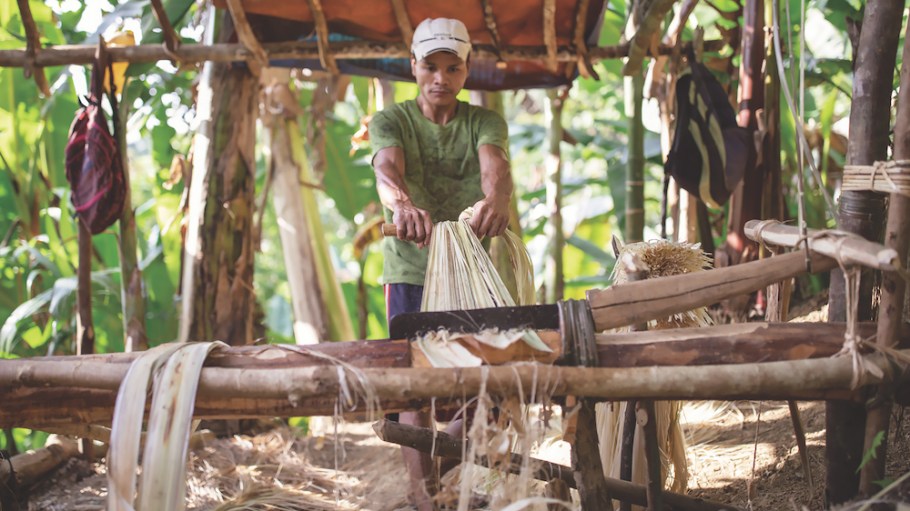
A 100 percent banana-fiber fabric, made entirely from abacá hemp, was launched in October 2018 by Swiss brand Qwstion, which Schönegger also co-founded, back in 2008. A decade later, the label launched its durable and biodegradable fiber as an open-source project. It’s since been used by the likes of Stella McCartney, Balenciaga and MCM Worldwide.
“If a brand genuinely understands its material impact and wants to scale long-term replacement—not just launch a capsule—then meaningful partnerships are possible,” Schönegger said. “But that intention must be real, and it must be company-wide.”
To that end, Downs asked the group if anyone had seen progress in how brands treat suppliers. In her experience, nothing’s really changed. Despite trade shows and industry events highlighting these pain points, many brands still treat innovators like traditional mills.
Brands tend to give directions—a hanger in hardwood or a swatch with shimmer—that remove collaboration from the equation. And every season brings a fresh wave of teams unfamiliar with how to work with each other.
Such turnover, per Schönegger, keeps the cycle of treating startups like vendors (and not partners) all too familiar.
“From working with all these different brands, it really revealed how they are used to working with their suppliers, and it’s not on an eye-to-eye level,” Schönegger said, noting it’s just the way this business works—or, at least, has. Why not try something else?
“We have to make the point [clear] that we are not a normal supplier contributing to this whole situation,” he said. “We are actually trying to be the solution, and that’s why we have to work on a different kind of relationship with the brands.”
Even when internal teams align with a startup, corporate politics and bottom-line math can kill momentum. The product might even make it to market—but without buy-in from leadership, it can get buried.
Biofurworld was born with that pain point in mind, according to founder Kym Canter. “We very intentionally set out to make a drop-in solution, right? Because we knew that was going to be significant in getting adoption,” she said. Canter founded the startup in 2022 to develop compostable, biobased fur alternative in partnership with Senbis Polymer Innovation.
The former J. Mendel designer’s tactic makes sense: drop-in compatibility reduces friction. Innovators who build with existing supply chains in mind report faster adoption, especially among volume-heavy brands who can’t afford to retool systems.
“So much comes down to supply chains—the complexity of supply chains and how difficult it is to change even tiny things in supply chains,” an anonymous executive added. “Unless it’s an exact drop-in solution, it’s more challenging—especially right now; R&D budgets are slashed, and everyone’s concerned about margins.”
The hardest solves tend to happen in the 11th hour: after an unpaid custom order is received. Only then, it seems, are brands interested in collaboration. It wouldn’t be so bad if it was a legacy—or otherwise widely-available—fabric. But for Uncaged, BioFuze runs $3,000 a roll.
Granted, there’s no expectation of a signed-and-sealed deal for every sample sent. A prototype or proof-of-concept, though, would be ideal; that kind of commitment signals seriousness and gives startups marketing fuel and/or internal momentum.
“Most brands don’t understand that an agreement, ramp-offs or not, can mean real funding for us,” Downs said. “But it shows traction, and that matters when you’re raising.”
When early-stage innovators inherit these expectations, projects drag on and costs pile up; evaporating any limited cash runway.
“I feel like we’re always stuck in this ‘you have this, so can you make this?’ cycle—that’s just going to plague us forever,” Canter continued. “To some degree, that’s human nature. But to another degree, we probably need to get together and draw a line in the sand.”
Weighing in with the designer’s perspective, she reiterated that brands aren’t trying to harm startups. They’re just stuck in an old system—one where suppliers are seen as lesser, and design whims reign supreme. Until that power dynamic shifts, Canter said, startups will keep getting steamrolled.
“Designers ask for everything because that’s how the system works,” the House of Fluff founder said. “You think you have a brilliant idea, but you don’t know if it works until you see the sample. It’s the real nature of the beast.”
On the surface, many corporate-startup engagements look like alignment: sustainability goals, innovation targets, shared ambitions. But beneath that, Lee considered, there’s room for disconnect—one rooted in how brands are accustomed to working with suppliers versus how they could work with innovators. “What takes 12 months at a legacy supplier can kill us in two,” she said.
It’s a shared belief that most brands want to do better, and that they just don’t know how. In turn, next-gen startups are ultimately (perhaps unwittingly) expected to act like fully-scaled mills. This disconnect (between good intentions and outdated systems) can upend (and undermine) progress. More specifically, the operational pace between brands and startups is mismatched; Downs likened the dynamic to a speedboat trying not to get crushed by a container ship.
Granted, these are the same brands that have been burned before. Early alt-material pioneers were not perfect.
“Let’s be honest,” one executive said, “some of us are paying for the sins of the last generation of innovation.”
On the other hand, some brands reach out with no intent to follow through. One told Downs they’d only consider lab-grown leather once it was cost-equivalent to conventional—a timeline some decades ahead that one exec called more akin to an avoidance plan than innovation goal.
“We’re not trying to beat up on brands,” Downs clarified. “But the old system is the real enemy—and it’s got to go.”
Consider that the old model in question makes material decisions based on price, not planetary impact. Which means new-gen materials are often priced by analogy, valued in comparison to traditional materials. The trouble is, those legacy fibers—let’s say, leather and polyester—are seriously subsidized.
“At the end of the day, we compete with material that is not sold at its real cost. There’s a price, but it is much lower than the real cost,” Schönegger said. “The real cost—that’s paid by nature, farmers, future generations.”
Until regulation raises the cost of unsustainable options, margins will dominate—what Schönegger called the final challenge the next-gen space must overcome.
“There are champions within companies—creative teams or innovation teams—who get it. But the project still dies when it hits the corporate layer,” he said. “Maybe the product exists. Maybe it’s for sale. But margin logic takes over and it never gets pushed. The issue is how much of the company has actually made the mindset shift.”
While attending a recent bio-conference, Aniela Hoitink of Dutch startup Neffa came to a similar realization. Neffa focuses on automated 3D manufacturing using circular mushroom-based biomaterials—Mycotex—with zero-waste robotics by German firm, Desma.
Hoitink, also Mycotex’s founder and CEO, noticed the next-gen sector is competing against legacy materials that don’t meet sustainability demands yet cost loss.
“Brands want to be carbon neutral by 2030 or 2050, cut water use by 50 percent—all great goals. But someone has to pay: us, nature, the farmers—but never the brands,” Hoitink said. “If you want a high-performance, sustainable product, it comes with a cost.”
No one is calling for brands to lower standards. They are calling for honesty, accountability, and a shared understanding of what it takes to build something new.
“We’re not suppliers,” as Schönegger put it. “We’re collaborators. If you want change, meet us halfway.”
Despite everything, next-gen’s inbound interest is massive. Jaguar, for instance, recently reached out to Uncaged via LinkedIn, where the company receives regular inquiries from global names. Demand isn’t the problem, Downs said. The problem is the funnel from inquiry to production. For the next-gen movement, it’s fundamentally fractured. She’s never seen anything like it.
“It’s not like we’re out here knocking on doors and peddling our wares, trying to drum up interest,” Downs said. “But something about getting the project to fruition is broken, between the first call and the store shelf.”
This article ran in SJ’s Material Innovations Report 2025. To download the full report, click here.