In the past few years, Hong Kong-based manufacturer Hanin has traded in mass production for an on-demand model.
Hanin’s pivot point came in 2017 when one of its major clients went bankrupt. The company’s response to this disruption was to be disruptive itself and completely change its manufacturing strategy. Instead of producing large orders and then shipping them to customers to retail, Hanin today produces to order, only manufacturing what has already been purchased by end consumers. This e-commerce production model not only cuts excess costs, but it is also more sustainable.
Related Stories
“The conventional push supply chain may no longer be effective and sustainable,” Paul Chan, chief amazement officer at Hanin, told Sourcing Journal. “It hasn’t changed much in the last half century—the processes is complex, too many stakeholders are involved, producing too much waste and not making sustainable profit. Consumers are seeking a personalized, direct-to-consumer approach that caters to their unique lifestyles, with an understanding of the varying needs across different segments.”
As part of this evolution, Hanin shrank its production lines. Previously, each line had 60 people producing 20 garments per day, for a total daily output of 1,200 articles. This provided high volumes, but it also made it more difficult to switch over to different styles if needed, since the entire line would need to be retrained. The revamped “smart production lines” are much smaller, with between five and 10 people, allowing for more agility. Workers are now producing bespoke items for fewer customers.
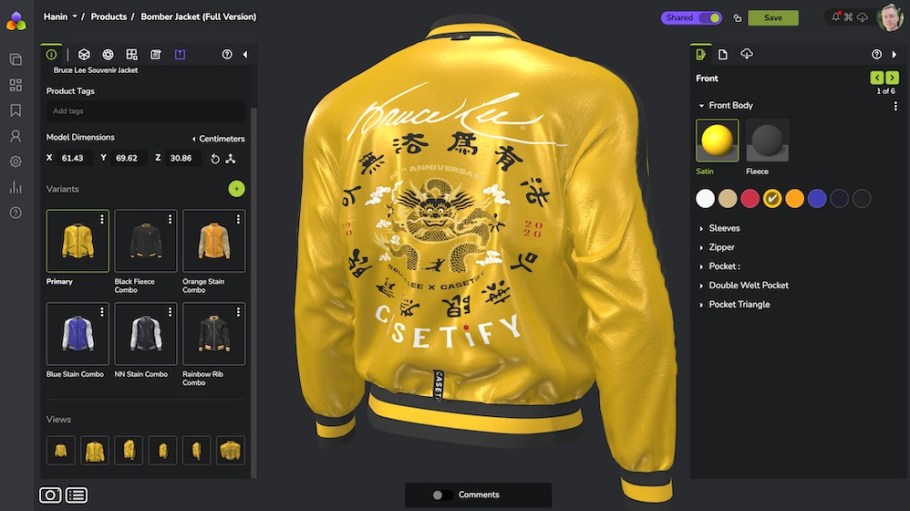
Underpinning this move toward an e-commerce-centric strategy has been Embodee’s Orchids platform, which has functions ranging from virtual product review to manufacturing “recipes.” “Orchids functions as a popular coffee chain’s mobile ordering system,” said Chan. “As soon as we receive an order, our smart factory can promptly manufacture it.”

Hanin has streamlined its design and development stage with Orchids’ web-based platform. Before adopting Orchids, each iteration of a style went through separate internal and external client reviews, feedback was compiled and then the few 3D designers had to synthesize the comments and make changes in the 3D program. In contrast, Orchids creates a centralized hub where 3D designs can be uploaded to the cloud to allow teams from around the globe to access files and weigh in simultaneously. The user-friendly interface enables users to comment in platform, eliminating time-consuming back and forth, and even individuals who do not have a 3D background can make updates such as changing the color or print of an item.
“Embodee’s Orchids allowed Hanin to achieve collaborative digital product design and all stakeholders to work closely together from anywhere,” said Wilitza Vázquez, director of business at Embodee. She added, “Silos between departments and companies are removed and relevant employees are brought closer together, giving them real-time visibility to let them make direct contributions. Decision-making across distance and time becomes faster, easier and less error prone.”
As a result of these workflow changes with Orchids, Hanin shortened development processes that used to take six to nine months to just one month. Additionally, Hanin was able to cut the number of sample rounds from between five and 10 to just one or two, saving time as well as costs.
Vázquez noted how other companies can take inspiration from Hanin. “They transformed their business model by implementing an online solution with little to no training requirements,” she said. “Higher productivity, simultaneous communication and engagement supercharges and transforms the way they work today.”