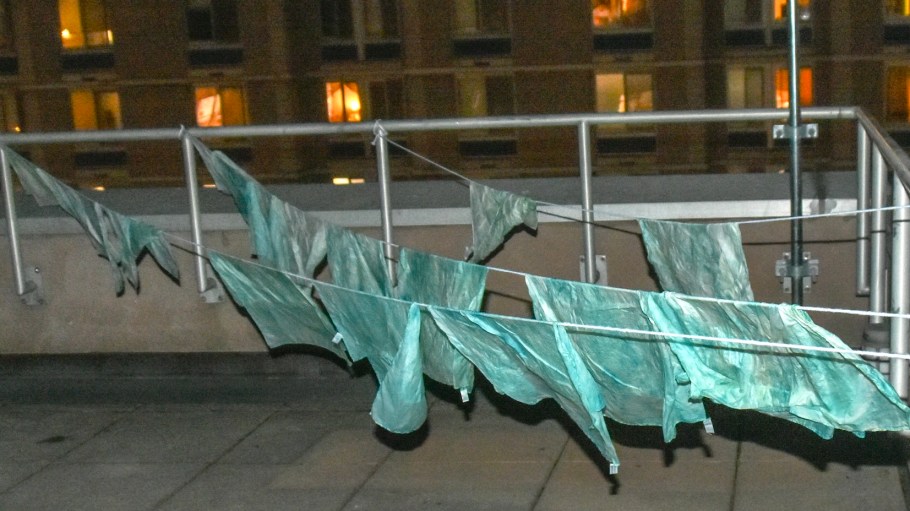
Held Oct. 7 at the Fashion Institute of Technology’s rooftop garden, the “Dialogue + Studio Workshop: Growing the Rainbow at FIT’s Natural Dye Garden with the American Folk Art Museum” session saw attendees tour the garden and transform freshly harvested indigo leaves into vibrant color on silk, creating their own naturally dyed scarf.
“Everyone should walk away tonight with a lovely piece of hand-dyed fabric made from our own leaves,” said Whitney Crutchfield, the garden’s guardian. “It’s been 80 degrees today—not great for plants or the planet—but a beautiful night for us to gather outdoors.”
Related Stories

Crutchfield is also an assistant professor in FIT’s textile development and marketing department and a member of its sustainability council, too. She led the tour, held in conjunction with the American Folk Art Museum’s current exhibition on the ecology of quilts and the country’s natural history of textiles. Standing among rows of dye plants, she gestured toward a cluster of green leaves—woad, the European cousin to indigo.
“You get blue from the leaves,” Crutchfield explained. “It’s part of the spinach family, and it was really Europe’s answer to indigo, because indigo can’t be grown in Northern Europe—or really anywhere above subtropical climates. Woad was the answer to that.”
The student-focused project’s research space supports more than 20 species of natural color-yielding plants—like chamomile and French marigold, plus pollinator plants like milkweed and lavender. Crutchfield walked attendees through both the plants and the college’s collection of dyestuffs, highlighting the institution’s sustainable processes at this rather unique urban greenspace.
The garden is still reaping the fruit of its foundation, too, as the natural dye garden was established over a decade ago. Three students out of FIT’s Textile Development & Marketing BS pitched the idea at the 2014 Clinton Global Initiative University (CGI U) conference in Tempe.
Those students—Caitlin Powell, Amber Harkonen and Meghan Navoy—presented a proposal for a natural dye garden that incorporated rain collection and composting; ultimately underscoring the industry’s future global challenges (plus past and present) and how FIT can tackle them. Of the 695 total commitments made—from the thousands of proposals submitted by collegiates around the nation—FIT was designated as one of the 32 teams to compete in the initiative’s “commitments challenge.”
The textile development and marketing students wanted to spotlight how damaging textile production can be—from water waste and chemical runoff to the side effects of taking too many synthetic shortcuts—and to give the FIT community a hands-on way to explore more sustainable dyeing and farming practices.
The trio said the project was rooted in regeneration—and as a response to the “alarmingly heaven burden” that global textile production (and thus the fashion industry) puts on the planet.
“Excess water use, toxic effluents, the use of petrochemicals on fiber plants as well as in synthetic dyes, and intensive farming practices are all problems that directly contribute to climate change,” the trio said at the time, per FIT. “This project aims to raise awareness about these issues—and, more important, to give the FIT population a tangible way to move away from these practices.”
While successfully developed through this student grant, the garden thrived for several years before going dormant during the pandemic. When Crutchfield revived it in 2021, she set out to diversify its crops, grow without chemicals and rebuild a thriving urban ecosystem—complete with nesting seagulls and a few determined pests. “The goal,” she said, “is balance: honoring our regional ecology while cultivating a full rainbow of color.”
At its core, the garden functions as both a classroom and a research site, giving students a window into the complexities of sustainable dyeing. Crutchfield said the team is studying whether natural dyes can be scaled for use in apparel, interiors, and other products.
“Interest in natural color is growing, but it’s not yet widely adopted commercially,” she said. “Our role is to prepare students to bring these practices into the industry and integrate them where they make sense.”
Their work also challenges the notion that “natural” always means sustainable. Many dyes rely on mordants—metallic salts used to fix color to fabric—that can range from benign to environmentally harmful.
“We emphasize a nuanced understanding of both natural and conventional dyeing,” Crutchfield said. “It’s about recognizing the trade-offs and learning where each approach fits best.”


