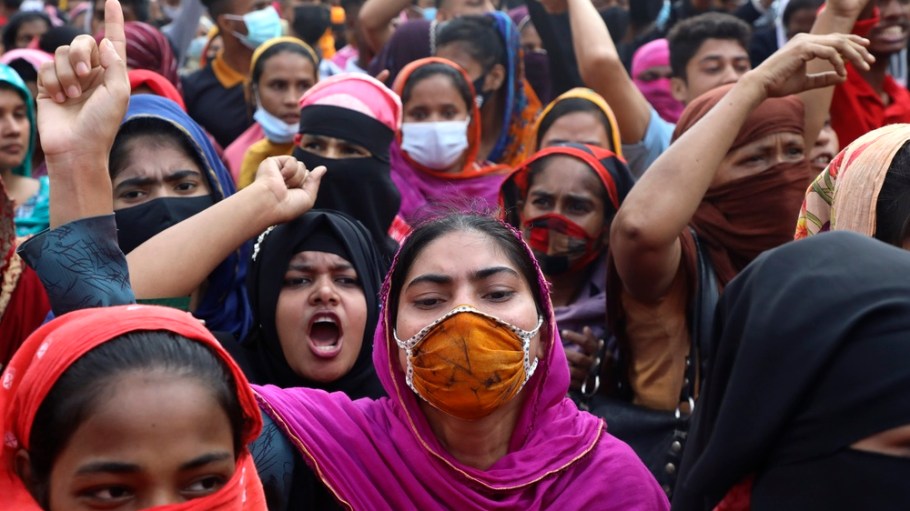
In what labor campaigners are hailing as a long-fought-for victory, Bangladesh’s interim government has dropped all outstanding criminal charges against tens of thousands of garment workers who were involved in the minimum wage protests in October and November 2023.
“This is a massive victory for workers in Bangladesh, for trade unions anywhere in the world and for international solidarity,” Kalpona Akter, a longtime labor activist, said in a statement through the Clean Clothes Campaign. “It shows the strength of workers, of organizing and of international solidarity work.”
Related Stories
Filed by disgruntled factory owners—many of them suppliers to major international brands—at the height of the violent clashes, during which four demonstrators died, dozens were injured, thousands axed from their jobs and 100 placed behind bars, the so-called First Information Reports, or FIRs, were especially pernicious because they were at once arbitrary, non-specific and largely unfounded, activists said.
These, they added, threatened 48,000 workers with the possibility of false arrest for anything from vandalism to attempted murder as a means of repression that was popular during prime minister Sheikh Hasina’s authoritarian regime before it was toppled the following year, essentially criminalizing workers en masse as a warning against organizing.
The protests had started peaceably enough after workers spilled into the streets in mid-October to voice their frustration at the then-monthly floor wage of 8,000 Bangladeshi taka ($65), which had remained stagnant since 2018 despite soaring inflation and the rising cost of living. Things escalated the following month after rumors spread that the Bangladesh Garment Exporters and Manufacturers Association, or BGMEA, the powerful trade group representing factory owners, would go no higher than 10,400 taka ($85) despite demands from unions that only 23,000 taka ($188) would be sufficient.
By the time the wage board announced that the lowest-grade workers would receive 12,500 Bangladeshi taka ($102) per month, full-fledged riots had broken out, drawing police gunfire that killed three workers and resulting in a factory blaze that caused the death of a fourth. Hasina herself told protestors to accept the offer or “go back to their village,” inflaming tempers further.
The American Apparel & Footwear Association, a trade group whose roster includes Adidas, H&M Group and Zara owner Inditex, wrote letters to Hasina “restating” its repeated calls to end the “ongoing detention and the continued threat of detention” of workers related to the minimum wage protests by canceling any related FIRs and preventing future retaliation.
Following additional pressure on the more than 40 brands that were identified as being linked to the suppliers involved in the FIRs by the Clean Clothes Campaign, the Worker Rights Consortium and the Solidarity Center, suppliers ended up abandoning 10 of the more than 35 charges, releasing 10,000 workers. And after the Hasina government unraveled the following August, trade unions were able to persuade the interim government to issue an executive order to withdraw the remaining cases as part of its labor reform initiative, they said.
It’s also because of the Muhummad Yunus-led “caretaker” administration’s efforts that Bangladesh last week became the first country in South Asia to ratify three key International Labour Organization conventions on occupational health, safety, violence and harassment, marking what the Nobel Peace Prize laureate called a day that “will remain a memorable one in the history of realizing the rights of working people in Bangladesh.”
“After the Rana Plaza tragedy, the then government agreed to do everything,” he said through a spokesperson. “But nothing happened as per their commitment. They kept saying ‘it is being done, it will be done.’ But we said, ‘no more it is being done, it will be done, we must do it.’ Since I took office as the chief adviser, labor rights were my first priority. I held meetings time and again and kept saying everywhere that this must be done. Signing this will benefit all of us.”
Now it’s a matter of implementing them, which is “another journey,” Nazma Akter, founder and executive director of Awaj Foundation, a workers’ advocacy group based in Dhaka that has been fighting for formal recognition of gender-based violence and harassment on the factory floor, told Sourcing Journal, her delight almost palpable over the phone. “That’s why we all need to work together: factory management, workers, businesses, government and all other stakeholders. We are happy, but we need to create more awareness to ensure equality, equity and inclusion.”
Writing in a press statement, the Fair Wear Foundation, a multi-stakeholder nonprofit, said that it will be using the ratifications to “shape and strengthen” its future work in Bangladesh by providing a “solid framework” for updating its guidance for brands, suppliers and industry partners, helping them integrate the principles of the conventions into responsible business practices.
“For brands and suppliers, this development reinforces the need to embed robust human rights and environmental due diligence processes, including stronger risk assessment, prevention and remediation mechanisms related to violence, harassment, and occupational safety,” it said. “It also offers opportunities for businesses to demonstrate responsible practices, strengthen worker protection, and build more transparent and resilient supply chains.”
Even so, the two-year ordeal Bangladesh’s garment workers endured over the “baseless” charges was entirely preventable, said Thulsi Narayanasamy, director of international advocacy at the Worker Rights Consortium. Brands, she told Sourcing Journal, stood by as their suppliers used the FIRs as a weapon of reprisal, “ despite knowing from past minimum wage protests how difficult it is to withdraw such cases.” Worse, many brands “disavowed responsibility for this blatant assault on rights,” Narayanasamy said.
“I recall one major British brand even interpreting a request to protect their supply chain workers’ rights as an attempt to ‘interfere in the sovereignty of another country,’” she said. Despite the news, conditions haven’t materially improved much either: Workers who took on crushing debt to survive the menace of looming arrest will now spend years repaying them on wages too meager to live on, Narayanasamy added, extending the “same poverty that drove the protests in the first place.”
And in any case, some 13 percent of the country’s garment workers have yet to receive the full wage hike, according to a survey conducted in May and June and published by the Institute of Bangladesh Studies at the University of Rajshahi last week. Of them, 8 percent received only a partial raise, while 5 percent saw no change in their paychecks at all.
Freedom of association among garment workers, too, is becoming increasingly elusive. And not just in Bangladesh but in other Asian nations like Cambodia and Vietnam, where the use of criminal charges is also being wielded to silence unionists in what Narayanasamy interprets as a “worrying corporate backslide on human rights.”
“While we are relieved the charges have been dropped, the criminalization of workers remains a serious and growing threat across garment-producing countries, fuelled by brands’ ineffective due diligence and their readiness to legitimize, rather than challenge, their suppliers’ repression of worker rights using police complaints,” she said.
On Friday, Kalpona Akter posted on Instagram a photo of a young girl sleeping on the street in front of a gleaming store window, in what appears to be Dhaka, proclaiming a “big sale” with up to 70 percent off on its clothing. It would be just two days later that the body of 14-year-old Marzia Sultana was recovered from the charred remains of a garment factory in Mirpur after a fire broke out earlier this month, raising the death toll to 17. Most of the deaths were caused by smoke inhalation after workers found themselves unable to escape due to the locked rooftop exit.
“Some sleep under bright lights of consumption, others under the same lights—in hunger and exhaustion,” Akter wrote. “This is not fate. This is inequality. Progress isn’t measured by how much we sell, but by how many we’ve left behind.”