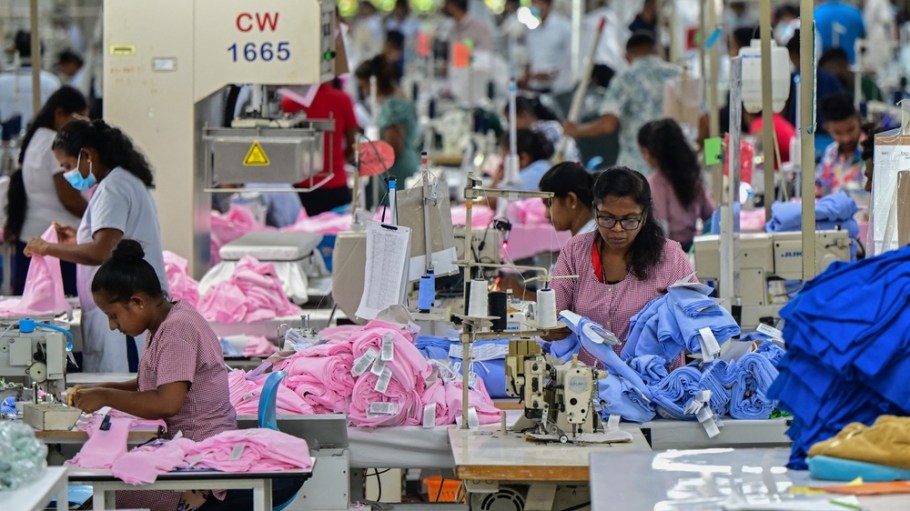
The first sign of trouble appeared last month after movers began hauling machinery out of a garment factory in the Sri Lankan suburb of Katunayake, the only one that Next operates in the South Asian nation with union representation.
“We immediately wrote to the company management, asking, ‘What is going on?’” said Anton Marcus, general secretary of the Free Trade Zones & General Services Employees Union of Sri Lanka, or FTZ for short. “They said that this was normal because it had three factories, so it might send machinery to one factory or bring some to another. There was no problem.”
Related Stories
As it turned out, this was an understatement. At a meeting with the British-owned fashion retailer’s management at its head office a few days later, Marcus was told that Next would be shutting down the factory. In fact, it was already done. More than 1,400 workers, some of whom had been fixtures on the production line for more than three decades, were told that they had been laid off via WhatsApp despite the existence of a collective bargaining agreement that included provisions against termination without prior negotiation with FTZ, an IndustriALL Global Union affiliate.
That this was the second time within a year that an apparel brand was shutting down a unionized factory that it owns and operates—itself a rare state of affairs in an industry that seeks to pare down the costs of production to its very core—has sent alarms ringing across the labor rights community, most of which isn’t buying claims that the closures are the result of poor financial returns alone.
“For some years now, the plant has been unprofitable, and despite our considerable efforts to rectify the situation, we have been unable to make the factory economically viable,” David Reay, Next’s director of manufacturing, said in a statement. “Recently, it has become clear that there is no prospect of this changing.”
Or maybe the closures were economically motivated, just not in the way they’re being framed, said Scott Nova, executive director of the Worker Rights Consortium. Unions, after all, are in the business of raising the cost of employment through higher wages and safer, more humane workplace conditions.“To put it bluntly, you can’t sell the concept of unionization to employers that it’s going to make things cheaper,” he said. “No one’s going to believe that.”
It was only this month that the Washington-D.C.-based nonprofit offered a blistering online rejoinder to Fruit of the Loom’s decision to shutter its two remaining unionized cut-and-sew facilities in Honduras—including one that it had held up as an emblem of labor rights progress—and cut off 3,000 employees. There is no significant apparel exporting country in the world where the right to organize and bargain collectively is respected, in practice, to the degree that it is in Honduras, Nova said. This is largely due to the hard-won efforts of the Central General de Trabajadores, or CGT, to organize the Kentucky-based undie purveyor’s workers.
“These closures are tragic for the thousands of workers affected: for nearly 15 years, they enjoyed respect for their right to freedom of association and better wages and conditions achieved through collective bargaining,” WRC wrote in its commentary. “And, while it is common for factories to close in the garment industry, it is deeply discouraging to see a facility shuttered that has been a widely recognized symbol of genuine respect for workers’ associational rights—in a region and an industry where these rights have often been trampled.”
In “important ways,” this sector-wide progress will be sustained through the tens of thousands of Honduran workers who continue to sew clothes in unionized factories with robust collective bargaining agreements, the organization said. Fruit of the Loom, however, will “no longer be part of that progress.”
Fruit of the Loom, which closed Jerzees Nuevo Día in Choloma in April and will have by now done the same with Confecciones Dos Caminos in Cortés, has defended what it describes as a “multi-year restructuring” of its operations due to “significant disruption” in the North American apparel market, including the “considerable growth” of retailer private label offerings and “increased competition” from products imported directly from Asia.
“We understand the magnitude of these changes and the impact on our team members,” a spokesperson said in a statement. “Decisions to close facilities are only made after careful review and consideration of alternative actions and are in no way based on the presence of unions in a facility.”
But labor activists want to know why Next and Fruit of the Loom aren’t choosing to close their non-unionized factories instead. Could the “real” reason, as Marcus asked of Next, be that the company has realized that having a union mandate annual wage increases—resulting in a 19 percent higher salary than its other units—is a burden it’d rather do without? At the same time, Next also contracts to third-party factories in the free trade zone, he said. It doesn’t have to pay for those workers’ transportation or meals. How can there be a lack of orders at the Katunayake factory if Next is its own client? Couldn’t it simply return the orders that it’s been contracting out to other plants?
“The Katunayake plant is not just another factory; they were producing flagship orders—the shipments are big,” Marcus said. “And Next made 1 billion euros in profit last year, the fourth company in the U.K. to do so. But still they say that this factory is making a loss and they have to close.”
The factory shutdowns come amid what the International Trade Union Confederation describes as a “sharp escalation” in violations of fundamental rights, including access to justice and the right to free speech, assembly and collective bargaining. In its latest global rights index, the Brussels-headquartered trade union federation said that violations of the right to strike and the right to register a trade union remain at “record levels,” underscoring the “intensifying crackdown on workers’ fundamental freedoms.”
Just the right to the legal registration of unions, it said, was impeded in 74 percent of countries, unchanged from 2024 and the worst level since the index began. And the right to collective bargaining was restricted in 80 percent of countries, up from 79 percent in 2024. Hostility against unionization, in other words, has never been higher. Neither has the propensity for union busting.
Far from local issues, the shuttered factories are a reflection of a “larger pattern” of corporations retreating from labor gains “under the cover of a global crisis,” said Kesi Foster, co-executive director of Partners for Dignity and Rights, a human rights advocacy group based in New York City. “Meaningful change doesn’t come from corporate pledges. It comes from workers organizing while allies demand accountability systems that enforce real consequences.”
Workers in Sri Lanka and Honduras have been left stunned by the closures. Despite compensation packages—“materially enhanced,” per Next of its severance and three months in the case of Fruit of the Loom’s—many describe feeling cast adrift, even abandoned.
“A lot of us are depressed because of what we’re suffering and what we’re having to live through without a job, without social security,” Rocio Hernandez, a 19-year veteran of Jerzees Nuevo Día and a founding member of its union, said through a translator. “CGT gave us the chance to have a dignified workplace. Now we are unprotected without employment. I have a nine-year-old daughter, and she needs me, and without employment, it is really hard.”
Marcus, who said that the Next case is being reviewed by Sri Lanka’s labor commission, said that workers from Katunayake have been blacklisted, making it difficult to find jobs at other garment factories, even though Next has offered to help them find alternate employment. Those who have found temporary work as manpower agency employees only want their old jobs back, he added.
Blacklisting was also the norm before CGT and Fruit of the Loom signed their first collective bargaining agreement, said Evangelina Argueta, a coordinator at the union. “The message that we sent back then was a strong message—uncomfortable for those big corporations, because back then, those companies acted that way,” she said through a translator. “Whatever they wanted to do, they could do to us.”
Whether there are other outlets from which workers can seek redress is unclear. The Ethical Trading Initiative, the labor rights multi-stakeholder organization to which Next belongs, said that it’s aware of the “deeply troubling” allegations being raised about the motivations behind the Sri Lankan factory’s closure and that it continues to engage with the retailer to seek a “fair and prompt resolution to this dispute.” Fruit of the Loom left the Fair Labor Association, another multi-stakeholder initiative that promotes human rights at work, last fall after 12 years of accreditation.
What the industry needs to understand is that it takes a “tremendous amount of bravery and effort and time and commitment” by garment workers to form unions wherever they are in the world, said Theresa Haas, director of global strategies at Workers United, an American and Canadian labor union based in Philadelphia. They also have to overcome incredible odds to be able to get to a point where they’re able to successfully negotiate a collective bargaining agreement with a company for rights and benefits that go beyond the law.
“And so when workers are, in the very rare instance, able to do that and succeed in making those gains, it is incumbent upon the brands and retailers that either own or source from those factories to do absolutely everything in their power to ensure that those factories stay open,” she said. “And I think the fact that Fruit of the Loom did not do that in Honduras and Next did not do that in Sri Lanka is incredibly problematic and reflects a lack of commitment by those brands to meaningfully implementing their own codes of conduct.”
Nova agreed. It’s the “nature of the industry” that so many closures happen because brands and retailers don’t place any priority on job stability for workers, he said. Rather, they go wherever it’s cheap, jumping elsewhere when there’s even a “short-term decline in orders,” leaving suppliers and workers to “pay the price.”
“If you were truly committed to gains in this vitally important area of worker rights, you’d do something very obvious: You would prioritize your relationship with that one factory or small number of factories where genuine progress in advancing your own labor standards has actually been achieved,” Nova said. “You would work closely with that factory. You would expand business with that factory. You certainly wouldn’t drop it as a supplier, unless there were no economic alternative to doing so. And yet, we see the opposite from many brands and retailers around the world.”