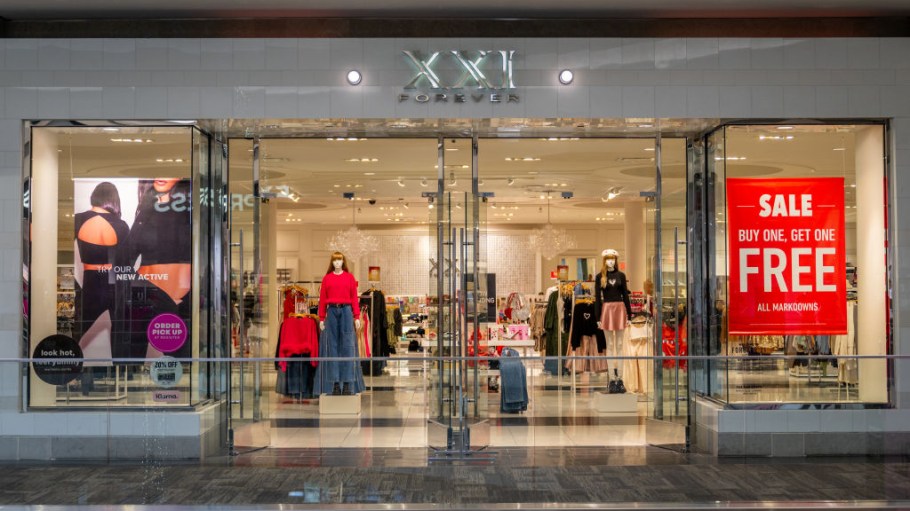
The massively oversized stores were always the stranglehold in Forever 21‘s operations.
Five years after the fast-fashion chain’s first Chapter 11 filing, the retail outposts remain a key stumbling block. Forever 21 filed its first Chapter 11 petition in September 2019. The brand management firm Authentic Brands Group subsequently acquired the business, partnering with mall operators Simon Property Group and Brookfield Corporation, in an $81 million deal. The three are also partners in SPARC (Simon Property Authentic Retail Concepts). Operations at Forever 21 have been pressured, and now there is talk about a possible second Chapter 11 filing. A representative for Authentic and Catalyst declined comment.
Related Stories
Authentic holds ownership of the IP and would not be impacted by a Chapter 11 filing. The SPARC umbrella functions as the store operating partner—under license for North America—for a number of retail brands. SPARC also owns JCPenney, which was also acquired out of bankruptcy. Shein and SPARC formed a strategic partnership in August 2023. That agreement saw the Chinese fast fashion firm take a one-third, minority stake in SPARC. A subsequent agreement inked that October called for a new Forever 21 x Shein collection, leveraging Shein’s on-demand production model, for distribution on Shein’s online sites across the U.S., parts of Europe, and Australia.
JCPenney and SPARC Group disclosed last month that they have combined to form Catalyst Brands, a new organization comprised of six retail banners. Those banners are Aéropostale, Brooks Brothers, Eddie Bauer, Lucky Brand, Nautica and JCPenney. The new joint venture—which counts Simon Property Group, Brookfield Corp., Authentic and Shein as shareholders— has more than $9 billion of revenue and over 1,800 stores.
The disclosure of the combination on Jan. 8, 2025 said Catalyst “sold the U.S. operations of Reebok and that it is exploring strategic options for the operations of Forever 21.” Options include a sale of the operation, a shut down, and now a possible bankruptcy filing. The store total count including international for Forever 21 is 460. A Chapter 11 bankruptcy would involve just the U.S. store operation, which totals 360 doors.
One might find it hard to imagine a buyer interested in taking on 360 doors, most of which historically range from 20,000 square feet to two-floor, 40,000 square feet units. Stores at those sizes also come with very high overhead costs. But some leases are likely profitable, depending on where those doors are located. And if there’s a going concern buyer, it might want to do a purchase via a Chapter 11 to use the process to close the stores it doesn’t want. Or the operating arm could try to sell assets, such as leases and inventory, piecemeal. If that fails, a bankruptcy filing remains an option.
And should Forever 21 join the Chapter 22 club without a going concern buyer, it could be to conduct an orderly wind-down of operations, or result in a liquidation. If that’s the case, don’t expect the Forever 21 brand to go away and never be heard from again. The 100 international doors are still in operation under license. Moreover, Authentic owns the IP and it has shown some major league know-how in how to reposition a brand and build out a new lifecyle. It did that with the luxury specialty chain Barneys New York when it fell on hard times. Authentic acquired the IP out of bankruptcy. While the stores were closed, Authentic later brought back the Barneys name in January 2021 where it now resides in a 54,000 square foot shop within the Saks Fifth Avenue flagship in Midtown Manhattan.
The fast fashion chain was co-founded by Do Won Chang and his wife Jin Sook in 1984. Business began feeling pressured after an extensive expansion of its store count, particularly when the square footage of those doors began to grow on a grand scale.
The Wall Street Journal first reported on the probability of a Chapter 11 petition.