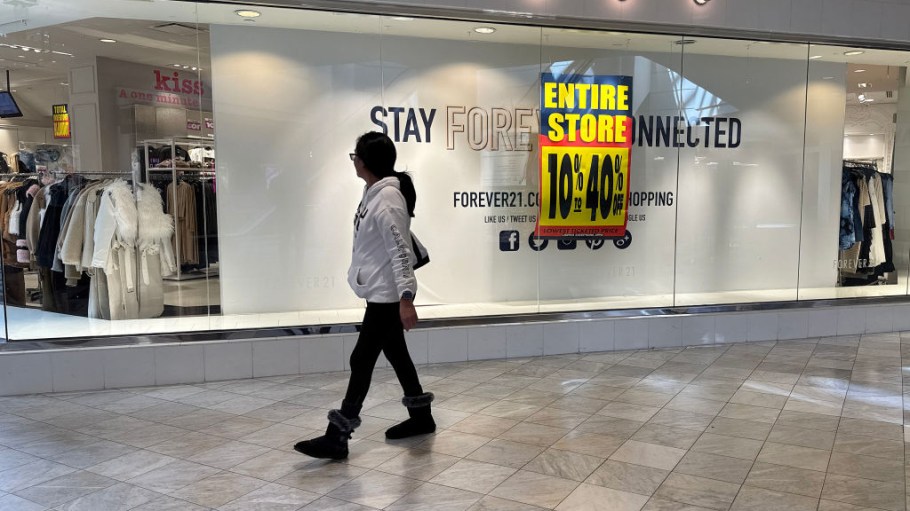
The U.S. operating unit of the Forever 21 retail business is preparing for layoffs and the shut-down of its Los Angeles headquarters, a sign that a bankruptcy filing—and even a liquidation—could be at hand.
Plans for the layoffs were disclosed in a Worker Adjustment and Retraining Notification (WARN) notice posted earlier this week. Just over 350 staff members are expected to lose their jobs, starting in mid-April.
The Los Angeles Daily News, among the first to report the layoffs, noted that Forever 21 CFO Bradley Sell is among the layoffs. Others include managers, designers, supply chain directors and those in store operations. Those who remain employed with the company will work remotely, the story said.
Related Stories
“Forever 21’s operating company, which is the brand licensee in the U.S., continues to explore strategic options while also looking at ways to reduce costs across our operations and optimize our store footprint,” a Forever 21 spokesperson said. “As part of this review, we have started the process of issuing WARN notices to employees who may be affected, in compliance with applicable legal requirements.”
The spokesperson added that the “decision was not made lightly, and we remain committed to transparency and fair treatment of our employees during this period of transition.”
There’s been a huge question mark over the Forever 21 operation since Jan. 8 when JCPenney and SPARC Group combined to form Catalyst Brands, a new organization comprised of six retail banners. Those banners are Aéropostale, Brooks Brothers, Eddie Bauer, Lucky Brand, Nautica and JCPenney. The new joint venture—which counts Simon Property Group, Brookfield Corp., Authentic and Shein as shareholders— has more than $9 billion of revenue and more than 1,800 stores.
But absent from the Catalyst Brand portfolio was Forever 21. It was noted at the time that Catalyst was exploring strategic options for the fast-fashion teen retailer’s operations, which included a sale and a shut down. Earlier this month, word shifted to a possible bankruptcy, making it the second time the banner would find itself under Chapter 11 oversight. In the weeks since then, even the idea of a liquidation has been mentioned.
Contributing to Forever 21’s struggle has been the quick rise of fast-fashion competitors Shein and Temu. Compounding its operational issues has been the high costs connected to operating super-sized stores, which historically range from 20,000 square feet to two-floor, 40,000 square feet units. And those stores could be the stumbling block that prevents the Forever 21 operational unit from finding a going-concern buyer. And while not all Forever 21 are big boxes, the still remain considerable in size even in mall locations. There are about 200 Forever 21 stores that are expected to close, according to a Bloomberg report last week. Some locations have already started store closing sales. If the operation were to liquidate, that would add at least another 150 doors to the store closure list.
The Forever 21 name is expected to continue to have some fashion presence. Brand management firm Authentic Brands Group owns the intellectual property, and that would not be impacted by a Chapter 11 filing of the operating unit. Authentic is expected to find some new format or lifecyle for the brand. In addition, international Forever 21 stores operated under license also would not be impacted by a U.S. bankruptcy filing.
The fast-fashion chain was co-founded by Do Won Chang and his wife Jin Sook in 1984. Following an extensive expansion of its store network, both in the number of doors and in square footage, the business began to feel pressure from its overhead costs. Forever 21 filed its first Chapter 11 petition in September 2019. Authentic Brands subsequently acquired the business, partnering with mall operators Simon Property Group and Brookfield Corporation, in an $81 million deal.