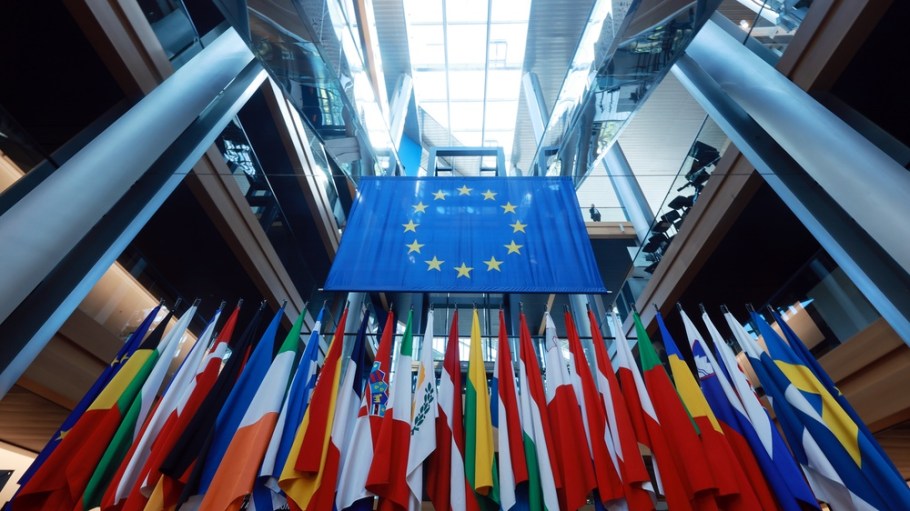
The European Union’s forced labor regulation has received its final green light, clearing the runway for a ban on all goods made in whole or in part with modern slavery in all 27 members of the world’s largest single market.
Adopted Tuesday following the European Council’s approval—the last hurdle in the decision-making process—the legislation will enter into force after it’s signed by the respective presidents of the European Council and Parliament and published in the Official Journal of the European Union. Member states will have three years to begin implementing the law alongside the bloc’s corporate sustainability due diligence directive, whose complementary supply chain due diligence requirements were O.K.ed in May.
Related Stories
The prohibition, which European Commission president Ursula von der Leyen introduced in her State of the Union speech in 2021, covers both domestically produced and imported products. Its goal is to free from the global supply chain the 27.6 million people that the International Labour Organization estimates are being forced to work under the threat of harm or penalty and without their voluntary consent. The EU has said that both combating forced labor and promoting corporate sustainability due diligence standards are priorities of its human rights agenda.
The regulation establishes what its proponents call the “necessary framework” to flag forced labor-tainted goods. But while it follows—and is clearly informed—by a U.S. law that has imposed a blanket ban on products from China’s Xinjiang Uyghur Autonomous Region, citing the state-sanctioned repression of Uyghurs and other Turkick Muslim minorities, the EU legislation will take a risk-based approach that puts the burden of proof on so-called competent authorities. It has also so far refrained from singling out China in the context of the law, since doing so would be a breach of the World Trade Organization’s rules of non-discrimination.
But critics of the law in its current form say that its lower evidentiary threshold makes it difficult for forced labor victims and their advocates to raise complaints, particularly if state-sponsored exploitation is involved. Mike Gallagher and Raja Krishnamoorthi, chairman and ranking member of the U.S. House Select Committee on the Chinese Communist Party, have also referred to what they consider the EU version of the Uyghur Forced Labor Prevention Act as a “weaker mandate,” proposing a joint U.S.-EU-U.K. forced labor enforcement task force to coordinate policy and enforcement.
The success of the regulation hinges on the EU’s ability to function as a collective. The European Commission, as the bloc’s administrative engine, has been tasked with creating a database that contains “verifiable and regularly updated” information about forced labor risks, such as reports from the ILO and others, that can support the work of competent authorities in assessing potential violations, including in specific economic sectors and geographical regions.
Depending on whether a potential violation occurs outside the EU or within a member state’s territory, the European Commission or national authorities can initiate an investigation. Governments are required to share information with other member states if they suspect that violations of the regulation occur in other parts of the continent, or with the European Commission if there are signs that a third country is involved.
The final decision to outlaw, withdraw or dispose of a product will be taken by whoever led the investigation, but it will also apply to all other member states based on the “principle of mutual recognition.” In instances where the product is considered critical, the competent authority can choose not to require its disposal but instead order the economic operator to suspend its circulation until forced labor has been eliminated.
A 2023 report from the Uyghur Rights Monitor, Sheffield Hallam University’s Helena Kennedy Centre for International Justice and the Uyghur Center for Democracy and Human Rights warned that a “substantial volume” of apparel tainted by Uyghur forced labor from China was “flooding” into the EU. Only legislation, it said, can result in the “sea change” necessary.
“The new rules will boost consumer confidence as products on the EU market are guaranteed to adhere to human rights standards,” the European Commission said in a statement that positioned the move as a win-win. “For businesses, the proposal has the potential to streamline social sustainability efforts, fostering increased public trust and credibility among customers.”