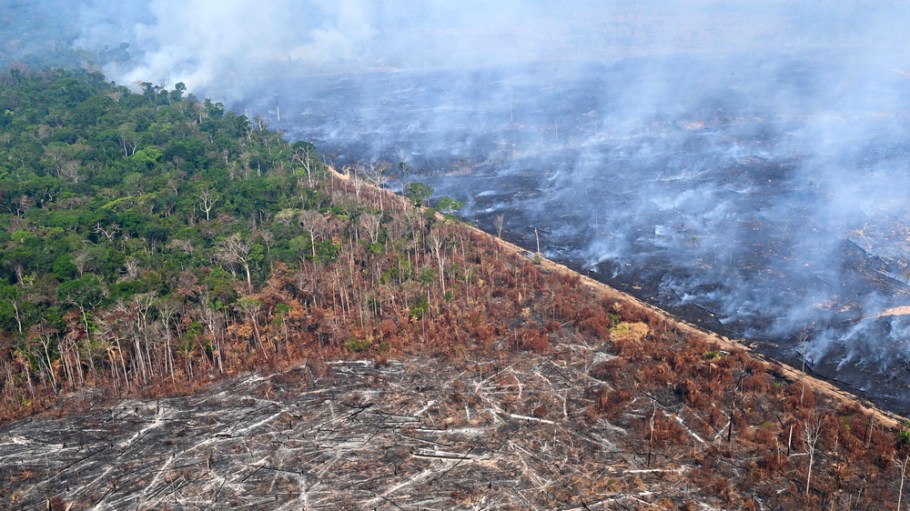
The European Union’s decision to delay a landmark anti-deforestation law that was poised to ban imports of commodities produced on illegally logged land could likewise stall a transition that is urgently needed to future-proof supply chains and keep trees standing, the head of a prominent forestry nonprofit said shortly after the news broke.
“The EU’s decision to once again delay the implementation of the EUDR creates uncertainty when clarity and momentum are needed,” said Nicole Rycroft, founder and CEO of Canopy, using a shorthand for the Regulation on Deforestation-free Products. “Forests—and the climate—cannot afford another year of inaction. Every delay risks eroding market confidence, slowing progress and undermining those companies already moving in good faith to prepare their supply chains.”
Related Stories
Canopy has been working to keep deforestation out of both the man-made cellulosic fiber and paper packaging industries. Every year, more than 3.2 billion trees are felled and pulped to produce everything from cardboard boxes to viscose clothing. Swathes of the world’s forests, including many that are ancient and endangered, have been transformed into grassland to raise livestock or grow cocoa, coffee, oil palm, rubber and soy. Ecosystems such as the Amazon play a critical role on a warming planet because they can bank billions of tons of heat-trapping carbon both above and below ground.
The policy’s delay to December 2026 will be the second time the EUDR’s deadline has been extended. But while the first postponement was driven by pressure from industry groups, trade allies such as Brazil, Malaysia and Indonesia, along with the then-Biden administration, the second deferment has been blamed on an IT system that won’t be able to cope with the deluge of data from economic operators digging deep into their supply chains.
“This is linked to a number of factors,” Jessica Roswall, the European commissioner for the environment, wrote in a letter to Antonio Decaro, chair of the European Parliament’s Committee on Environment, Public Health and Food Safety, on Tuesday. “Among these, one issue is related to the way economic operators can choose to interact with the IT system to facilitate their operations. Another is related to the obligations placed on downstream operators by the EUDR, despite efforts over the last months to provide simplification to stakeholders. Further factors relate to the high volume of small packages that are imported into the EU, or the impact of the length of replies to operators of various internal checks by the Commission or the competent authorities of the member states related to submitted data.”
Writing on LinkedIn, however, Catarina Vieira, a Dutch Member of Parliament, wasn’t buying it. She questioned how many more “transition periods” the European Commission will insist on “while forests continue to fall.”
“The shortcomings in the IT system are regrettable, but when something matters, you put in the resources to make it work,” she said. “The Commission has had sufficient time since summer 2023 to plan and implement an adequate system. Only today were legislators informed of flaws the Commission has known about for months. Two years was more than enough.”
Calling the EUDR the 27-member block’s “first and only tool” for effectively tackling the impact of Europe’s consumption of the world’s forests, Viera warned that without it the continent “risks being complicit in the destruction it claims to oppose.”
For the center-right European People’s Party, the largest political group in the European Parliament, however, the decision was a win that dovetailed with its efforts to relieve businesses of red-tape burdens, resulting in what some have described as a watering down of once-revolutionary corporate accountability measures.
“Our efforts have finally been successful,” said German politician Peter Liese, the EPP’s spokesman on the environment. “If the deforestation regulation had entered into force unchanged on January 1, it would have caused unsolvable problems for many small foresters, farmers, and small and medium-sized enterprises, such as [a] medium-sized coffee roaster.”
For Anke Schulmeister-Oldenhove, forest policy manager at WWF’s European policy office, however, it was “probably no coincidence” that the move “comes right as the Commission pursues an unprecedented deregulation agenda, throwing the EUDR under the bus.”
“This is unacceptable and a massive embarrassment for President Von der Leyen and her Commission,” she said. “If this technical issue is real, this shows not only incompetence, but also a clear lack of political will to invest sufficiently in a timely implementation of the EUDR. We should be able to expect more from our leaders than an excuse like ‘The dog ate my homework.’”
Rycroft cautioned companies against slowing down their efforts to ensure that their products are deforestation-free. She said that the business community must use this delay as a “springboard, not a snooze button.”
“Companies have a critical window to build resiliency in their supply chains: to transition from volatile extractive forest-dependent products to next-gen, low-impact solutions that reduce risk and strengthen traceability,” Rycroft said. “By moving faster, businesses not only get ahead of regulation, but also respond to growing consumer and investor expectations for leadership and resilience.”