
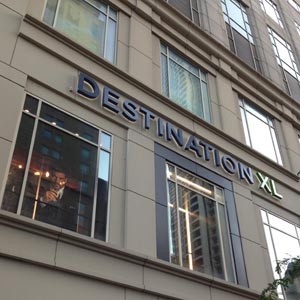
Destination XL Group slipped into the red in the first quarter in response to what its chief executive officer characterized as the “economic downcycle” that prompted a customer shift away from designer brands to lower-priced goods.
In the period ended May 3, the Canton, Mass.-based men’s big and tall retailer reported a net loss of $1.9 million, or 4 cents a share, compared to net income of $3.8 million, or 6 cents a share, in the same period last year.
Total sales dropped 8.6 percent to $105.5 million from $115.5 million in the first quarter of fiscal 2024. Comparable-store sales decreased 9.4 percent. The company did say that sales improved as the quarter progressed with comps down 13.9 percent in February, 8.2 percent in March and 7.2 percent in April. But for the first three weeks of May, comps are down just under 10 percent.
Related Stories
By channel, comparable sales in the DXL stores dropped 6.6 percent but 16.2 percent online. Even so, the retailer has made some tweaks that are expected to improve its performance in the second half.
“We believe that our targeted promotions, which include our Price Match Guarantee, Fit Exchange by DXL, our Hero/First Responder discounts as well as the introduction of new value-driven brands, have had a positive impact on our store traffic,” the company said. “The direct business, which includes our website, app and marketplaces, struggled during the first quarter of fiscal 2025 and was challenged by decreases in online traffic and average order value, while conversion was relatively flat.”
The company also said that there were some “functionalities” that likely had a negative impact on sales in the quarter, but those have been corrected. As a result, it said it expects comp sales to gradually improve the remainder of the year and is projecting a single-digit decrease in the second quarter followed by a return to positive comps in the second half.
In reporting the earnings Thursday morning, Harvey Kanter, president and CEO, said: “We are currently managing our business through an economic downcycle, and our performance does not reflect the opportunity in our total addressable market or the longer-term potential for our brand. We believe the broader macroeconomic challenges within the apparel industry and consumer sentiment are pushing our customer to be more discerning in what he is buying. Our assortment is well positioned to serve those value-oriented customers who are trading down from national designer brands to our private label brands, which have lower average unit retail prices but higher margins.”
He said in the first quarter, private brands accounted for 57 percent of sales, up from 55 percent last year. But national brands continue to be a focus. Kanter pointed to last month’s introduction of Dickies and Haggar, which have performed in line or above plan respectively. And the Perry Ellis brand was just introduced last week.
Turning to tariffs, Kanter said the situation remains “very fluid and we continue to monitor trade discussions and changes to policy as they develop. We are leaning into relationships with our vendors and suppliers around the world and we are working very hard to mitigate the cost of those tariffs. Our discussions with our private label vendors have been productive. On the domestic side, we are also having dialogue with our national brands as we all try to navigate this environment.”
In the company’s earnings call Thursday morning, Kanter said that assuming the current global tariff rate policies do not change for the balance of the year, and no new tariffs are added, he expects the impact to add less than $2 million to costs this year. Approximately 80 percent of DXL’s private label imports are sourced from Vietnam, Bangladesh and India and fewer than 5 percent from China.
“At this point, we have not yet taken any price increases, but that is still possible,” he said. “We are continuing to assess whether there is enough price elasticity of demand to take market share by keeping constant prices at lower margin versus passing on the impact of those tariffs to the end consumer to maintain our margins but risk losing share. We know there is a sensitivity to price and we are trying to be smart about how we strike the right balance.”
Kanter also provided an update on the company’s performance on the Nordstrom Marketplace. DXL went live on the site in June of 2024 and now offers 37 brands and more than 2,200 styles. Top performers include Polo, private brands Harbor Bay and Oak Hill, as well as Vineyard Vines, Brooks Brothers and Reebok, he said.
Destination XL operates a total of 290 stores under the DXL and Casual Male nameplates. In the first quarter, the company opened two new DXL stores and converted one Casual Male XL full-price store and one Casual Male XL outlet to DXLs. The company expects to open four additional stores this year before it pauses to focus on stabilizing the business and preserving cash flow, Kanter said.
The company also touted a new technology that is expected to help boost business. Called FiTMAP, it is a proprietary sizing technology for which DXL has the exclusive license for big and tall men until 2030. It is a contactless digital scanning technology that captures 242 measurements to ensure a proper fit and can be used for both ready-to-wear and custom apparel. Currently, FiTMAP provides recommended sizes for all of DXL’s private brands as well as 15 national labels.
To date, the retailer has scanned over 20,000 customers in the 52 DXL locations where it is currently offered. The plan is to roll out the technology to 85 stores by the end of this year and to as many as 200 stores by the end of fiscal 2027.


