You’ve surely heard the words Digital IDs and Digital Product Passports (DPPs) bandied about, especially in light of impending legislation that will soon demand them. But do you really know what they are and what they contain? How are they different from a bar code? How can brands fully use them for everything from policy compliance to sustainability storytelling, customer retention and repeat revenue?
These questions and more were answered in the attendee-packed webinar “Digital Product Passports: Shaping the Future of Commerce,” which ran on Sept. 18 and is now available for on-demand viewing.
Related Stories
Panelists included Joon Silverstein, Coach SVP Global Marketing, Creative and Sustainability and Head of Coachtopia; Natasha Franck, CEO and founder of EON and Julie Brown, Head of Sustainability and Policy at EON. The session was moderated by Jasmin Malik Chua, Sourcing Journal’s Sourcing and Labor Editor.
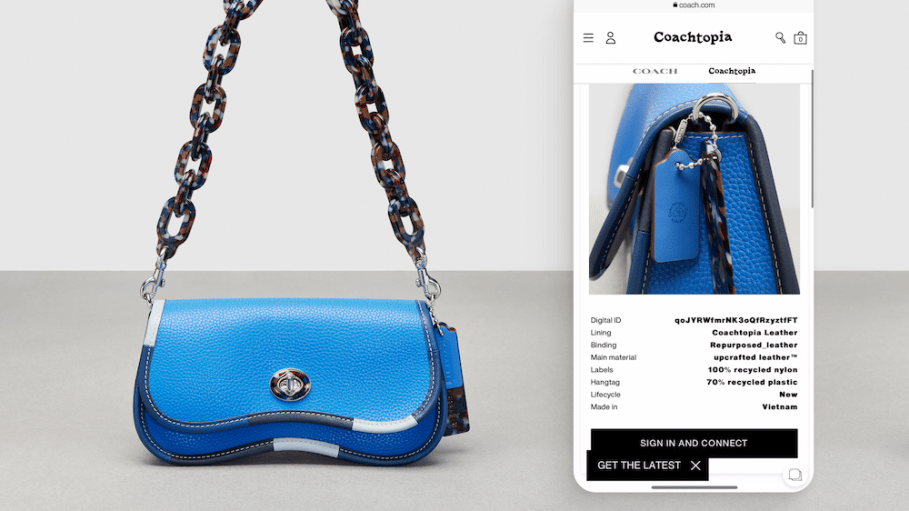
“A digital product passport is a digital twin of a physical product, with a data profile in the cloud holding all the information about that product,” said Franck, noting that it takes embedded material, design, inspiration and process stories and makes them visible to the consumer. “It links the physical product connected with an NFC chip or QR code that enables this unique product to be identified and tracked throughout its entire life cycle. Now, it can be identified with its original sale price and authenticity for resale, and with its materials for recycling, and there’s a continuous connection to the customer to provide these services upon a scan of the product.”
With forthcoming legislation, DPPs won’t be just a nice-to-have. Impending regulations such as the U.S. Digital Care Label and the EU’s Strategy for Sustainable and Circular Textiles mean they will soon be mandatory for product compliance.
“This EU strategy for sustainable and circular textiles released in March last year calls for DPPs to be implemented on all textile products within this decade,” said EON’s Brown, who added that in the EU alone there will be 16 different pieces of sustainability-focused legislation. “[This will] change the way data exchange takes place along the value chain.”
The recycled and resale economies have also added urgency to Digital Product Passports, both to protect brand integrity as fashion items get new lives, and to ensure that embedded data is retrievable in all future incarnations.
Connecting with consumers
If complying with looming legislation isn’t enough to drive brands to Digital Product Passports, then the enhanced opportunities to connect with consumers should be.
Fashion luxury house Coach has been an early adopter of Digital IDs, leveraging EON’s enterprise tech to drive deeper customer relationships, support sustainability goals and increase product value for its line of circular Coachtopia products through new services. This has built the foundation for a circular business model transformation, in addition to complying with DPP regulations.
Silverstein outlined the three main reasons Coachtopia has implemented Digital Product Passports.
First, data-driven transparency. “We’ve learned from our Gen Z community that they want brands to be more open and honest about their sustainability efforts, to not only share intents but [to share] quantifiable impacts and to bring [consumers] along on the journey,” she said.
Second, facilitating circular product journeys. “One of Coachtopia’s core circularity principles is to design each product for multiple lives, so it can be more easily repaired, disassembled, remade, recycled for second and even third life, and to scale the circular pathway so our products can stay in use and out of landfill,” she said.
Third, community engagement. Customers can connect the product’s digital passport to their Coach account and access a range of circular services that will help prolong the lifespan of their product. This connection is possible regardless of where the customer buys the product.
While direct-to-consumer models give companies more control over their brands, Digital IDs add a helpful layer when dealing with other channels. “What’s nice about Digital Product Passports is that even when we’re selling in wholesalers with third party partners, we can develop that direct connection to consumers,” said Silverstein. “[It allows] consumers to connect to our products and begin a richer dialog with us. In so many ways, we’ve become so disconnected from the people and processes behind the products, and [it’s exciting] to tell more human storytelling around each of our products and the journey we’re on together.”
To watch the webinar, click above. To learn more about EON or request a demo, click here.