Children’s Place Inc. has some tough decisions ahead.
The company said in a regulatory filing last week that it is working with advisors, including Centerview Partners, and lenders to obtain new financing to support ongoing operations. It also said the company is “considering strategic alternatives” in case it can’t close on new funding.
The disclosure was in a filing that detailed preliminary fourth-quarter results. The key number is its adjusted operating loss. Excluding certain items, the range is expected to be down 8 to 9 percent of net sales, versus prior guidance of 2 to 3 percent of net sales. Net sales were projected in the range of $454 million to $456 million, versus prior guidance of $460 million to $465 million.
Related Stories
The adjusted operating loss is due to the impact of lower-than-expected margins due to more aggressive promotions to maximize sales, higher than expected split shipments to meet customer e-commerce demand, and increased inventory valuation adjustments, the children’s retailer said in the filing.
The company expects to end the year in a clean inventory position, with levels projected to be down 16 to 20 percent versus the prior year.
It also forecast total liquidity for the fourth quarter ending Feb. 3, 2024, at about $45 million, including $13 million of cash and cash equivalents and $32 million of excess availability under the retailer’s credit facility after excluding required reserves and excess availability requirements. Total debt was guided to $277 million, versus $408 million for the third quarter ended Oct. 28, 2023.
Net income for the third quarter was down 10.2 percent to $38.5 million, or $3.05 a diluted share, on a net sales decline of 5.7 percent to $480.2 million.
President and CEO Jane Elfers said at the time that bottom-lline results were negatively impacted by higher-than-planned distribution costs.
Elfers also said in November that the retailer’s core millennial customer “remains under significant pressure.” But their preference for shopping online has also driven up fulfillment costs for the retailer, including its increased use of third-party fulfillment services and higher labor costs due to increased e-commerce demand. E-commerce traffic rose to 57 percent of retail sales in the third quarter, versus 50 percent in the same 2022 quarter and just 37 percent in 2019.
The Children’s Place ended the third quarter with 591 stores in operation. It closed six locations in the quarter, and a total of 608 doors since 2013. The company said it plans to begin the 2024 retail calendar on Feb. 4 with 530 stores. That’s compared with 612 doors at the start of 2023’s retail calendar.
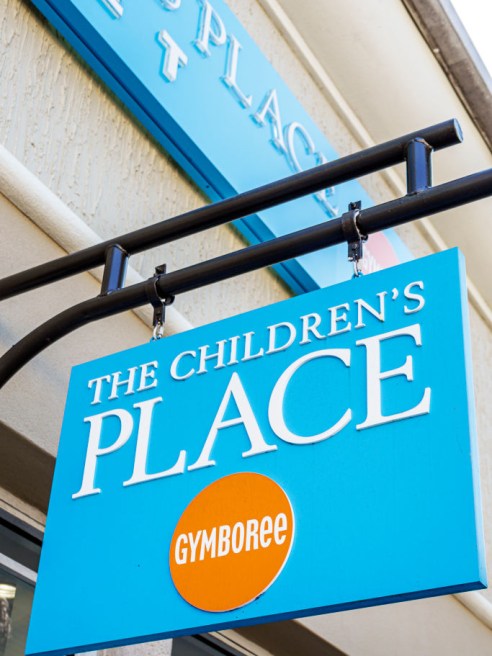
The retailer last June let go of 17 percent of its staff, or 181 employees, as part of a plan to go digital-first. The owner of the Baby Place, Gymboree, Sugar & Jade and PJ Place banners had targeted up to 100 more doors for closures, and said it would exit its Secaucus, N.J. headquarter lease this May instead of 2029. The layoffs and real estate moves helped the retailer cut costs as consumers pulled back on spending.
Elfers said in August when the company posted-second quarter results that “Gen Z digital buyers will surge from 45 million today to over 61 million in 2027,” hence the need to move fast on its digital-first game plan. The irony was that its big competitor Carter’s was betting big on store growth—it plans to open 250 U.S. stores by 2027 to help grow sales by $250 million—as The Children’s Place was banking on a digital future.
Whether The Children’s Place can get financing to help it ease some cost pressures as it moves to realize its digital-first dreams remains unclear. The company last June said it had expanded its revolving credit facility to $445 million from $350 million. That expansion brought in PNC Bank, which committed an additional $95 million toward the credit facility. With consumer demand down, lenders might not be so willing to help with another round of financing.