Imagine a raised runway running down Chicago’s LaSalle Street, showcasing the city’s most innovative designers, the Chicago Board of Trade towering in the backdrop.
“Thousands of Chicagoans lining the [LaSalle] Corridor. Drone cameras capturing the spectacle as the energy and pride of this city are broadcast across the world,” said Ian Gerard, cofounder of the nonprofit Chicago Fashion Vanguard, on Thursday evening at the historic Chairman’s Room of The Field Building, the former headquarters of retail giant Marshall Field. “It will be breathtaking. It will be defining. It will be Chicago.”
Related Stories
The Field Building, located at 135 South LaSalle Street, is among six buildings in the Loop being revived through the city’s Tax Increment Financing grants. The real estate partners behind the redevelopment of The Field Building joined CFV to unveil the latest initiative designed to make the LaSalle Corridor and the historic central Loop an international fashion destination.
The LaSalle Corridor, located in the heart of The Loop, includes LaSalle Street and its nearby streets and architectural masterpieces like the Chicago Board of Trade, The Rookery and The Field Building.
“Significant resources, planning and investment are already underway to redevelop and reactivate the beautiful architecture of the LaSalle Corridor but buildings alone do not change a neighborhood. Culture does, people do,” said Maggie Gillette, cofounder of CFV and principal, along with Gerard, of The Curio, a fashion events organization. “That means bringing immersive experiences, bringing fashion, commerce, creativity, performance and community back to the street. Creating reasons to walk here, gather here and to celebrate here. To see the LaSalle Corridor not as what it was, but as what it can be. Greater than ever.”
The pinnacle runway event would be part of a four-day program of fashion, design and culture spanning multiple venues next fall. It’s tentatively titled “Chicago Style Weekend: From Corridor to Catwalk, LaSalle Reimagined” and would include pop-up markets, exhibitions and educational collaborations with the city’s five fashion schools, taking place throughout The Loop and at buildings being renovated through the TIF grants. A two-day “Fashion at The Field” program would precede Chicago Style Weekend in the spring.
The vacancy rate in the Loop is 24.4 percent, marginally down from last quarter’s record high of 24.7 percent, according to Bradford Allen, a commercial real estate firm.
The Field Building, an Art Deco skyscraper built in 1934 and designated as a Chicago landmark in 1994, was approved for $98 million — the largest TIF funding given to a LaSalle Corridor reuse project. The $241.6 million project will repurpose about 485,000 square feet of underutilized commercial space into residential apartments. Plans also include 92,000 square feet of commercial space.
The other five TIF-supported LaSalle Corridor projects include: 208 S. LaSalle St., with $26.2 million in TIF funding; 111 West Monroe Street, with $40 million in TIF funding; 30 North LaSalle Street, with $57 million in TIF funding; 105 West Adams Street, $67.5 million in TIF funding, and 79 West Monroe Street, with $28 million in TIF funding.
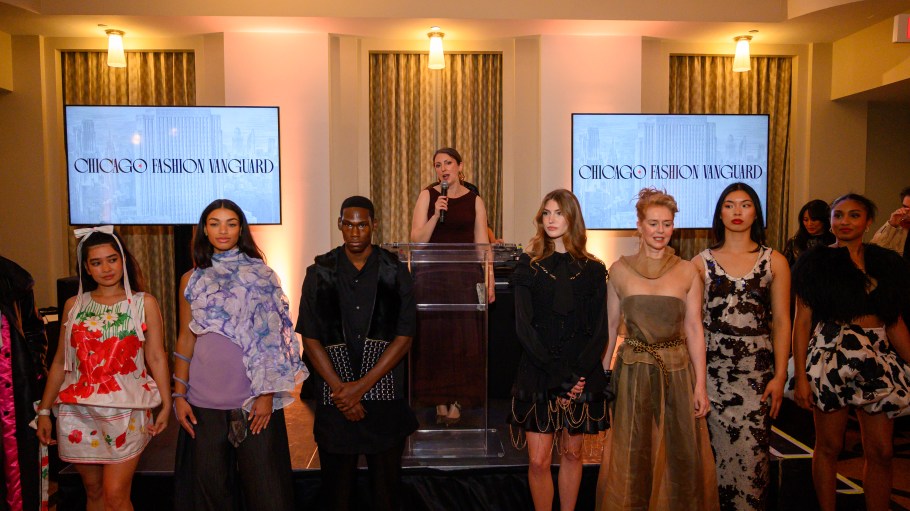
The presentation Thursday featured stills and a black-and-white short film, shot in The Loop, by John Fromstein. Models wore looks by Chicago designers Grevyi, Niczka and Stephane St. Jaymes.
About 125 guests attended, spanning fashion, business and city government, including several key real estate partners from AmTrust, JLL and Riverside.
“Chicago doesn’t need another Chicago Fashion Week. It needs a fashion renaissance,” said Christine Griffith, cofounder and creative director of Monte Vista and principal at CFV. “This is a city that has been generating culture and not consuming it. Law Roach, Jerry Lorenzo of Fear of God, Barbara Bates, Don C, Joe Freshgoods, Maria Pinto, Cynthia Rowley and, of course, Virgil Abloh. The list doesn’t end, it evolves.”
The biggest obstacle to moving the initiative forward is funding.
“There is strong enthusiasm across stakeholders who see the opportunity for high-profile fashion and cultural programming to play a meaningful role in reshaping the narrative of this part of the city,” Gerard said after the event. “Our next move is to meet with leadership from the remaining TIF-supported LaSalle Reimagined buildings to advance discussions toward formal participation.”